
Gone Gardenin’ — Blooming bellflowers a blast of colour
Advertisement
Read this article for free:
or
Already have an account? Log in here »
We need your support!
Local journalism needs your support!
As we navigate through unprecedented times, our journalists are working harder than ever to bring you the latest local updates to keep you safe and informed.
Now, more than ever, we need your support.
Starting at $15.99 plus taxes every four weeks you can access your Brandon Sun online and full access to all content as it appears on our website.
Subscribe Nowor call circulation directly at (204) 727-0527.
Your pledge helps to ensure we provide the news that matters most to your community!
To continue reading, please subscribe:
Add Brandon Sun access to your Free Press subscription for only an additional
$1 for the first 4 weeks*
*Your next subscription payment will increase by $1.00 and you will be charged $20.00 plus GST for four weeks. After four weeks, your payment will increase to $24.00 plus GST every four weeks.
Read unlimited articles for free today:
or
Already have an account? Log in here »
Hey there, time traveller!
This article was published 19/07/2018 (2717 days ago), so information in it may no longer be current.
In every perennial border there is more than likely at least one bellflower variety in the plant design. The bellflower plant family is a huge one that includes a wide array of plants of different sizes, shapes and forms. The bellflower family includes the very common C. glomerata, more commonly called clustered bellflower, which seems to be ever present in most gardens.
Although it has lovely dark purple blooms (there is an attractive white and blue variegated variety), the plant is quite invasive and so many gardeners have either removed it from their gardens or begrudgingly tolerate it because of its long lasting bloom. If retained, it is usually relegated to a space where it can be confined, such as a narrow planting along a house foundation where it won’t invade the space of other plants.
Some bellflowers form tufts of foliage at ground level and then send up flower stalks. peach leaf bellflower (Campanula persicifolia) is one example. The bellflower family also includes some quite tall specimens. C. latifolia ‘Brantford’ is one such variety. It soon becomes obvious that this immense plant family has innumerable members

Probably the most popular variety of bellflower used in gardens in recent years is a rather short version of the plant, the “Clips” series. They are Campanula carpatica and have become popular because they are a short version of bellflower, thus useful in urban gardens where space is limited. They also have a long bloom period which many gardeners find enticing.
Commonly called Blue Clips and White Clips, these plants form low, cushion-shaped mounds of finely textured foliage. The small leaves are round and light green and add textural contrast to a border when planted next to plants with coarser foliage. Sometimes these plants are labelled as Carpathian Bluebells as their native habitat is the Carpathian Mountains. Being mountain plants, they prefer cool summer nights and for this reason they may look stressed during periods of hot summer weather when night time temperatures remain high.
Clips plants produce clear medium blue or white (depending on the variety) up-facing, open, cup-shaped flowers during the entire summer. They produce the first flush of bloom in early summer when the mounds of foliage are covered with bloom. If the plants are regularly deadheaded, they will continue to bloom all summer.
If the plants begin to get leggy and produce blooms only sporadically in mid-summer, some renewal pruning can improve their performance. Cutting back a few stems at a time over a period of a couple of weeks until the plants have been rejuvenated will bring the plants back into flower production and eliminate their leggy appearance. Alternately, some gardeners simply shear off the top 10 cm or so of the plants; they recover quickly and soon begin to produce flower buds.
Blue Clips and White Clips are low maintenance plants. They are not demanding about soil type, nor are they demanding about moisture — they seem to withstand dry periods quite well, although the flowers will be bigger and longer lasting if the plants are provided with a consistent supply of moisture. Clips like full sun but will also thrive in a part sun location. They will, however, become less compact the more shade they must endure so for the best looking bushy, compact plants, they should be grown in full sun.
The plants grow only about 20 cm tall and they are self supporting. If a mature plant begins to split in the middle and fall away a simple solution is to simply tie a string around the plant — low enough so it will be hidden by the foliage but high enough so that it will tighten the plant up and close the gap in the centre. I often do this with Herman’s Pride lamianstrum when it does the same thing, since this trick works like a charm with many plants that have a tendency to split and collapse.
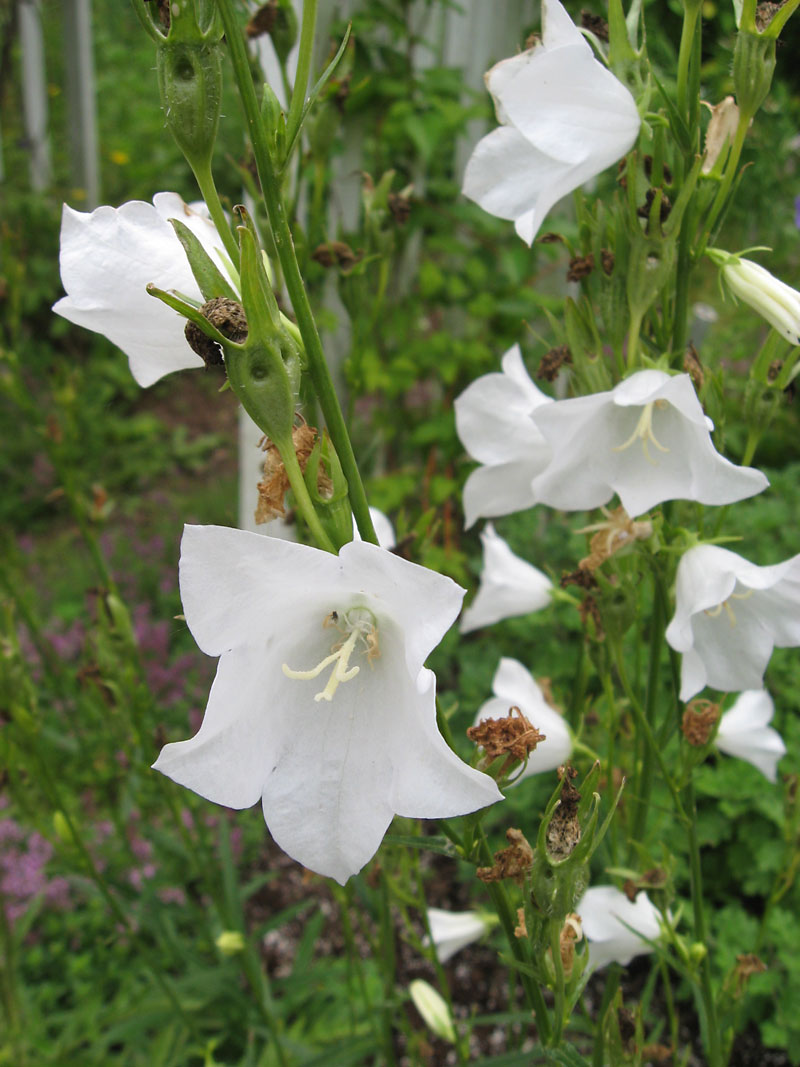
Their small size, mounding growth habit, and continuous bloom make the Clips useful plants in the landscape. They can be used as edging along the front of a perennial border; while their tidy form makes them ideal candidates to be planted along sidewalks or as short foundation plantings in front of buildings.
They are wonderful accent plants placed towards the front of a flower border, whether it is a perennial border or a mixed flower bed containing both perennials and annuals. Its compact growth habit makes Blue Clips a wonderful addition to a rock garden and also allows it to be used effectively in containers. It can be mass planted to produce a tall ground cover of blue or white — the plants should be planted closer together in this instance to create a carpet effect.
Because Clips can withstand some drought, they can be planted to perk up a dry spot in the garden. They are perfect plants to go into those small spaces that we always wonder what we are going to plant there. Positioning a few Blue Clips or White Clips near the outdoor living areas of the home will allow you to enjoy the butterflies that these plants attract. The open cup-shaped flowers seem to lure butterflies and hummingbirds to the plants.
Surprisingly, these flowers also make great cut flowers. The small flowers add interest to a small dainty arrangement — perhaps one designed for a tea table. Combined with some asparagus greenery and perhaps a few yellow daisies, a perfect little arrangement can be created using a few blooms from Blue Clips.
Whether you use the blue variety or the white version of this versatile plant, you will enjoy the summer display of finely textured foliage and upward facing blooms of Clips. Members of the Clips series of bellflowers might just be the perennials you are looking for to enhance the beauty of your landscape this summer.

Albert Parsons lives, writes, and gardens in Minnedosa.
» wtw@brandonsun.com