
Gone Gardenin’ — Japanese bleeding hearts add a lot to one’s garden
Advertisement
Read this article for free:
or
Already have an account? Log in here »
We need your support!
Local journalism needs your support!
As we navigate through unprecedented times, our journalists are working harder than ever to bring you the latest local updates to keep you safe and informed.
Now, more than ever, we need your support.
Starting at $15.99 plus taxes every four weeks you can access your Brandon Sun online and full access to all content as it appears on our website.
Subscribe Nowor call circulation directly at (204) 727-0527.
Your pledge helps to ensure we provide the news that matters most to your community!
To continue reading, please subscribe:
Add Brandon Sun access to your Free Press subscription for only an additional
$1 for the first 4 weeks*
- Enjoy unlimited reading on brandonsun.com
- Read the Brandon Sun E-Edition, our digital replica newspaper
*Your next Free Press subscription payment will increase by $1.00 and you will be charged $20.95 plus GST for four weeks. After four weeks, your payment will increase to $24.95 plus GST every four weeks.
Read unlimited articles for free today:
or
Already have an account? Log in here »
Hey there, time traveller!
This article was published 02/08/2018 (2847 days ago), so information in it may no longer be current.
The bleeding heart is an old-fashioned favourite of many gardeners because it is a reliable, easy-to-grow perennial perfectly hardy in our area. The most popular one grown is Dicentra spectabilis, which is often called the common bleeding heart. It is native to Japan.
The foliage appears first in the spring, followed by sturdy arching flowering stems upon which are borne lovely red and white (or pure white, depending on the variety) blooms that hang down from the undersides of the stems. The flowers give the plant its name because they are heart-shaped with what appears to be a tear drop located at the bottom of each flower.
The common bleeding heart likes a shady or part-shade location. I have mine on the west side of my garage under a wide roof overhang so it gets late afternoon and evening sun, and it seems to like the location. It likes rich organic soil and will not tolerate heavy clay or soggy soils; the plant is susceptible to root rot when planted in wet heavy soil.

A bleeding heart will add old-world charm to a garden in the spring. Eventually however, the blooms fade and the plant will start to go into decline as it heads into dormancy. By mid-summer, the attractive bluish-green foliage will have withered and yellowed. It can be removed after this happens. The deteriorating foliage of a bleeding heart is not the most attractive sight, so many gardeners plant a perennial in front of the bleeding heart — annuals work as well — that develops later in the spring so that it will not hide the bleeding heart while it is in bloom but will camouflage the deteriorating bleeding heart foliage later in the season. I use a large yellow day lily to do this job, which seems to work well.
Bleeding hearts like lots of organic material in the soil, so compost can be worked into the soil around the bleeding heart. An organic mulch can also be put over the plant in late fall, both to protect it from the frigid temperatures of winter but also to add organic matter to the soil. The plant really doesn’t need winter protection as it is quite hardy.
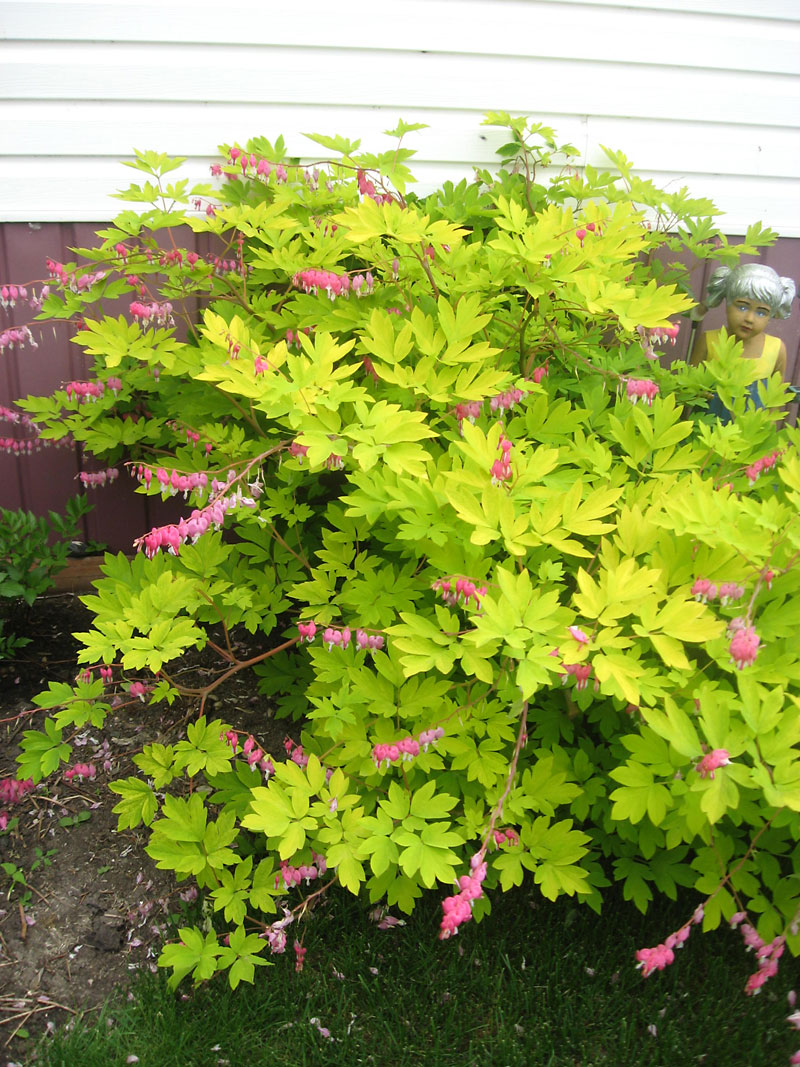
The most common variety of bleeding heart is ‘Valentine,’ with the classic red and white flowers. ‘Alba’, on the other hand, has pure white blooms. There is a lovely variegated variety of Dicentra spectabilis called ‘Gold Heart’ that has bright golden foliage. The eye-catching foliage is a nice contrast to the red and white blooms and it continues to add interest to the garden after the blooms fade. The foliage of this variety doesn’t deteriorate as quickly as that of other varieties, so it need not be hidden from view after the flowers fade.
While bleeding hearts purchased as container-grown plants can be planted almost anytime, bare root bleeding hearts should only be planted in springtime. These are generally available in the spring, buried in peat moss inside plastic bags. Before planting a bare root bleeding heart, soak them in water for an hour to rehydrate it, but do not let it soak much longer than that.
Dig a hole large enough to accommodate the bare root plant. The crown should stick slightly above the soil level and the roots should be spread out. The best way to accomplish this is to create a mound of soil in the centre of the hole you’ve dug, then place the tuber, crown side up, on the top of the mound and then spread the roots so that they spread over and down the mound. Refill the hole with soil, holding the tuber in place and lightly tamp down the soil as you refill the hole. Lastly, water the newly planted tuber.
Although the common bleeding hearts (Dicentra spectabilis) have long since finished blooming, the fern leaf or so-called fringed bleeding heart Dicentra eximia will bloom intermittently all summer. This plant likes the same conditions as other bleeding hearts but it differs in appearance. It has ferny foliage and only gets 30-50 cm tall while the other varieties can get quite a bit taller.
The flowers of fringed bleeding hearts are slightly different in form and the foliage is distinctively blue-green. It is native to the Eastern United States and grows on forest floors so likes lots of organic material in the soil and prefers shade. The variety ‘Luxuriant’ has red flowers while the variety ‘Alba’ produces white blooms.
If you have a Dicentra spectabilis in your garden you will have enjoyed its bloom already. If you have a Dicentra eximia, you can continue to enjoy bleeding heart blooms for the rest of the summer. Bleeding hearts are old tried and true, easy care herbaceous perennials that enhance the appearance of any garden hopefully you have one in yours.
OUT & ABOUT
Flower shows are a great place to talk gardening with fellow gardeners.
The Minnedosa Horticultural Society’s annual Flower Show is being held on Friday, August 3, in the Minnedosa Community Conference Centre.
I hope you will consider coming out and to view our exhibits and to see what we have grown in our gardens this year. See you there!
Albert Parsons lives, writes, and gardens in Minnedosa.
» wtw@brandonsun.com