
Gone Gardenin’ — Drying flowers to help brighten the winter months
Advertisement
Read this article for free:
or
Already have an account? Log in here »
We need your support!
Local journalism needs your support!
As we navigate through unprecedented times, our journalists are working harder than ever to bring you the latest local updates to keep you safe and informed.
Now, more than ever, we need your support.
Starting at $15.99 plus taxes every four weeks you can access your Brandon Sun online and full access to all content as it appears on our website.
Subscribe Nowor call circulation directly at (204) 727-0527.
Your pledge helps to ensure we provide the news that matters most to your community!
To continue reading, please subscribe:
Add Brandon Sun access to your Free Press subscription for only an additional
$1 for the first 4 weeks*
*Your next subscription payment will increase by $1.00 and you will be charged $20.00 plus GST for four weeks. After four weeks, your payment will increase to $24.00 plus GST every four weeks.
Read unlimited articles for free today:
or
Already have an account? Log in here »
Hey there, time traveller!
This article was published 13/09/2018 (2692 days ago), so information in it may no longer be current.
We all bemoan the fact that summer seems to fly by and by September we are all asking, “Where did the summer go?” We yearn to experience again the joy of seeing brilliant clumps of tulips, having huge peony blossoms in which to bury our noses, and the extravaganza of our annual borders.
There is a way to preserve some of summer’s beauty and that is by drying flowers to create dried flower designs to enjoy well after all the blooms in the garden have faded into a memory. There are basically two methods of drying flowers: air drying them and using a substance called silica gel to desiccate them.
Many flowers will not air dry successfully, but there are a few that will. Among them are delphinium, solidago, tansy, and many seed heads including those of the poppy, which come in handy when creating arrangements.
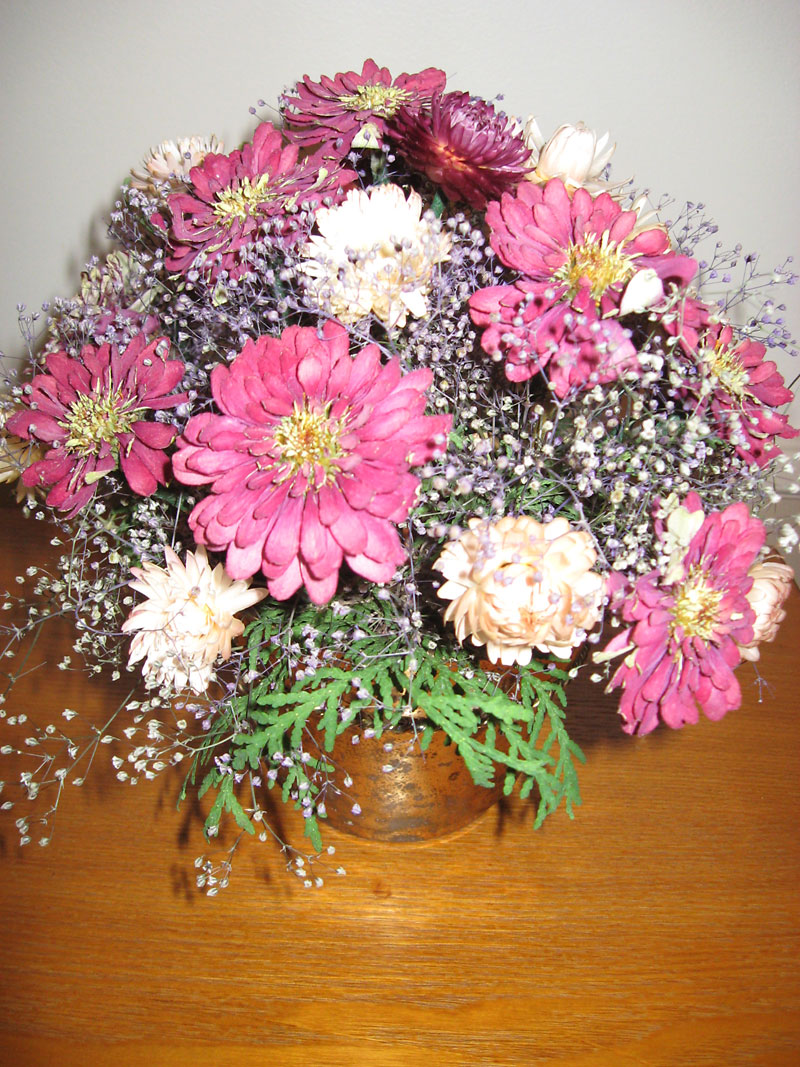
Air-drying simply involves hanging flower stems upside down in a dark airy place and letting them dry naturally. It is wise to not make the bundles too large so the air can get at all the stems and dry them thoroughly.
The stems are hung upside down because generally they wilt as they begin to dry and if they were standing upright in a container they would bend over and not be attractive. There are exceptions, such as allium seed heads, which are generally dried in an upright position.
I mostly use silica gel to dry flowers. Silica gel is a granular material about the consistency of white sugar. It is available in craft stores, and while not inexpensive, it can be used over and over again. It is a desiccant — the same material you find in those little packages in new shoes, although that silica gel has larger grains than the material used to dry flowers.
The silica gel must be heated to remove moisture before flowers are placed in it. I bake it for about an hour in a 250 degree oven, then let it thoroughly cool before I use it.
Although many flowers can be dried using this method, I have found great success using zinnias. They are naturally stiff and dry-feeling, and after being dried they have some substance and are not fragile as some dried flowers tend to be.
I place three or four centimetres of silica gel in the bottom of an airtight container (I use a large Tupperware container whose lid is tight fitting). I arrange zinnias, facing down, on top of the gel, making sure they are not touching each other. I leave enough stem (about 4-5 cm) on each flower to enable me to attach a longer stem after the flowers are dried.
I cover the flowers completely with silica gel then add another layer of flowers, covering them with silica gel as well. Luckily, I have accumulated enough silica gel that I can make three layers of flowers in the large container I use.
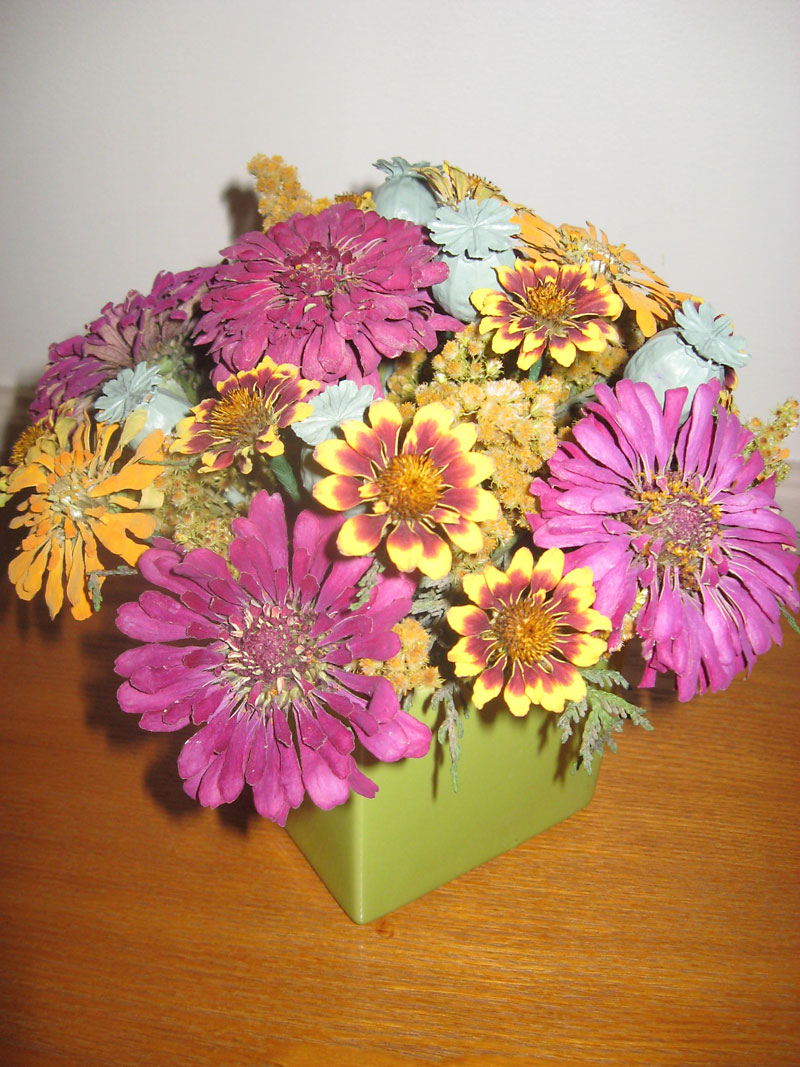
I close the container and place it in a warm, dry spot for four days when the flowers can be removed. I carefully pour some of the silica gel out of the container until the first layer of flowers is visible.
I gently let the flowers out of the gel and shake the silica gel off them. I store the dried flowers in shoe boxes with the holes covered over in a dry warm spot (I use the tops of the kitchen cabinets). I keep pouring off more silica gel and retrieving the flowers until they are all out of the gel.
I find that I can dry a second batch of flowers in the silica gel without drying it in the oven, but if you want to be sure your flowers will dry thoroughly you might heat the gel to dry it out before drying more flowers in it.
I use a glue gun to attach stems to the dried flowers and use dried golden rod stems and any other thin stem-like material I have on hand. Sometimes I use floral wire and floral tape to make stems.
To create the arrangements, I use oasis and cover it with sphagnum moss or potpourri. I sometimes use fresh cedar which dries naturally over time and makes a nice addition to the arrangements.
The zinnias I use are 6-8 cm in diameter and it takes about 6 or 7 to create a nice sized arrangement. As a filler I use poppy seed heads (painted various colours), grasses, dried miniature zinnias (I use Persian Capet), strawflowers, or gypsophilia. Air-dried golden rod is also a useful filler.
Dried autumn arrangements look best in brass, basket or brown ceramic or plastic containers. I tend to dry zinnias in the red, orange and yellow colour range as the pinks just don’t seem to say “autumn” in the same way.
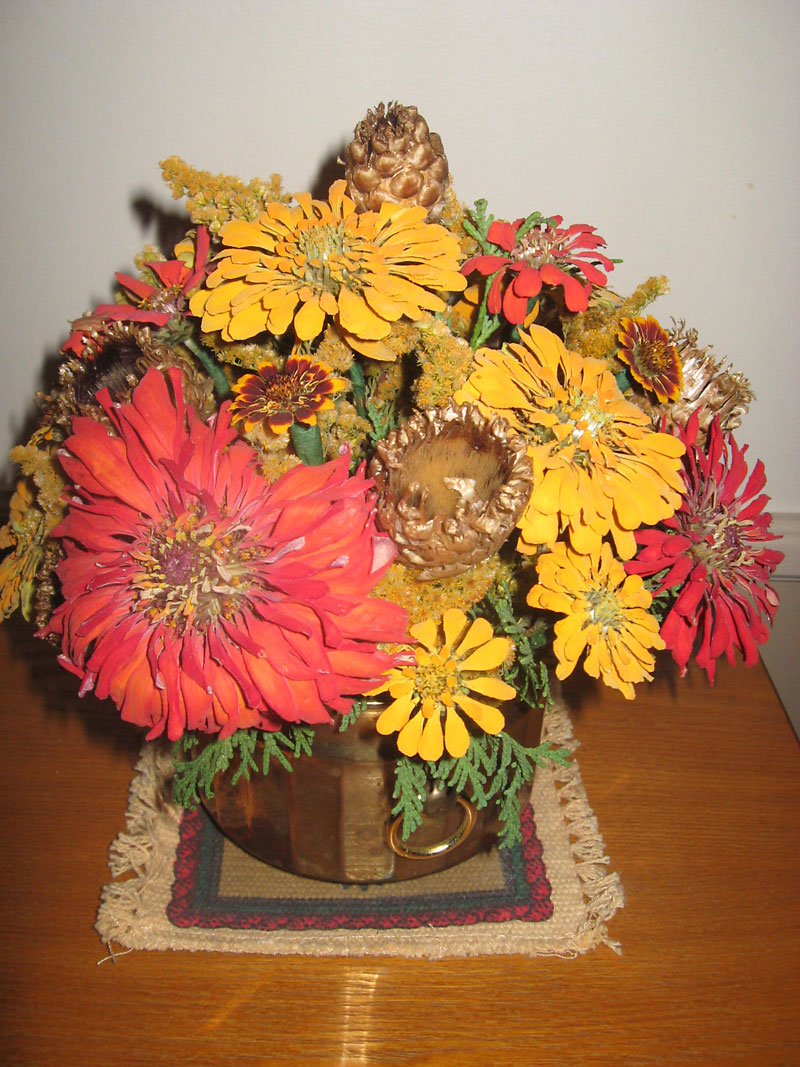
Perhaps you will try to capture some of the beauty of your summer garden by drying some zinnias and creating a dried floral design. You will create a beautiful visual memory of your summer garden.
Albert Parsons lives, writes, and gardens in Minnedosa.
» wtw@brandonsun.com