
Second World War feels like yesterday for veteran
Advertisement
Read this article for free:
or
Already have an account? Log in here »
We need your support!
Local journalism needs your support!
As we navigate through unprecedented times, our journalists are working harder than ever to bring you the latest local updates to keep you safe and informed.
Now, more than ever, we need your support.
Starting at $15.99 plus taxes every four weeks you can access your Brandon Sun online and full access to all content as it appears on our website.
Subscribe Nowor call circulation directly at (204) 727-0527.
Your pledge helps to ensure we provide the news that matters most to your community!
To continue reading, please subscribe:
Add Brandon Sun access to your Free Press subscription for only an additional
$1 for the first 4 weeks*
*Your next subscription payment will increase by $1.00 and you will be charged $20.00 plus GST for four weeks. After four weeks, your payment will increase to $24.00 plus GST every four weeks.
Read unlimited articles for free today:
or
Already have an account? Log in here »
Hey there, time traveller!
This article was published 01/11/2018 (2715 days ago), so information in it may no longer be current.
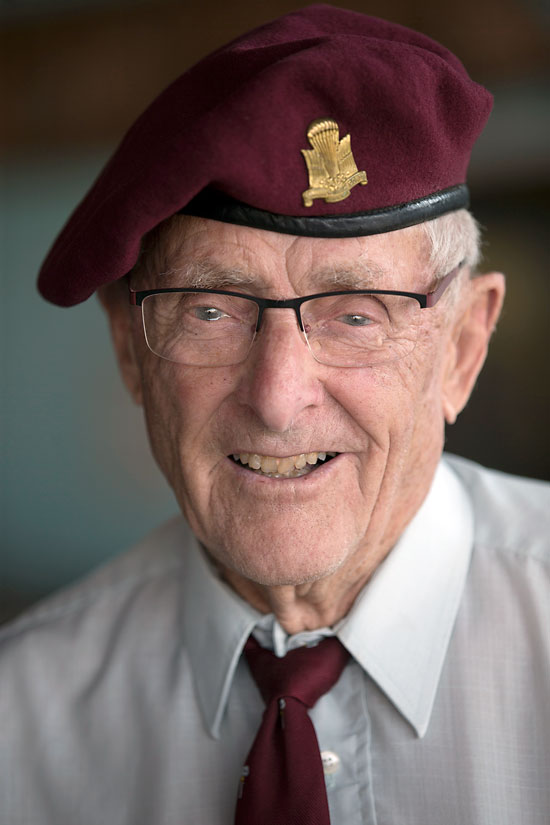
For Ross Mitchell, 93, the Second World War still feels like it was yesterday.
“Those memories are pretty well glued in my mind I’m afraid,” Mitchell said. “I wish I could remember what I did yesterday as well as what I can remember what went on in the war.”
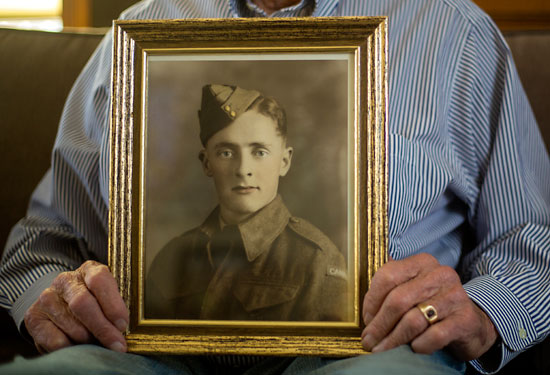
Born and raised on a farm near Douglas, Mitchell joined the army when he was 18 and spent the summer of 1944 training in Shilo.
A brother of his joined the navy the previous year, while an older brother remained on the farm to help his father and a younger brother stayed in school.
Mitchell’s infantry soldier training began with five-mile runs, 20-mile hikes and shooting on the ranges.
Looking back, it’s difficult for Mitchell to understand how kids like himself were taken from the farm and trained to kill Germans.
At the time, they didn’t think about the fact they were being trained to kill. He was instructed to shoot first, killing the enemy before they had the chance to kill him.
“They certainly couldn’t train me today to do what I did then,” Mitchell said. “I wouldn’t do it.”
As his training progressed, Mitchell felt himself drawn to the air, soon joining the airborne paratroopers.
“I could see the (paratroopers) jumping tower out of my bedroom window, and that kind of intrigued me,” Mitchell said.
After three weeks of parachue training, Mitchell was jumping off of that same tower and floating down to the ground in preparation for war. He also joined his colleagues in dropping from aircraft five times in order to qualify as a paratrooper.
“Standing up and jumping out the door is quite an experience,” Mitchell said, describing this as the most challenging part of his training.
The paratrooper went overseas in November 1944, joining the reserve battalion in Britain.
The trip marked the first time Mitchell had been outside of Manitoba.
He considers himself lucky because he was not seasick during the five-day journey from Canada to Europe. By contrast, he said that one boy with him was sick before they left the dock in Halifax.
In February of 1945 he began receiving training as a sniper. Mitchell had always enjoyed shooting and hunting on his father’s farm, and the move seemed like a natural fit for his skills.
He still has permanent hearing damage as a result of the training, since he said no one told him he should wear ear protection.
Joining the active battalion, Mitchell along with 6,000 others in the British Sixth Air Division were dropped behind enemy lines in Germany near the Rhine River on March 24, 1945.
“You couldn’t help but be a little scared, but that was what you had been trained for,” he said.
Mitchell said that he’s thankful for his late entry into the war, especially since he and his comrades were dropped after D-Day.
Mitchell still remember the first dead German he encountered. The soldier had been shot between the eyes and was laying on his back.
“I’ll always remember that sight,” Mitchell said.
As the soldiers made their advance through Germany, the war soon came to an end. Two days after Hitler shot himself, the European side of the war was declared over and the soldiers continued their march through the country.
The group spent six weeks marching on foot or riding in tanks until they reached the port of Wismar on the Baltic Sea in Germany on June 6, after which they soon returned to Britain and later Canada.
Arriving back home in Douglas, Mitchell was given a month’s leave and told he would be shipped out to fight again, only this time in Japan.
On the train to his deployment in Niagara, Ont., he learned the atomic bomb had been dropped, which to his relief effectively ended the war.
With the war over, Mitchell moved on with his life and went on to marry and have children.
He met his future wife in 1949, and married Mabel in October 1951. They had four little girls, of whom one died when she was 12. The other three are married and he is now the proud grandfather of seven grandchildren and 10 great-grandchildren.
“I really feel grateful about it,” Mitchell said.
He hopes that younger people take time to pause for a short minute or two on Remembrance Day to respect those that paid the ultimate sacrifice in defeating the Germans.
With the memories remaining vivid, Mitchell never again wants to see the horrific violence of an event like the Second World War.
“I just hope that my children will never see a war as terrible as I did,” Mitchell said. “I hope they never have to go overseas and fight.”
»ckemp@brandonsun.com
»@The_ChelseaKemp