
Gone Gardenin’ — The octopus tree, star leaf, or umbrella plant
Advertisement
Read this article for free:
or
Already have an account? Log in here »
We need your support!
Local journalism needs your support!
As we navigate through unprecedented times, our journalists are working harder than ever to bring you the latest local updates to keep you safe and informed.
Now, more than ever, we need your support.
Starting at $15.99 plus taxes every four weeks you can access your Brandon Sun online and full access to all content as it appears on our website.
Subscribe Nowor call circulation directly at (204) 727-0527.
Your pledge helps to ensure we provide the news that matters most to your community!
To continue reading, please subscribe:
Add Brandon Sun access to your Free Press subscription for only an additional
$1 for the first 4 weeks*
- Enjoy unlimited reading on brandonsun.com
- Read the Brandon Sun E-Edition, our digital replica newspaper
*Your next Free Press subscription payment will increase by $1.00 and you will be charged $20.95 plus GST for four weeks. After four weeks, your payment will increase to $24.95 plus GST every four weeks.
Read unlimited articles for free today:
or
Already have an account? Log in here »
Hey there, time traveller!
This article was published 08/11/2018 (2888 days ago), so information in it may no longer be current.
Instead of calling many plants by their botanical names we often use common names that have developed over the years. This phenomenon usually occurs with quite ordinary plants that are popular and that many gardeners have in their collections and recognize right off the bat.
One such plant is Schefflera. It goes by several common names, including octopus tree, star leaf, parasol plant, and umbrella plant. These common names tell us a lot about the plant and we know from the names people call Schefflera that it must have many branches just like an octopus has many arms and its branches must carry star-shaped leaves.
We also conclude that the plant’s form must resemble an umbrella. Our conclusion is correct as the schefflera is a multi-stemmed plant whose green leaves have five to seven leaflets which are elongated ovals.

Schefflera leaves are held aloft on long stalks that resemble parasols. The plant is composed of several very sturdy stems which tend to grow somewhat vertically but also on an outward angle so that the plant can get to be quite tall and wide; it has a pleasing shape.
A specimen of schefflera can get to be quite large, reaching a height and width of about two meters, but it can be kept a smaller size by keeping it in a smaller pot; an eight-inch pot will keep the plant to a manageable size. In its natural habitat it is a shrub, so when its roots are confined to a smaller space the plant doesn’t grow as big.
Also, if a schefflera is cut back new shoots will soon emerge from its stems. The top pieces of stem that were removed can be used to start new plants, which, of course, will be shorter than the parent plant. When potting up a schefflera or starting new ones from slips, a peat-based soilless mix that contains some perlite to increase soil porosity is the best choice.
The schefflera originates from the tropics and in its natural environment grows under a tropical forest canopy, so it does not like bright light and will not perform well if it receives direct sunlight. On the other hand it is not really a truly low light plant and will begin to decline if the light levels are too low.
A schefflera is best placed adjacent to a window — even a north-facing one — where good indirect light will be the norm. Scheffleras seem to perform well in interior spaces that have bright artificial lighting so they make great office plants and you often see them used in malls and other public spaces that have artificial light but little or no natural light.
The schefflera should be watered moderately, giving the top few centimetres of soil a chance to dry out between waterings. During the winter, it is wise to hold back on the water even more, just giving the plant enough moisture so that the soil does not completely dry out; if the soil is kept too wet the plant may develop rot.
This plant requires good drainage and will object to having its pot sit in water or have water collect in the bottom of the pot. The pot should have drainage holes and the pot should not be allowed to sit in any excess water.
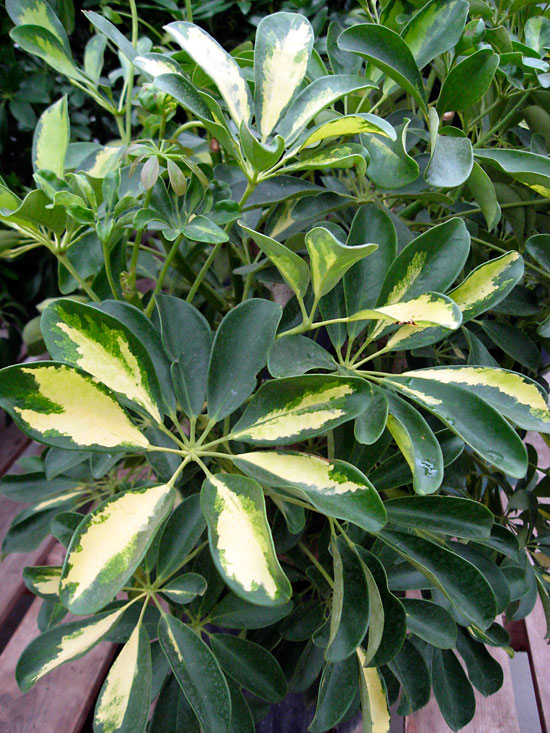
Its foliage is the schefflera’s main attraction. New leaves are shiny but the leaf surfaces lose their lustre as they age; the leaves are dark green.
Over time its leaves will collect dust so it is a good idea to periodically give the leaves a gentle wipe with a damp cloth. The stems can do with a wipe from time to time as well. This process can be a bit tedious but by placing each leaf on one hand while gently wiping the leaf with the other, in a few minutes the plant will be refreshed.
During the active growing period in the summer a schefflera can be fertilized every month or so with an all purpose soluble fertilizer at half strength. During the winter months the plant’s growth rate will slow down substantially and it should not be fed. A schefflera is happy in the temperatures found in the average house during the winter.
A schefflera is a useful plant for indoor landscaping and large specimens are often seen in waiting rooms and offices because of its tolerance for such indoor environments. It is most commonly used as a floor plant in a private home.
There are a number of forms of schefflera, including the most common, the solid green form. A newer variety has foliage that is beautifully variegated with yellow splashes on its glossy green leaves — its leaves will gradually lose their sheen as they grow older but the variegation will endure.
In a house, an umbrella plant can add interest to a corner or can be located in an entrance hall. If the plant is a large one, it can be positioned on the floor; a smaller plant can be placed on a small table.
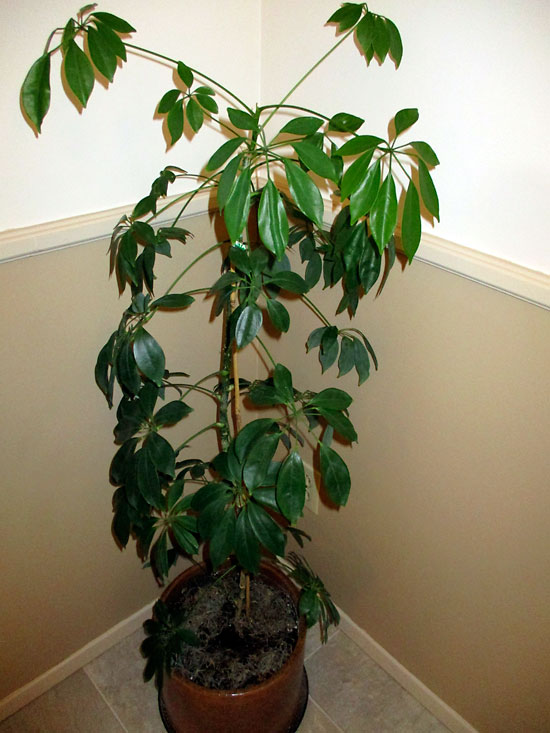
There are hundreds of varieties of schefflera; some have long, narrow leaflets, while others have leaflets that have rounded tips or that are slightly divided and rounded at their tips. Some forms are much larger than others. The smallest varieties can even be combined with other plants in an indoor container arrangement. Well cared for, its foliage kept clean, and placed in an attractive jardinière, perhaps with a bit of Spanish moss to cover the soil surface, a schefflera makes a great addition to any interior landscape.
Albert Parsons lives, writes, and gardens in Minnedosa.
» wtw@brandonsun.com