
Gone Gardenin’ — How to attract birds to a winter garden
Advertisement
Read this article for free:
or
Already have an account? Log in here »
We need your support!
Local journalism needs your support!
As we navigate through unprecedented times, our journalists are working harder than ever to bring you the latest local updates to keep you safe and informed.
Now, more than ever, we need your support.
Starting at $15.99 plus taxes every four weeks you can access your Brandon Sun online and full access to all content as it appears on our website.
Subscribe Nowor call circulation directly at (204) 727-0527.
Your pledge helps to ensure we provide the news that matters most to your community!
To continue reading, please subscribe:
Add Brandon Sun access to your Free Press subscription for only an additional
$1 for the first 4 weeks*
- Enjoy unlimited reading on brandonsun.com
- Read the Brandon Sun E-Edition, our digital replica newspaper
*Your next Free Press subscription payment will increase by $1.00 and you will be charged $20.95 plus GST for four weeks. After four weeks, your payment will increase to $24.95 plus GST every four weeks.
Read unlimited articles for free today:
or
Already have an account? Log in here »
Hey there, time traveller!
This article was published 07/03/2019 (2628 days ago), so information in it may no longer be current.
For a number of years, we have left “Sunny Manitoba” for warmer places during much of the winter, but this year we have stayed in Manitoba for the winter. This resulted in reminding us how much we enjoy watching the birds that come to the feeders in our front yard.
We do enjoy the many birds that visit the feeders during the spring, summer and fall, but winter birds are a real treat to watch; they bring life to a seemingly lifeless outdoor landscape and provide hours of enjoyment during a period when we have lots of time to sit and watch them. Previously I have written about how to attract birds to a garden during the growing season, but until now I have not extended that discussion to include the best methods to use to get birds to visit the winter garden.
Although some methods of attracting birds to the feeder area of the garden in the winter are similar to those employed for attracting them to the summer garden, there are a few specific things that can be done to get the maximum number of winter birds to visit the garden. Winter weather is severe, and if it isn’t bitterly cold, then it might very well be windy so consideration of winter weather is foremost in deciding on ways to attract birds to winter feeders.
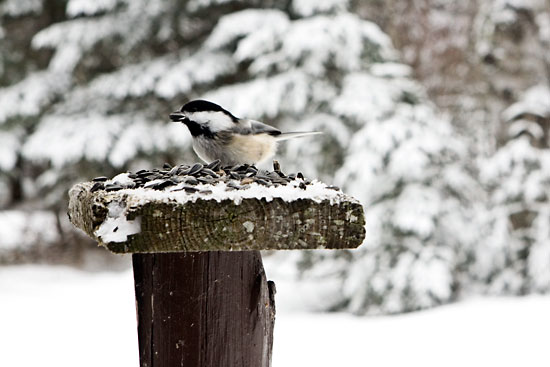
A sheltered spot in which to locate feeders is a must as birds will be attracted to locations that are sheltered from winter winds and avoid those that are not. Trees and shrubs located to the north and west of the feeder area will protect it from most of the prevailing winter winds.
If possible, locate feeders so that they are both exposed to direct sunlight; the birds will be happy to bask in the sunshine while they are feeding. Birds love trees and shrubs that are close to the feeding area to provide protection from wind.
Besides offering shelter from winds, the vegetation provides birds landing sites that they will utilize when approaching the feeders. It is not common to see birds fly directly to a feeder; they more often alight on a branch of a tree or shrub and hop/fly from branch to branch as they scout for danger before finally landing on a feeder.
Birds are on constant alert for danger. They appreciate nearby trees and shrubs into which they can fly when disturbed by any kind of perceived danger while feeding.
If thickets of shrubbery can be located near feeding areas, the environment will be more naturalistic and the birds will use the thickets of shrubbery for protection and well as for feeding. It is not unusual to see birds feeding on seeds or berries on shrubs such as cedars and cotoneaster or hopping around under shrubs (unless the snow is unusually deep) looking for food.
It is important to determine the preferred food of the winter visitors — so you have to know which species of birds are apt to be attracted to your feeders. Providing a variety of food in separate feeders means more birds will use the feeding area and there will be less competition for space at the feeders.
Finch feeders will satisfy those birds that prefer canola or niger seed, while sunflower seeds will keep nuthatches, blue jays and chickadees happy. Mesh bags used by grocers to package onions and other produce can be used to hold pieces of suet, which is a favourite food for woodpeckers, although chickadees, nuthatches and blue jays will feed on suet as well; these bags should be tied onto tree branches high enough so that they are not accessible to roaming animals.
Red squirrels can be a nuisance at bird feeding stations on warm days during the winter; they scare away the birds and eat a lot of the food — mostly going after sunflower seeds. A squirrel-proof feeder might be necessary if squirrels become a problem. Unwanted pests such as rabbits and mice might be attracted to the debris below the feeders, so it might be necessary to erect a barrier to keep such pests away from the feeders and out of the garden.
Bags of suet and finch feeders survive snowfalls unscathed, but seeds in any platform feeders holding mixed seed or sunflower seeds will soon get covered with snow during a snowstorm. Therefore, such feeders should have roofs to keep the snow out of them.
Although the roofs are necessary, the feeders must be open enough to enable the birds to feel safe when entering them. Cautious birds are hesitant to enter a feeder that prevents them from seeing out to catch sight of approaching danger.
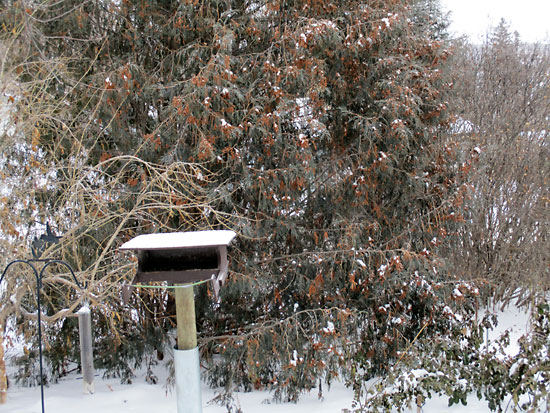
Besides the feeders erected to hold food, if the feeders are located over or next to an area of the garden that contains perennials then the birds will have another source of food — and a natural one at that, which will certainly entice more birds to the garden. Native plants often hang on to their seeds for the winter so perennials like coneflowers, golden rod and heliopsis, as well as annuals like ornamental grasses and poppies can be left in the garden for the birds to enjoy during the winter.
Some avid birders even provide their feathered friends with water during the winter. Special heaters can be purchased that fit into bird baths to keep the water from freezing so that the birds can access the water to drink. Birds will not bath in the water if the air temperature is low — they instinctively know that getting wet in frigid temperatures is not a good idea. They will, however, drink the water.
If no open water is provided, birds will either melt snow in their beaks or under their feathers to obtain water, or they will obtain water from a source in nature, such as a fast-moving current in a river or stream. Birds, however, can survive the winter without the luxury of a heated bird bath as a source of water, so this is not a necessity to attract birds to your yard.
Feeding birds during the winter months provides birders with hours of enjoyment and it also helps our feathered friends survive even the most severe winters. Be sure to erect bird feeders in the garden where you can see them from your windows so that you will get the pleasure of watching them from the comfort of your home.
Albert Parsons lives, writes, and gardens in Minnedosa.
» wtw@brandonsun.com