
Proposed Hylife expansion ignites debate in community
Advertisement
Read this article for free:
or
Already have an account? Log in here »
We need your support!
Local journalism needs your support!
As we navigate through unprecedented times, our journalists are working harder than ever to bring you the latest local updates to keep you safe and informed.
Now, more than ever, we need your support.
Starting at $15.99 plus taxes every four weeks you can access your Brandon Sun online and full access to all content as it appears on our website.
Subscribe Nowor call circulation directly at (204) 727-0527.
Your pledge helps to ensure we provide the news that matters most to your community!
To continue reading, please subscribe:
Add Brandon Sun access to your Free Press subscription for only an additional
$1 for the first 4 weeks*
- Enjoy unlimited reading on brandonsun.com
- Read the Brandon Sun E-Edition, our digital replica newspaper
*Your next Free Press subscription payment will increase by $1.00 and you will be charged $20.95 plus GST for four weeks. After four weeks, your payment will increase to $24.95 plus GST every four weeks.
Read unlimited articles for free today:
or
Already have an account? Log in here »
Hey there, time traveller!
This article was published 26/01/2022 (1725 days ago), so information in it may no longer be current.
HyLife Food is continuing to expand its reach in southwestern Manitoba, with the proposed expansion of its operation in the RM of Deloraine-Winchester.
The pork producer held an open house for residents on Jan. 5 to gauge public feedback, said corporate sustainability director Sheldon Stott.
“We had a number of people come through they asked some really good questions, and I feel like we were able to address them as best we could in the circumstances that we were in,” Stott said.
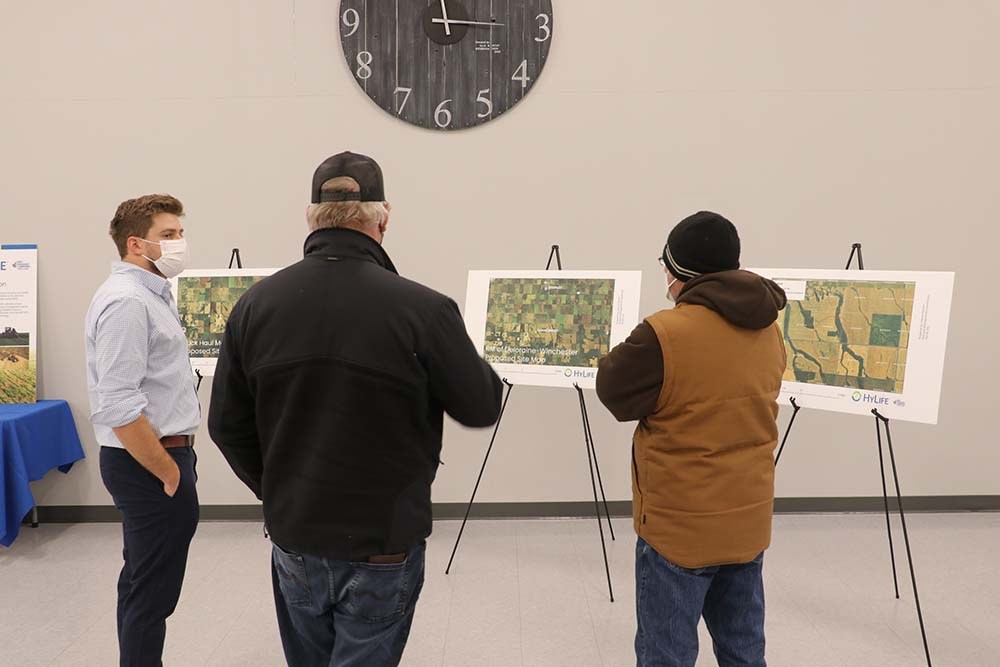
The proposed facility in the RM will serve a multiplier site, consisting of a barn with 3,800 nursery hogs and three barns with 7,600 finishing hogs. The site will have earthen manure storage.
If things go to plan in a perfect world, the company would like to break ground on the project in the early spring or summer, he said.
Stott added HyLife is currently in the preliminary stages of the project and has not made formal applications for conditional use permits. There is a long list of due diligence that must be completed, along with due diligence by the provincial technical review committee to confirm the sustainability of the proposed site development.
HyLife has already established that the site meets local municipal land use planning, one of the most critical aspects, showing the facility is appropriate for the area of the municipality. The pork producer has also taken into account its proximity to residents in Deloraine-Winchester.
“This is highly productive agricultural land, which fits well,” Stott said.
The last step is to ensure there is a sustainable water supply to feed the facility.
HyLife projects have been feeling the impacts of COVID-19 and supply chain issues, and this could impact when the potential project could break ground.
Pursuing the construction of facilities has been challenging during the global health crisis, Stott said, both in the logistics of getting supplies and the increasing prices of goods and services needed to complete projects.
“Finding workers and crews capable of performing this work has been an ongoing challenge for us throughout the pandemic,” Stott said. “Our construction team has worked really tirelessly in getting creative in trying to find different material sources as well as reaching out and really digging deep into their contact lists to find additional labour to put these facilities together.”
The cost of the proposed facility in Deloraine-Winchester is anticipated to come in around the $8- to $10-million range, although this will be subject to change based on COVID-19.
“It’s been a bit of a moving target over the last little while,” Stott said.
Establishing the facility could serve as an important economic activity, as HyLife invests millions of dollars in each project, Stott said.
The site will create four full-time positions, he said, adding this means there is the potential of growth in the community of four additional families.
“To me, that probably is the biggest impact is being able to sustain and continue some moderate growth in these rural communities,” Stott said. “People are spending money because they are in the community eating lunches and shopping at the local stores. But then, there’s the long term. There’s obviously a tax piece that is contributing back to the local municipality and to the province and then job.”
HyLife has been in an expansion phase in southwestern Manitoba for several years, and the proposed barns in Deloraine-Winchester are bringing the final steps of the expansion to fruition.
The pork producer developed a feed mill in Killarney and has built subsequent farming operations in the surrounding municipality and areas.
“This is one more piece of that puzzle that we’re trying to put together,” Stott said.
As of now, HyLife is not looking at too much more development in southwestern Manitoba at this time, Stott said, adding the pork producer is considering one more facility in 2021 in a different area.
“We’re taking it one step at a time and wanted to get through these developments and then look towards next year. Right now, there’s nothing on the books for us,” Stott said.
Before the proposed development in Deloraine-Winchester, HyLife already had an established hub of facilities in southwest Manitoba. The producer has been in the area for several years and remains focussed on completing a production loop, Stott said.
The company has a $30-million feed mill in Killarney that had a certain level of capacity and is now looking to fill that capacity within existing infrastructure with farrowing operations.
HyLife’s growth in southwestern Manitoba has provided 38 new full-time jobs in the community to date.
“It’s an attractive area because it’s really been a progressive part of the province. We’ve seen a lot of opportunity and growth in that area, not only just driven by ourselves but driven by local municipalities willing to open up and encourage additional investment and growth, so we’ve taken advantage of that,” Stott said.
Deloraine-Winchester Reeve Gord Weidenhamer said the proposed HyLife facility has sparked a fiery conversation in the community.
Some vocal community members have had an extremely negative reaction to the facility, placing the future of the expansion largely in doubt based on the current proposed location.
“There’s a lot of backlash from the community,” Weidenhamer said, adding this has included a petition against the facility and neighbours standing in opposition to the expansion. “People seem to have negative feelings toward it.”
Complaints have largely centred on concerns over the odour that would come from the facility.
He added locals would also like to see the placement of the facility shifted to another location if development were to go ahead.
Another emerging issue is HyLife is taxed as a farm-based business when many in the community would like to see the company taxed as a commercial industry. He noted these taxes are set by the province.
HyLife has applied for a conditional use permit in the municipality, Weidenhamer said, and a public hearing regarding the expansion will be set at a future date.
The municipality is continuing to look for infrastructure in the community to keep taxes at bay and ensure employment opportunities are available for residents.
“There’s not a lot of options for small towns without investment coming forward,” Weidenhamer said.
This economic growth can be a difficult balance strike, he added, because it can be difficult to draw outside investment into the community, but HyLife has drawn significant vitriol from residents.
He noted investment would create jobs and tax dollars in the small community with minimal investment from the tax base. This would include the four full-time jobs in the community with the potential for spousal spin-off jobs in the area.
“We’re looking for options,” Weidenhamer said. “We want to expand our community and make it grow but it’s tough if quite honestly the options aren’t out there.”
Deloraine-Winchester is a unique municipality with a range of demographics including small-town, rural and recreational residents.
It can be challenging to find vested shared investment between these groups. Weidenhamer added overcoming these adversities requires community involvement and he would like to see more people come forward to join in on these conversations.
He considers them lucky in the southwest because they have the oil industry for the younger generation to work in, but it remains essential to find industries that want to invest in smaller towns.
“There is negativity and by the looks of it, it probably won’t go ahead in the end. But it’s back to the question of the community. We’re looking for answers out there that what industry can be brought to a small community with minimal investment and add to our tax base and add to jobs in our community,” Weidenhamer said.
» ckemp@brandonsun.com
» Twitter: @The_ChelseaKemp