
A gentle genius: Remembering Morgen Burke
Advertisement
Read this article for free:
or
Already have an account? Log in here »
We need your support!
Local journalism needs your support!
As we navigate through unprecedented times, our journalists are working harder than ever to bring you the latest local updates to keep you safe and informed.
Now, more than ever, we need your support.
Starting at $15.99 plus taxes every four weeks you can access your Brandon Sun online and full access to all content as it appears on our website.
Subscribe Nowor call circulation directly at (204) 727-0527.
Your pledge helps to ensure we provide the news that matters most to your community!
To continue reading, please subscribe:
Add Brandon Sun access to your Free Press subscription for only an additional
$1 for the first 4 weeks*
*Your next subscription payment will increase by $1.00 and you will be charged $20.00 plus GST for four weeks. After four weeks, your payment will increase to $24.00 plus GST every four weeks.
Read unlimited articles for free today:
or
Already have an account? Log in here »
Hey there, time traveller!
This article was published 25/08/2022 (1331 days ago), so information in it may no longer be current.
A new endowed fellowship at the University of North Dakota is one way the legacy of longtime Westman resident Morgen Burke will live on.
Burke died in his Carberry home on April 11 at just 30 years of age following a battle with brain cancer. However, it’s not how he died but rather how he lived — and his contributions to science and academia — that people remember about Burke, in addition to his gentle, caring nature.
Burke was born on July 31, 1991 in Virden to parents Cam and Diane Burke. As a child, he loved nature and science. This inspired him to study science at Brandon University in 2014, where he also reconnected with his future wife, Justine.
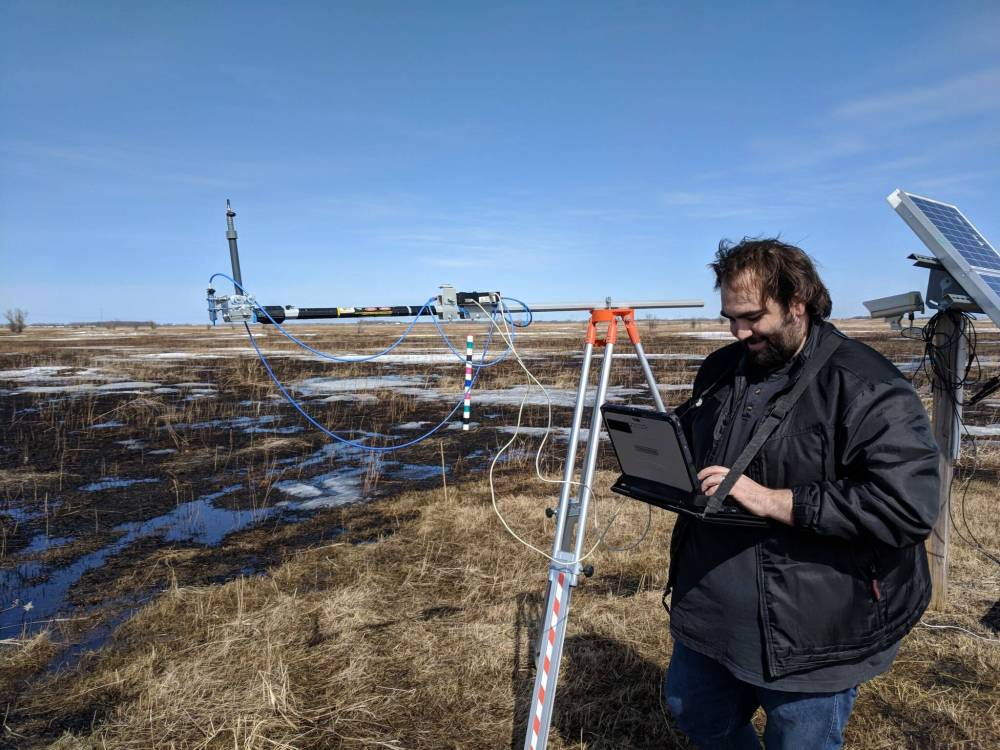
Morgen Burke works on equipment for the phenocam at the University of North Dakota’s Oakville Prairie near Emerado, N.D. (University of North Dakota)
“We grew up in the same town, so I knew him since fifth grade,” Justine told the Sun. “We didn’t start dating until after high school, and then we both went to Brandon University.”
The couple got married in 2014, right after Burke’s graduation. Shortly after the wedding, Burke moved to the United States to study at the University of North Dakota (UND). There, he completed a master’s degree in geography and a PhD in Earth system science. He wrapped up his doctorate degree in November 2021, following his brain cancer diagnosis the previous June.
Jeffrey VanLooy, associate professor of Earth system science and policy at UND, said Burke was always interested in remote sensing, satellite imagery and how the Earth’s vegetation was changing.
This interest led him to Bradley Rundquist, dean and professor of geography at UND.
VanLooy ended up working with Burke as his technical adviser, while Rundquist was Burke’s adviser while he worked on his dissertation.
“Morgen was a fantastic student, and he worked incredibly hard,” VanLooy said.
“Not only did he have the intelligence and the drive, which are really critical in getting a PhD done, he was also probably the nicest guy I’ve ever met.”
Rundquist agreed, saying that Burke exceeded expectations during his time at UND.
“He was very collaborative … he was curious. He wanted to be involved in things,” Rundquist said.
In addition to studying and working on his dissertation, Burke was hired by UND as the computer lab manager for the geography department. It’s in this role, Rundquist said, that Burke’s helpful, caring nature was on full display.
“He set a great example for our students,” Rundquist said. “I couldn’t even begin to imagine how many students he helped. He was always available. He never said no to anybody. He was very patient. It’s just hard to quantify all the assistance that he provided to these students who, themselves, have graduated and moved on.”
VanLooy said he cherishes Burke’s memory and speaks to other students about him.
“He is the person that I will point to for all the students in the future and say, ‘This is the person you want to be.’”
During his time at UND, Burke published four peer-reviewed scientific journal articles between 2018 and 2021. Rundquist said Burke also became involved in a project that entailed monitoring seasonal changes in vegetation on tall-grass prairie at UND. A camera system was set up, but there was no internet connection, and Burke quickly became interested in seeing how he could make it work in such a remote area. Burke eventually took over leadership of the project.
In the project, Burke used a special digital camera called a phenocam to monitor the changes. The time-lapse camera captures images every half-hour and has done so for around eight years.
“After that, he suggested additional equipment out at the prairie site, so we put out a weather station. And he figured out what instruments we needed and how to put it all together: how to power it, how to connect it to the network, how to automate the process … he was really the key component to that whole project … that’s still out there and operating,” Rundquist said.
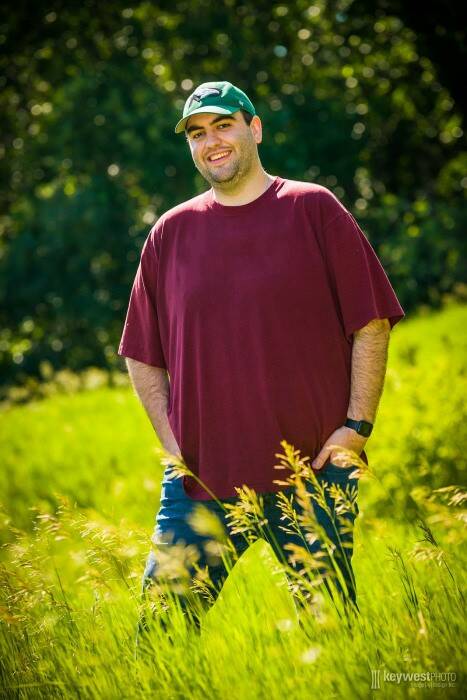
Morgen Burke stands in a field in the sunshine. (Submitted)
Burke took the research one step further by finding a way to calibrate satellite data using phenocam data from multiple grassland sites, allowing researchers to better characterize highly dynamic grassland processes.
Burke powered the site with marine batteries, then rigged solar panels and a wind turbine to charge them. Scientists are using the data from Burke’s setup to learn how weather and climate are impacting the environment.
In another project, Burke used historic aerial images from as far back as 1962 to study density trends in Grand Forks County’s rural shelterbelts. His research showed that density increased until it hit a downward trend in 2014, which he attributed to the natural lifespan of the trees and the active removal of them to make room for expanded row crops.
Burke concluded that certain agricultural areas now stand at an increased risk of wind-induced soil erosion, perhaps at a level similar to that experienced in the Midwest in the 1930s.
But while Burke worked diligently on all his projects, he silently battled his illness, refusing to draw any attention to himself, his wife said.
“He was just a humble guy, so … he never posted on social media that he was sick or anything, and neither did I, in respect to that, so people didn’t really know,” Justine said.
Because much of what happened with his illness played out during the COVID-19 pandemic, VonLooy said Burke’s death came as a shock to many of the faculty and students at UND.
“From the department’s stance, people really didn’t know what was going on with his illness, but the big reason was he didn’t want people to know,” VanLooy said.
“Up until the very end, there were a lot of people that still didn’t realize how sick he was. That’s just Morgen. He didn’t want to bring attention to himself over something like that.”
Those who worked with, knew and loved Burke were determined to keep his memory alive.
The University of North Dakota’s College of Arts and Sciences partnered with the John D. Odegard School of Aerospace Sciences to establish the Morgen W.V. Burke Memorial Graduate Fellowship. The scholarship will be awarded each year to an outstanding graduate student in either geography or Earth system science and policy, a release from the university said.
Rundquist said the idea for the fellowship grew from a reflection of who Burke was as a student and a person.
“He was just so curious about the world,” Rundquist said. “He was so kind to everybody — students, staff, faculty. We just thought he embodied the ideal student, and that his name should live on here at UND.”
Justine said the UND scholarship is very meaningful to her.
“It brings me a lot of comfort to know that that scholarship exists — like a little part of him is still doing his work.”
Justine also created a scholarship in her husband’s memory, which was already given to a student who will be entering an environmental science program at Brandon University.
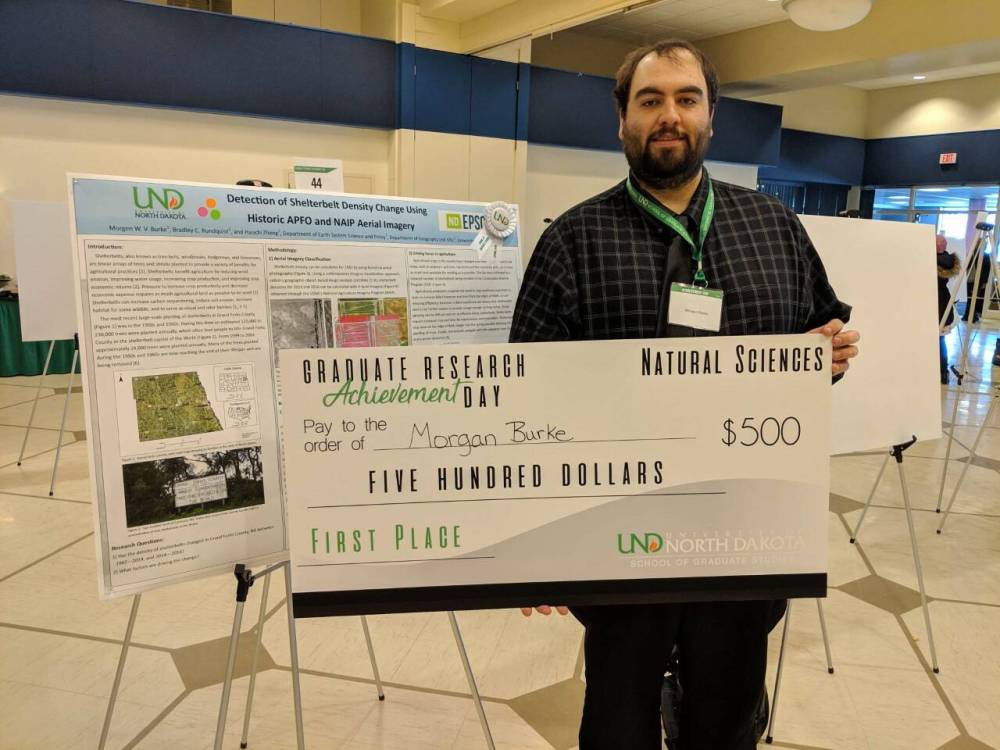
Morgen Burke holds a cheque he was awarded from the UND for winning first place on Graduate Research Achievement Day. (Submitted)
“It’s [for] someone who has demonstrated an exemplary work ethic and community-mindedness.”
It’s that community-mindedness, which was so important to Burke, that was returned in kind when he became sick and later died, she said.
“This community [in Carberry] has been beyond amazing through this whole process,” said Justine, a music teacher at Carberry Collegiate.
She explained that two to three weeks before Burke was diagnosed, the couple purchased a house in Carberry. It didn’t take long before staff from her school were painting the house and maintaining the yard.
“When I brought Morgen home, I needed a ramp to make it safe, and three guys from my school came [and built one]. They wouldn’t let me pay for it.”
Morgen’s mother Diane said she misses her son very much.
“He’ll always be with us. How we’re looking at it is we were blessed to have him for 30 years. He was … very modest and humble. He was always that way.”
Burke’s great passion was his scholarly pursuits and the outdoors, Diane said. She remembers her son as an endlessly curious student, even from when he was in elementary school. For this reason, she is very happy about the UND scholarship.
“That’s a real honour. That’s a legacy.”
Donations to the Morgen W.V. Burke Memorial Graduate Fellowship Endowment Fund can be made at undalumni.org/donate.
» mleybourne@brandonsun.com
» Twitter: @miraleybourne