
Aging leaders threaten world order
Advertisement
Read this article for free:
or
Already have an account? Log in here »
We need your support!
Local journalism needs your support!
As we navigate through unprecedented times, our journalists are working harder than ever to bring you the latest local updates to keep you safe and informed.
Now, more than ever, we need your support.
Starting at $15.99 plus taxes every four weeks you can access your Brandon Sun online and full access to all content as it appears on our website.
Subscribe Nowor call circulation directly at (204) 727-0527.
Your pledge helps to ensure we provide the news that matters most to your community!
To continue reading, please subscribe:
Add Brandon Sun access to your Free Press subscription for only an additional
$1 for the first 4 weeks*
*Your next subscription payment will increase by $1.00 and you will be charged $20.00 plus GST for four weeks. After four weeks, your payment will increase to $24.00 plus GST every four weeks.
Read unlimited articles for free today:
or
Already have an account? Log in here »
Hey there, time traveller!
This article was published 01/12/2022 (1228 days ago), so information in it may no longer be current.
Joe Biden just turned 80. Russia’s Vladimir Putin is 70; India’s Narendra Modi is 72, while China’s Xi Jinping at 69 is the youngest of the rulers of the major world powers.
None is planning to retire.
Brazil just elected a 77-year-old as its new president, while Israel’s incoming prime minister is 73. As younger men, both Luiz Inácio Lula da Silva and Benjamin Netanyahu held power previously. Donald Trump, at age 76, just announced he will seek the American presidency a second time in 2024.
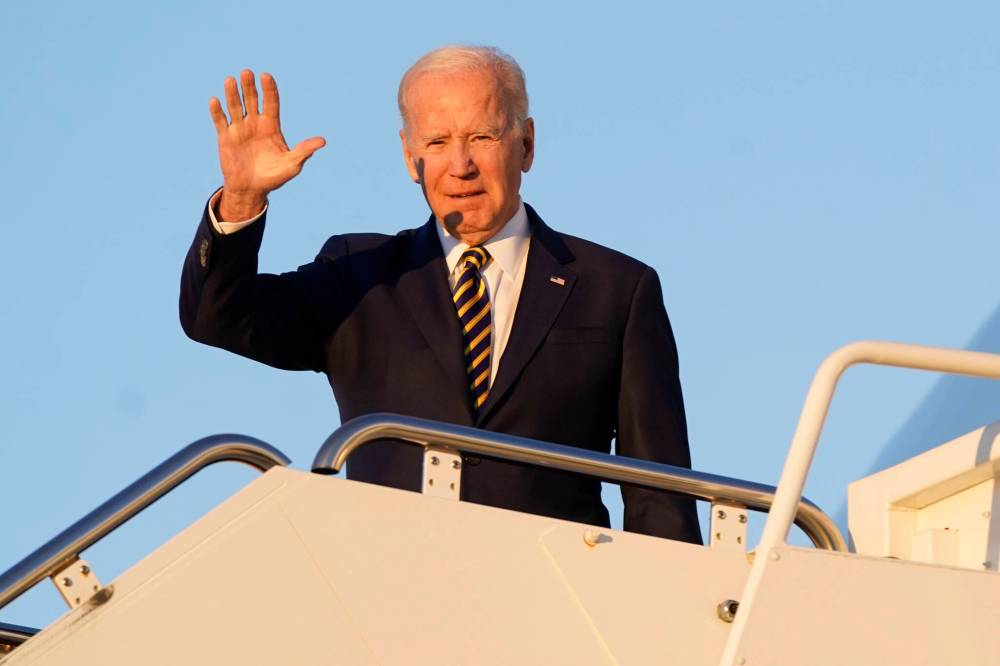
U.S. President Joe Biden, who turned 80 on Nov. 20, is the elder statesman among the geriatric leaders of major world powers. (The Associated Press)
One reason for the gerontocracy is that those who assumed power at younger ages in non-democratic countries have amended constitutions and rules to allow unlimited terms of office.
In Russia, Putin has ruled uninterrupted for 23 years, while in China, Xi has ensured unlimited years of rule for himself.
In democratic countries, older politicians draw on decades of political capital and alliances. Biden’s success in running for U.S. president was partly due to the fact that he convinced voters that his 36 years as senator and eight years as vice-president would benefit America.
The surprisingly strong performance of Democrats in the midterm elections suggests he has a point.
Like Biden, older leaders often promise continuity and stability.
In a world beset with daunting problems — from climate change to pandemics and inflation — a capable leader, particularly of a major power, is often seen by citizens as someone who has a track record. Those with many years of political experience argue they are best placed to deal with what lies ahead.
Challenges faced by novices
The sorry tale of Liz Truss, Britain’s prime minister for 44 days earlier this year, shows how quickly and furiously the business and political establishment can turn on a novice leader.
Curiously, western Europe, the region with the largest proportion of older citizens (more than one-fifth of western Europeans are over age 65), has the youngest leaders. France’s Emmanuel Macron, in his second term, is 44, while the United Kingdom’s Rishi Sunak is 42. German Chancellor Olaf Scholz at 64 is the oldest leader of a major European country.
The phenomenon of younger leaders but a greying population in Europe is to some extent the result of the unique politics of many countries in the region. Nearly all European nations have a multitude of political parties, meaning coalition governments are the norm.
Other countries, such as the U.K., have party rules that make it relatively easy to replace leaders. Under such conditions, outcomes in political leadership races are less predictable, and there’s more turnover. Britain has had five prime ministers in the past six years, while Italy has had four.
Women are largely absent among world leaders. The few women who have recently reached the pinnacle of political power have done so early in their careers.
Giorgia Meloni, the new prime minister of Italy, is 45, while Jacinda Ardern of New Zealand is 42. Sanna Marin, the prime minister of Finland, turns 37 soon.
Working longer
Around the world, people are living longer and healthier lives than ever before in human history, and in many cases working longer. This is good news, but there are concerns about elderly and long-serving leaders.
They may be out of touch with the younger generations they need to represent. Solutions to policy conundrums that worked for them decades ago might no longer apply now or in the future.
Their attitudes and perspectives may become conservative or inflexible. Unlike Finland’s Marin, they probably don’t have children in kindergarten, and so don’t see how policy plays out in real life.
Transitions from one leader to another are among the most dangerous times in the political life of a nation, whether they’re democracies or authoritarian regimes.
The Capitol Hill riots in the United States during the last days of Trump’s infamous presidency are a reminder of how even in the “world’s greatest democracy,” long-established rules about the transfer of power can quickly be undermined.
But when the same person dominates public life in a nation for a long time, transitions are bound to be even more difficult. This is especially worrying in a large and powerful country, since internal volatility can quickly have dramatic, and unpredictable, international repercussions.
Long-term rulers rarely prepare a succession plan, if only because doing so jeopardizes their grip on power.
But without a succession strategy and strong institutions that support a peaceful transition to the next leader, the aging leaders of the world’s superpowers can represent a serious threat to the global order.
» Thomas Klassen is a professor in the school of public policy and administration at York University.
» This article was first published at The Conversation Canada: theconversation.com/ca.