
Wellness room promotes mental health
Advertisement
Read this article for free:
or
Already have an account? Log in here »
We need your support!
Local journalism needs your support!
As we navigate through unprecedented times, our journalists are working harder than ever to bring you the latest local updates to keep you safe and informed.
Now, more than ever, we need your support.
Starting at $15.99 plus taxes every four weeks you can access your Brandon Sun online and full access to all content as it appears on our website.
Subscribe Nowor call circulation directly at (204) 727-0527.
Your pledge helps to ensure we provide the news that matters most to your community!
To continue reading, please subscribe:
Add Brandon Sun access to your Free Press subscription for only an additional
$1 for the first 4 weeks*
- Enjoy unlimited reading on brandonsun.com
- Read the Brandon Sun E-Edition, our digital replica newspaper
*Your next Free Press subscription payment will increase by $1.00 and you will be charged $20.95 plus GST for four weeks. After four weeks, your payment will increase to $24.95 plus GST every four weeks.
Read unlimited articles for free today:
or
Already have an account? Log in here »
Hey there, time traveller!
This article was published 30/03/2023 (1262 days ago), so information in it may no longer be current.
Students at Birtle Collegiate who need a break from the pressures of school now have a dedicated space to do so in a brand-new wellness room.
The wellness room came about after Josie Simard, a guidance counsellor at the high school and elementary school in Birtle, located 145 kilometres northwest of Brandon, and Tanis Cheasley, an English teacher at the collegiate, realized students were facing high anxiety coming out of the COVID-19 pandemic.
“COVID affected kids in many different ways,” Simard said, pointing out that mental health has always been a priority at Birtle Collegiate, even before the pandemic hit in 2020. “We already had a good basis for doing some education and some training around mental health.”
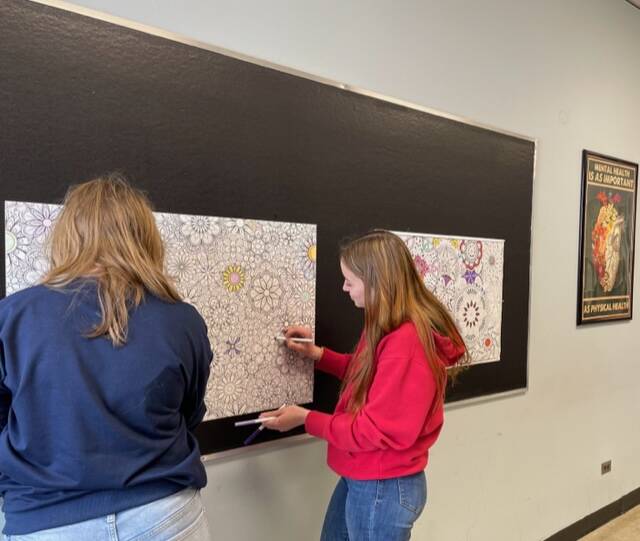
Students at Birtle Collegiate take part in mindful colouring in the school’s new wellness room. (Submitted)
Cheasley quickly noticed an undercurrent of worry and fear that had pervaded her students’ classroom work.
“Over the last three years, a variety of students have written that there’s been worry about what the future is going to hold for them, how that will all turn out,” she said.
The COVID-19 pandemic also added to mental health challenges that are already common in youth today. According to Statistics Canada data from 2019, fewer youth aged 15 to 30 self-reported their mental health as “excellent” or “very good” compared to all other age groups. Among them, females and youth living in lower-income households reported having positive mental health less frequently.
Factors other than age and gender that have been linked to poorer mental health among youth include food insecurity, homelessness, trauma or violence, bullying, recurrent pain or sleeping difficulties, being a member of the LGBTQ+ community, family history of mental illness, screen time and problematic social media use.
Among youth aged 12 to 17, 7.4 per cent were diagnosed as having an anxiety disorder, 3.8 per cent with a mood disorder, and 0.6 per cent with an eating disorder, according to the 2019 Canadian Health Survey on Children and Youth.
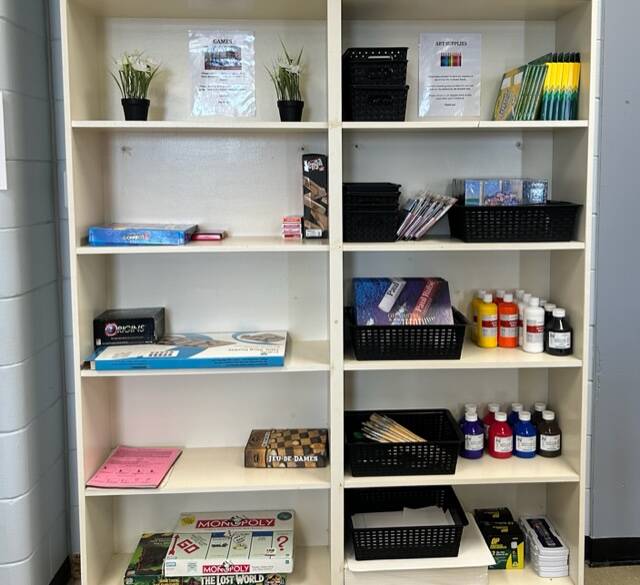
Supplies for mindful activities, such as colouring, can be found in the wellness room at Birtle Collegiate.
Remote learning and fewer opportunities to socialize, prompted by the pandemic, quickly became the norm. And youth could feel the effect on their well-being. A StatCan survey found 57 per cent of respondents between 15 and 17 years old reported their mental health as either “somewhat worse” or “much worse” than it was before physical distancing measures were implemented.
“You start to have a little division,” Simard said. “Some of those kids didn’t see their peers at all, so that was really tough.”
The fear around COVID-19 was also very strong, she noted. That fear was enough to keep students from seeking out the connection they needed for healthy development. Not being able to see their peers was difficult, but for some students, not being able to see family members was also a challenge.
“That was really tough,” Simard said.
Ever since things have been back to a relative state of normalcy, Simard has noticed students have been eager to put the years of the pandemic behind them. However, high school students in particular have been worried that they’ve missed out on a full education, and fear they’re going to fall behind when looking to their future.
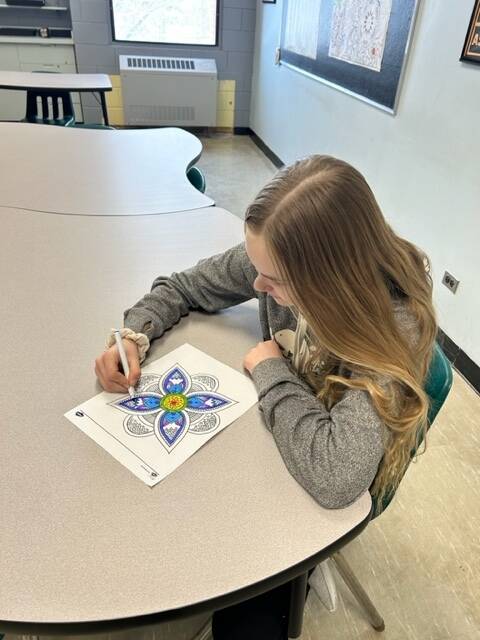
A student takes some time out of a busy day to do some mindful colouring at the wellness room in Birtle Collegiate. (Submitted)
“I would say this group that’s graduating this year was probably affected the most because they were our Grade 9 students when this started, and that’s the beginning of high school years,” Simard said.
Seeing students faced with worries and anxieties moved the school to action, and Simard and Cheasley applied for a provincial government grant called the Teachers’ Idea Fund, part of a five-year, $25-million investment in the ideas and innovations of teachers and educational staff across Manitoba. This year’s Teachers’ Idea Fund, the province’s website states, is focusing on projects that promote mental health and well-being for students and educators.
After Birtle Collegiate was awarded the grant, some of the money went toward group gatherings and activities, while some was set aside for the creation of a wellness room.
“After tossing around a few ideas, we asked for permission to use this money to create a lasting effect,” Cheasley said.
The room is cosy, with lots of natural light and tables, chairs and a comfy couch. There are some recliners that students can kick back in, and visual reminders up on the walls to instruct students on breathing and grounding techniques to help them when they’re feeling anxious.
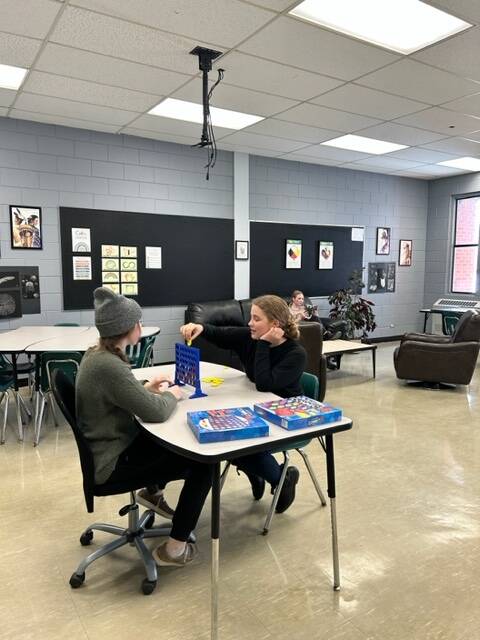
Students relax at the wellness room at Birtle Collegiate. (Submitted)
Creating the room seemed like the perfect remedy for the cares that had been burdening the students, Simard said.
“It just felt like the right thing to do at that time,” she said. “We’ve done so much mental health education, and now we have tools to create spaces and opportunities for students to actually use their mental health tools.”
Best of all, Simard said, feedback from students has been very positive. They also seem to understand that the room is not meant to be used for recreation or socializing, but as a place that is truly there for them when they need it.
“They’re actually being very respectful of each other in there because they know what the purpose is. And I do believe that’s from years of education around mental health, and we’re so proud of them.”
Seeing this generation take their mental health into their own hands, self-regulate and learn to use coping skills, as well as understanding that it’s OK to reach out for help, gives Simard a lot of hope for her students, she said. She hopes students will keep coming to the wellness room to foster their mental health and that it will also help students understand that mental health challenges are a normal part of life and nothing to be ashamed of.
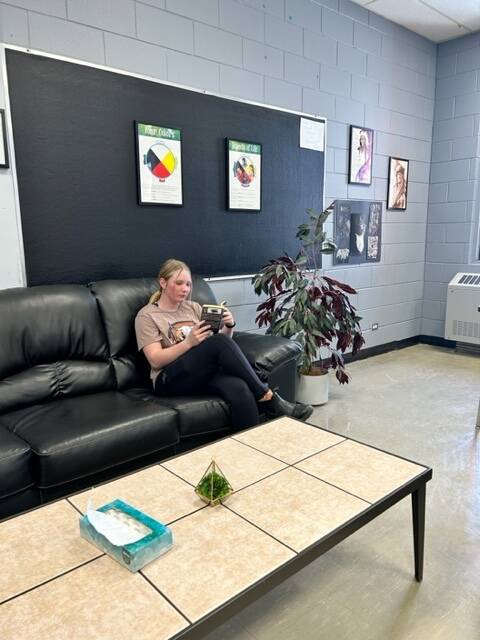
A student relaxes on the couch in the wellness room at Birtle Collegiate. (Submitted)
“We’re going to have those challenges, and we are going to have those low days,” she said. “But here’s what we can do to help ourselves — here’s who you can access help from.”
» mleybourne@brandonsun.com
» Twitter: @miraleybourne
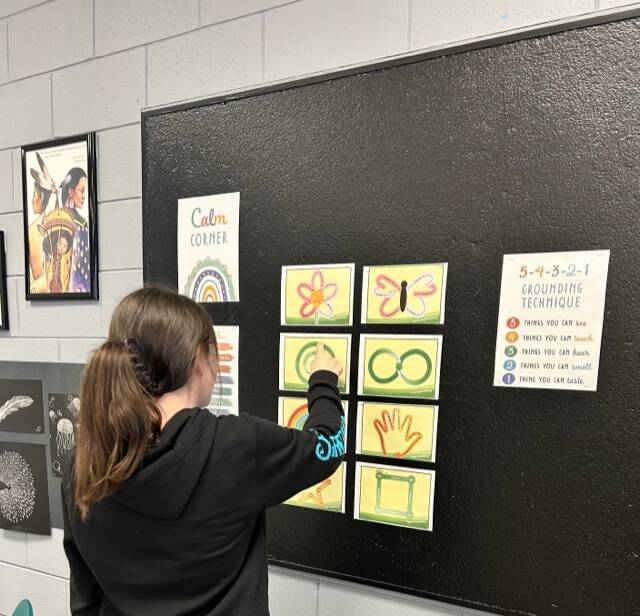
LEFT: A student reviews mental health grounding tips at the “Calm Corner” of the wellness room at Birtle Collegiate. RIGHT: A student relaxes on the couch in Birtle Collegiate’s wellness room.
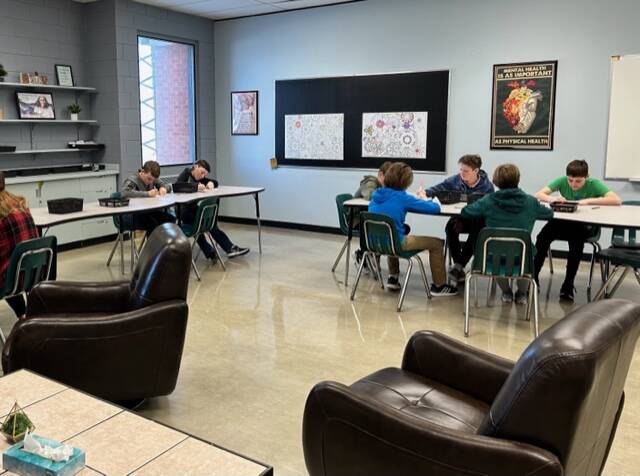
Students relax in the wellness room at Birtle Collegiate. (Submitted photos)