
Parks Canada promotes animal safety
Advertisement
Read this article for free:
or
Already have an account? Log in here »
We need your support!
Local journalism needs your support!
As we navigate through unprecedented times, our journalists are working harder than ever to bring you the latest local updates to keep you safe and informed.
Now, more than ever, we need your support.
Starting at $15.99 plus taxes every four weeks you can access your Brandon Sun online and full access to all content as it appears on our website.
Subscribe Nowor call circulation directly at (204) 727-0527.
Your pledge helps to ensure we provide the news that matters most to your community!
To continue reading, please subscribe:
Add Brandon Sun access to your Free Press subscription for only an additional
$1 for the first 4 weeks*
*Your next subscription payment will increase by $1.00 and you will be charged $20.00 plus GST for four weeks. After four weeks, your payment will increase to $24.00 plus GST every four weeks.
Read unlimited articles for free today:
or
Already have an account? Log in here »
Hey there, time traveller!
This article was published 27/04/2023 (1104 days ago), so information in it may no longer be current.
With bears in Riding Mountain National Park and other parts of western Manitoba waking up from their winter slumbers, the park is encouraging people to educate themselves on how to be bear smart.
Parks Canada estimates there are around 800 to 1,000 bears in the park, although it’s hard to tally the exact number through traditional methods of counting from the air due to leaf cover and how well the animals blend into the environment. Instead, the park currently uses an estimate based on the available habitat types and use methods from other jurisdictions that have worked to determine bear populations.
Spring, especially late April, is the time when bears are waking up and tentatively surveying their environments, said Tim Sallows, Riding Mountain National Park’s human wildlife interaction expert.
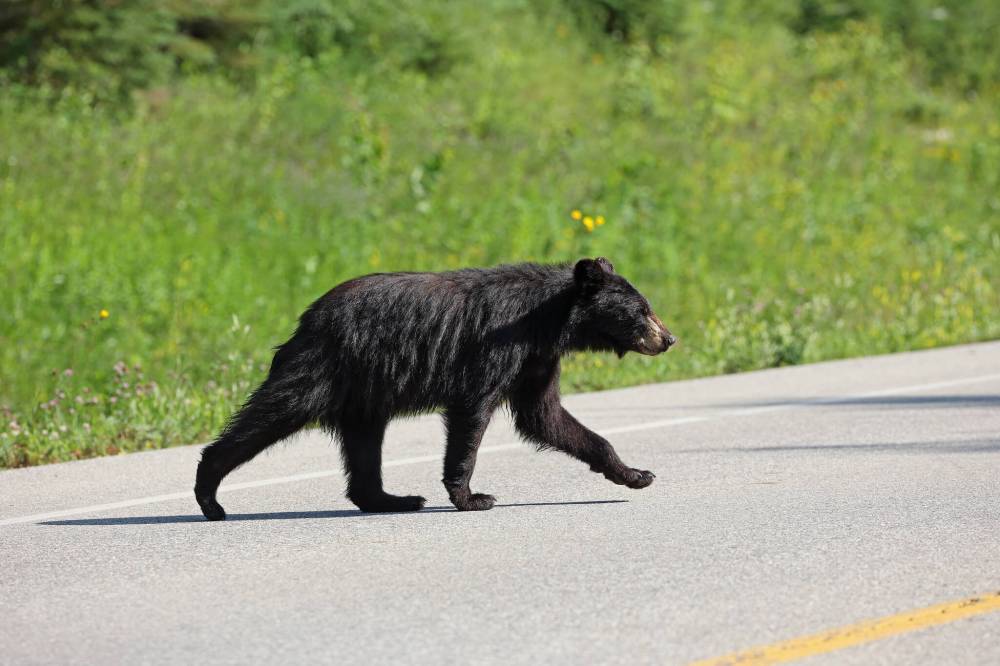
A black bear crosses Highway 10 in Riding Mountain National Park. (File)
“They just kind of hang around their dens for a little while to make sure the weather is going to co-operate.”
As soon as the buds come out on the aspen trees, people can see bears up in the trees a lot more than on the ground.
“Until there’s some food around, they’ll just hang around their dens,” Sallows said.
In North America, Ursus americanus — more commonly known as the black bear — ranged throughout forested areas across most of the continent, from Alaska to Mexico, in the past. Now, they exist in about 60 per cent of that range.
Black bears evolved in forest ecosystems, so their current distribution is largely influenced by the amount of undisturbed forest cover available to them.
While the number of bear sightings in Riding Mountain National Park remains high, resource conservation staff are reminding the public of the possibility of meeting bears in the park. And while the number of encounters between bears and people has risen since 2021, the Parks Canada website says no aggressive behaviour has been reported.
“It’s best to just observe bears from afar,” Sallows said. “They certainly don’t want to deal with people.”
The best ways to remain bear safe include not leaving out food, coolers, garbage or other highly scented items when spending time in the park. Such items can attract the attention of curious bears looking for easy meals.
Visitors should also stay on established hiking trails, hike during daylight hours, make plenty of noise and travel in groups. Cyclists and runners are more at risk of sneaking up on a bear because they are quiet and fast, Parks Canada says.
It’s important to be alert in areas that bears frequent, such as berry patches. Watching for bear signs, like fresh tracks, droppings or evidence of digging, is also a good idea.
Children should stay with adults and dogs must be kept on a leash at all times, or left at home when visiting the park. Roaming dogs can be perceived as threats to bears or their cubs. If visitors come across any dead animals, their best course of action is to leave the area immediately and report it to park staff.
If someone actually comes face to face with a bear, there are a few things to keep in mind, Sallows said. It’s important to remain calm and speak to the bear in a low voice. Do not alarm it with loud noises or sudden movement. Back away slowly, and never run. Make yourself large, and stay in a group, picking up small children. Don’t drop backpacks, as wearing them can provide protection in the event of an attack. And finally, it’s important to leave the area or take a detour. Climbing trees is not recommended.
If a motorist spots a bear, they are encouraged to drive by slowly instead of stopping, to warn other motorists by flashing their hazard lights, and to be extra cautious, as sight lines are often blocked by improperly parked cars. Motorists should also be on the lookout for distracted drivers, people crossing the highway, or the possibility of a bear daring out in front of them.
For people who choose to stop, it’s recommended they pull over safely without blocking the driving lane, observe and photograph bears from the safety of their vehicle and ensure they are not crowding, approaching or obstructing a bear’s pathway. Bears should never be fed or enticed to come closer.
Although they’re not spotted nearly as often as bears, mountain lions or cougars have been seen in the park, but there is no official population. Rather, they often travel through Riding Mountain, Sallows said. In recent years, two cougars were killed outside the park boundary. Given the increase in sightings, Parks Canada says it’s likely only a matter of time before sightings of cougar kittens occur.
Cougars prefer to hunt relatively small game, with the largest they regularly prey on being deer. While the park does have a large deer population, it is spread out. Cougars will most likely be attracted to areas where deer congregate in large numbers, and the escarpment of the park may offer good habitat. The relatively larger deer population in Wasagaming and Onanole may also prove attractive to a cougar in the future, Parks Canada said.
Still, there’s no reason to worry about cougars as long as people are being cautious, Sallows said.
“If you’re lucky enough to see one, just keep your distance and do what you usually do around an animal — just make yourself look big. Try to look intimidating to the animals and they’ll usually stay away. Keep your dogs on leash for sure.”
The most dangerous animal in the park, Sallows said, is a cow (female) moose with its calf.
Wild boars, which have been plaguing the province and are categorized by the Manitoba government as invasive swine, having been brought over from Europe in the 1980s, are fortunately not a problem in Riding Mountain National Park, Sallows said.
“They’re certainly on our doorstep, but we don’t have any yet.”
Parks Canada recommends all wildlife encounters be reported to park staff. The dispatch number is 1-877-852-3100.
» mleybourne@brandonsun.com
» Twitter: @miraleybourne