
Book promotes understanding
Advertisement
Read this article for free:
or
Already have an account? Log in here »
We need your support!
Local journalism needs your support!
As we navigate through unprecedented times, our journalists are working harder than ever to bring you the latest local updates to keep you safe and informed.
Now, more than ever, we need your support.
Starting at $15.99 plus taxes every four weeks you can access your Brandon Sun online and full access to all content as it appears on our website.
Subscribe Nowor call circulation directly at (204) 727-0527.
Your pledge helps to ensure we provide the news that matters most to your community!
To continue reading, please subscribe:
Add Brandon Sun access to your Free Press subscription for only an additional
$1 for the first 4 weeks*
- Enjoy unlimited reading on brandonsun.com
- Read the Brandon Sun E-Edition, our digital replica newspaper
*Your next Free Press subscription payment will increase by $1.00 and you will be charged $20.95 plus GST for four weeks. After four weeks, your payment will increase to $24.95 plus GST every four weeks.
Read unlimited articles for free today:
or
Already have an account? Log in here »
Hey there, time traveller!
This article was published 24/08/2023 (1116 days ago), so information in it may no longer be current.
In the year since Valley of the Birdtail: An Indian Reserve, a White Town, and the Road to Reconciliation was published, its authors have travelled around Canada speaking about it. A copy has even made it’s way into the hands of King Charles III.
The book, written by authors Andrew Stobo Sniderman and Douglas Sanderson (Amo Binashii), examines the communities of Rossburn and Waywayseecappo First Nation, located about 150 kilometres northwest of Brandon, and how despite facing similar socio-economic conditions, the two communities have seen very different outcomes.
Rossburn, settled by Ukrainians who fled poverty and persecution in their home country, boasts a family income nearing the national average, with university graduates making up more than one-third of its adult population. By contrast, Waywaseecappo’s average family lives below the national poverty line and fewer than one-third of the adults living here have graduated high school.
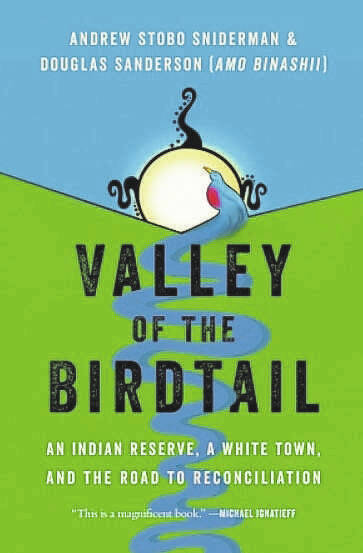
RIGHT: Valley of the Birdtail was published last year. Since then, it has won several awards and has even made its way into the hands of King Charles III. (File)
Valley of the Birdtail was published last year. Since then, it has won several awards and has even made its way into the hands of King Charles III. (File)
With an average of 4.8 out of 5 stars on Amazon, Valley of the Birdtail is ranked #3 in 20th Century Canadian History, #4 in History of Canada in the 20th Century, and #6 in Native Canadian Biographies.
The best seller, which was published by Harper Collins on Aug. 30 of last year, has also won the KOBO Emerging Writer Prize, the John W. Dafoe Book Prize, the OLA Evergreen Award, the Shaughnessy Cohen Prize for Political Writing, and the Stubbendieck Great Plains Distinguished Book Prize. Most recently, Valley of the Birdtail was given the Manitoba Historical Society’s Margaret McWilliams Award for local history.
But far more meaningful to the authors than any accolades and awards is the journey writing and promoting their book has taken them on, Sniderman and Sanderson told the Sun.
The authors spent the last year travelling Canada from coast to coast talking about the book at bookstores and universities, and meeting with teachers, law firms and even judges who have taken an interest in the book’s themes including racism and reconciliation.
“There’s always a few people who make very emotional comments about what the book means to them, and many of these people have never been to Manitoba,” Sniderman said. “A woman said, ‘I am Rossburn. I recognize people from Rossburn in my family,’…so while the story is largely based in Manitoba, it seems to have resonated with people all across the country.”
Although the story is local to the province, Valley of the Birdtail is also a story about Canada, and about the experience of Canadians and their interaction with Indigenous peoples over hundreds of years that is very familiar to many people, Sanderson said.
“It turns out that the geography of a reserve community right next to a small down with a river dividing them is pretty common,” he said. “It’s not particular to Manitoba, and it’s much more universal in that way.”
The Lieutenant Governor of Manitoba, Anita Neville, thought the book important enough to present a copy to King Charles for his coronation.
Educators across the country have responded enthusiastically to the book, which Sniderman said is indicative of then need for resources about Indigenous history and reconciliation.
“They seem like they’re really hungry for resources, not only for themselves, to get the context they want on Indigenous-settler questions, which is on peoples’ minds, but also for their students,” he said.
In light of that, Sniderman and Sanderson will be travelling to Brandon in early October to speak to 250 teacher trainees at Brandon University, who will all be getting a copy of Valley of the Birdtail. Later that week, 500 copies will be distributed to every student in the Faculty of Education of the University of Winnipeg.
“Some of the characters of this story are teachers who went into the classroom with zero understanding of this complicated history, and so it’s very rewarding to think that there’s many hundreds of people now who are just so much better equipped to learn and teach about this,” Sniderman said.
Those who work in the justice system have also gleaned important insight the book shines on issues such as the inequality that exists in Canada between Indigenous and non-Indigenous people.
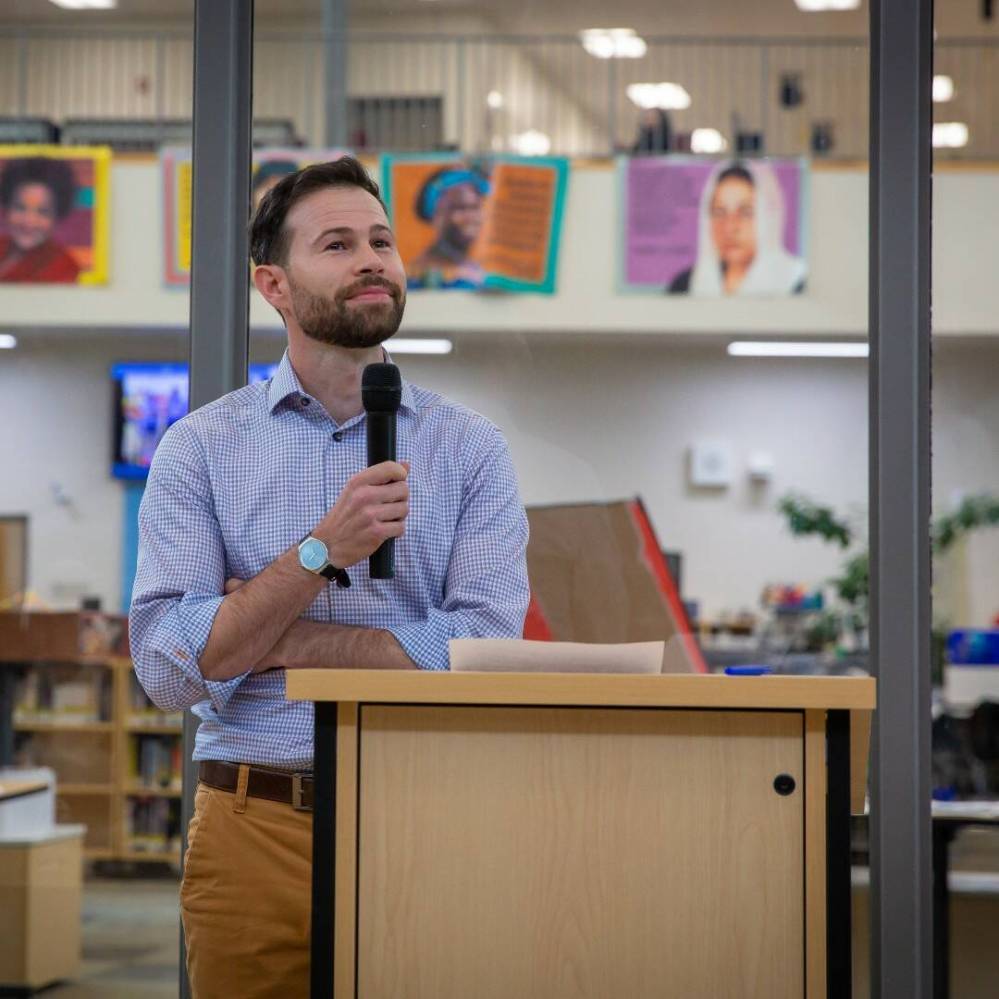
Valley of the Birdtail author Andrew Stobo Sniderman spoke to students of Mandela High School in Calgary, Alta., about the book. (Facebook)
Valley of the Birdtail author Andrew Stobo Sniderman spoke to students of Mandela High School in Calgary, Alta., about the book. (Facebook)
“As it turns out, a lot of people find that relevant to their work, to their lives,” Sniderman said.
And while there is a deep hunger to learn about what happened after Europeans made contact with Indigenous people and how that still affects both Indigenous and non-Indigenous people today, Sniderman said that it’s also important not to lecture people, as they’ll turn away from learning and understanding. It’s why Valley of the Birdtail is less a history book and more a narrative of two communities.
“We’re trying to take seriously the point of view of immigrants and the point of view of Indigenous Canadians, and people are responding to that. We’re not yelling at readers, and we’re not wagging our finger at people, and I think that’s actually what a classroom wants – a book that is capable of taking to the whole classroom and fostering discussion among people,” he said.
And while some of the parts are difficult, they’re all appropriate – and important – for students in Manitoba to understand if they want to make sense of colonization, including residential and day schools. The depths of depravity heard about in the historical accounts from residential school survivors can often be so shocking that, while people believe them, they can’t make any sense of them or learn from them, Sanderson said. That’s why he Sniderman sought to make those lessons accessible with Valley of the Birdtail.
“It puts that residential school experience into an appropriate historical context, which I think many Canadians are still learning. They understand that residential schools happened, but they don’t know why, and they don’t see it within the larger narrative of the Indigenous-settler relationship.”
Ultimately, Sniderman hopes that people will walk away from reading Valley of the Birdtail with a deeper understanding of the history of colonization and its affect on Indigenous and non-Indigenous communities, and a deeper compassion for Indigenous and non-Indigenous people and their respective journeys.
“I hope that we’re building compassion on both sides of the river, and that there’s a little bit more compassion for an older white person who’s slowly learning more, and also building compassion for someone who’s coming from a very dark experience, whose still working out that as well,” he said.
Valley of the Birdtail is available in bookstores and online.
» mleybourne@brandonsun.com
» X: @miraleybourne