
Dress made by Métis artist symbolizes MMIWG
Advertisement
Read this article for free:
or
Already have an account? Log in here »
We need your support!
Local journalism needs your support!
As we navigate through unprecedented times, our journalists are working harder than ever to bring you the latest local updates to keep you safe and informed.
Now, more than ever, we need your support.
Starting at $15.99 plus taxes every four weeks you can access your Brandon Sun online and full access to all content as it appears on our website.
Subscribe Nowor call circulation directly at (204) 727-0527.
Your pledge helps to ensure we provide the news that matters most to your community!
To continue reading, please subscribe:
Add Brandon Sun access to your Free Press subscription for only an additional
$1 for the first 4 weeks*
- Enjoy unlimited reading on brandonsun.com
- Read the Brandon Sun E-Edition, our digital replica newspaper
*Your next Free Press subscription payment will increase by $1.00 and you will be charged $20.95 plus GST for four weeks. After four weeks, your payment will increase to $24.95 plus GST every four weeks.
Read unlimited articles for free today:
or
Already have an account? Log in here »
Hey there, time traveller!
This article was published 28/09/2023 (1087 days ago), so information in it may no longer be current.
When Métis artist and student Amelia Rempel designed a dress representing missing and murdered Indigenous women and girls, she couldn’t help but imagine how she would feel if someone she loved met the same fate.
For her first-year project, worth 100 per cent of her grade at the University of the Arts London Wimbledon in the United Kingdom — where Rempel is studying costume for theatre and screen design — she created a dress imprinted with news articles about murdered and missing Indigenous women and girls (MMIWG).
The dress was topped with a red scarf showing a list of some of the names of women and girls who have been lost.
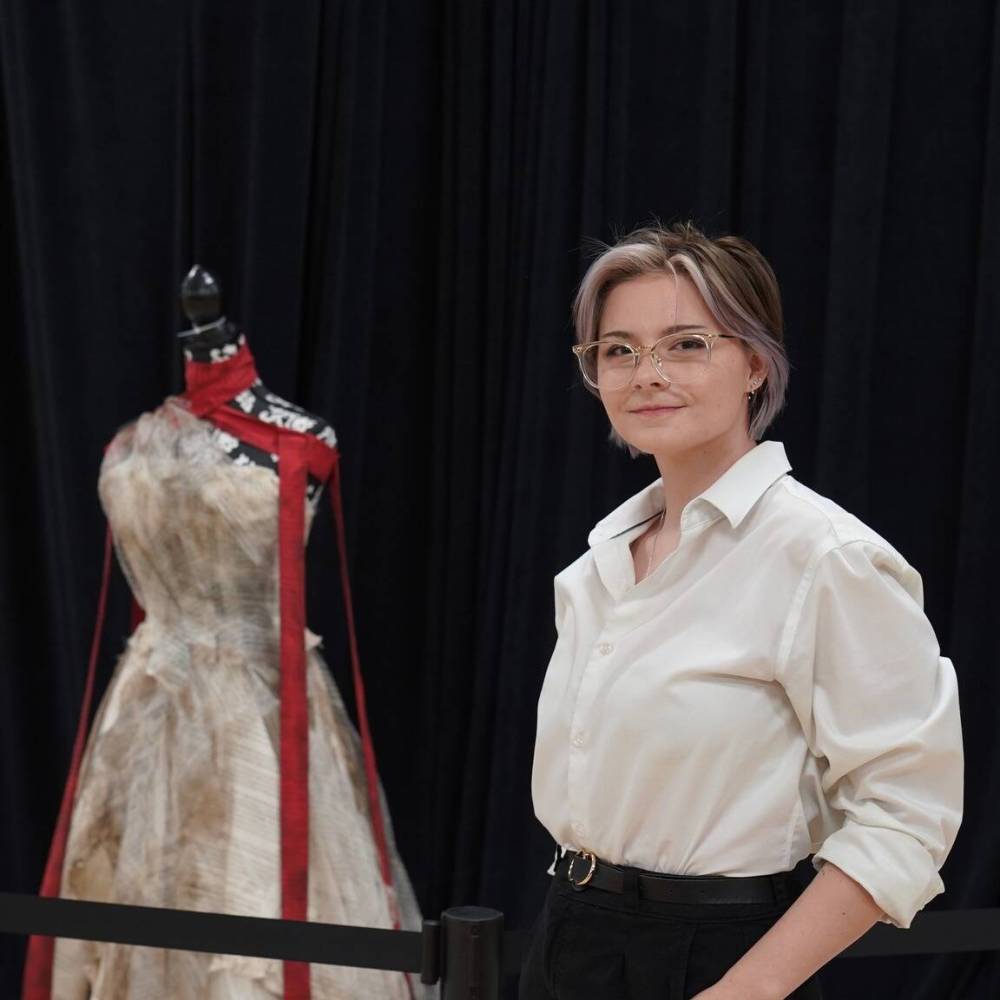
“There is red around her mouth, her neck and her arms, covered in the names and ages of the women that have gone missing, and I didn’t even get a quarter of the way through the list,” Rempel, whose family lives in Dauphin, located 166 kilometres north of Brandon, told the Sun.
“It was names from the late ‘90s, early 2000s … and a lot of them were either in high school or middle school, or some even older women around my mom’s age. And they talked about what their goals were and what they wanted to do,” she said.
The fact that those women and girls never got to achieve their goals or live full lives struck a chord with Rempel, who felt compelled to tell their stories.
“Their stories didn’t deserve to be cut short like that. Nobody deserves to have their stories cut short like that,” she said.
Rempel also wanted to create the dress as a testament to a part of Canadian history – and an ongoing crisis – that is not widely understood or talked about in international circles like London.
“I knew that I had to do something that would push me out of my comfort zone, but was also near and dear to my heart — something that I could pour my heart and soul into,” she said. “It would have to be a piece of Canada that I would have to represent. Unfortunately, it was not one of our good pieces of history. It’s an epidemic that is happening right now.”
A lot of people in London have never heard of residential schools, Rempel came to learn. They aren’t aware of the crisis of MMIWG, for the most part, either. But remaining silent about such issues on a global scale would only allow them to get worse, Rempel believes.
“If we just ignore it, it’s not going to go away. It’s like a wound. It’ll fester. We need to acknowledge it,” she said. “These are human lives that are being allowed to be taken, and [some people] won’t acknowledge it because they’re so ashamed of Canada’s history.”
Indigenous women represent 10 per cent of the total population of missing women in Canada, even though, according to the 2011 National Household Survey, Indigenous women made up only four per cent of the total female popluation in Canada.
Between 1980 and 2014, Indigenous women made up 16 per cent of police-reported female homicide cases in Canada. And while, since 1991 the number of murdered non-Indigenous women has declined, the number of murdered Indigenous women has remained relatively stable, accounting for an increasing proportion of Indigenous female homicide victims.
The eyes of Manitobans and Canadians have been on political leaders and the family members of Marcedes Myran and Morgan Harris, whose remains are believed to be in the Prairie Green and Brady landfills near Winnipeg.
The Manitoba Métis Federation (MMF), the National Government of the Red River Métis and it’s affiliate, the Infinity Women Secretariat (IWS), says the work Rempel has done to draw attention to MMIWG is outstanding.
“When the dress was brought to our attention, we knew it was a powerful symbol that needed to be shared,” said Frances Chartrand, vice-president of the MMF’s northwest region, where Rempel lives when she is not at school. “The creativity and heart Amelia put into the making of this dress clearly show in the results, and I know our region is very proud of all her accomplishments, present and future.”
The MMF was so proud of Rempel’s design that it joined with the IWS and the Northwest Métis Council to purchase the dress, presenting Rempel with a $20,000 cheque to help with her school fees.
The reaction to her dress has been unreal, Rempel said.
“Honestly, it’s really crazy. I didn’t think this would happen,” she said. “I wanted to give it as a gift, because I felt like this was a way that I could help spread awareness and help my people and all Indigenous people, as well.”
Rempel had an emotional response when she was asked if the groups could purchase her dress, especially because her tuition at school isn’t cheap, and her family has been wondering how they could cover those costs.
“We were actually at the point where we didn’t know if I was even going to go back after this summer,” she said.
After having a conversation with MMF President David Chartrand, who insisted she take the payment for the dress, Rempel was flooded with relief.
“I just thought that presenting this dress was a good gift … and he kept insisting that he buy the dress — the words that he said to me made my mom, my dad and I tear up — he said, ‘I’m going to accept your gift, but you need to accept my gift. How about I buy it off of you for $20,000?’ I just immediately started sobbing,” she said.
The money will go directly to Rempel’s tuition and accommodation. She’s now secured a flat in London where she’ll be able to live for the duration of her studies as well.
The support Rempel has received from the MMF has also helped to soothe some of the nerves she felt while designing the dress, which stemmed from a belief that she wasn’t worthy to take on such a project. This was only exacerbated when some of her British peers told her she didn’t have a right to do the project based on the colour of her skin.
“When I started this project, I was frequently told by people in my classroom that I was not Métis enough, or not Indigenous enough to do this project. They said I was too white,” she said.
Although their words hurt and gave Rempel pause, her parents, who she calls her biggest advocates, both told her to keep going with her project.
“My mom and my dad have always been supportive. They’ve never once doubted me. When I doubt myself, they would be there to support me,” she said.
To see that same pride and support from the MMF has meant the world to Rempel, she added.
“To see that come to life with other people watching what I’ve done and what I’m making … it’s crazy,” she said.
The dress will be displayed at local, regional, and national MMF gatherings to help raise awareness of MMIWG and will become a part of the collection at the Red River Métis Heritage Centre in Winnipeg, scheduled to open in 2026.
When a young Red River Métis woman creates something powerful that elevates an important cause for all women, it is imperative that it is brought into greater focus, said Anita Campbell, a spokesperson for the WIS.
“We regularly provide programming and education to our women about how to identify, prevent and address gender-based violence. Our goal is to end violence against women in our nation, and all nations. Until that day comes, we honour Amelia’s outstanding efforts to ensure no one forgets our lost sisters,” Campbell said.
Along with creating the dress, Amelia envisioned a persona — a woman who would wear the dress — who wanders the world observing instances of violence against women, with the dress becoming heavier and heavier after each instance.
“As a Red River Métis woman, I read the stories of these women who have gone missing or been taken and I connected with them. I connected with their stories, their dreams, and their aspirations,” Rempel said. “I hope their stories will reach the people of the world. Their names should not and will not be forgotten.”
» mleybourne@brandonsun.com
» X: @miraleybourne