
Survey to test public’s knowledge of aquatic invasive species
Advertisement
Read this article for free:
or
Already have an account? Log in here »
We need your support!
Local journalism needs your support!
As we navigate through unprecedented times, our journalists are working harder than ever to bring you the latest local updates to keep you safe and informed.
Now, more than ever, we need your support.
Starting at $15.99 plus taxes every four weeks you can access your Brandon Sun online and full access to all content as it appears on our website.
Subscribe Nowor call circulation directly at (204) 727-0527.
Your pledge helps to ensure we provide the news that matters most to your community!
To continue reading, please subscribe:
Add Brandon Sun access to your Free Press subscription for only an additional
$1 for the first 4 weeks*
- Enjoy unlimited reading on brandonsun.com
- Read the Brandon Sun E-Edition, our digital replica newspaper
*Your next Free Press subscription payment will increase by $1.00 and you will be charged $20.95 plus GST for four weeks. After four weeks, your payment will increase to $24.95 plus GST every four weeks.
Read unlimited articles for free today:
or
Already have an account? Log in here »
Hey there, time traveller!
This article was published 28/09/2023 (1080 days ago), so information in it may no longer be current.
Now that summer — the main boating season in Manitoba — is drawing to a close, people worried about aquatic invasive species like zebra mussels wonder how much attention the public has paid to new education campaigns intended to help keep the province’s lakes clean.
As the Sun previously reported, boaters in Riding Mountain National Park, located 99 kilometres north of Brandon, were subject to new rules this boating season after zebra mussel environmental DNA was found in Clear Lake in January. Throughout the boating season, to receive a permit to use a trailered vessel in Clear Lake operators couldn’t use their crafts in any other body of water and had to pass an initial inspection before June 15.
In addition, the Province of Manitoba ramped up its annual watercraft inspection program with inspection stations across Manitoba — including additions to Minnedosa, Grand Rapids and Ste. Rose du Lac — placed in response to growing zebra mussels and other aquatic invasive species (AIS) threats in western Manitoba.
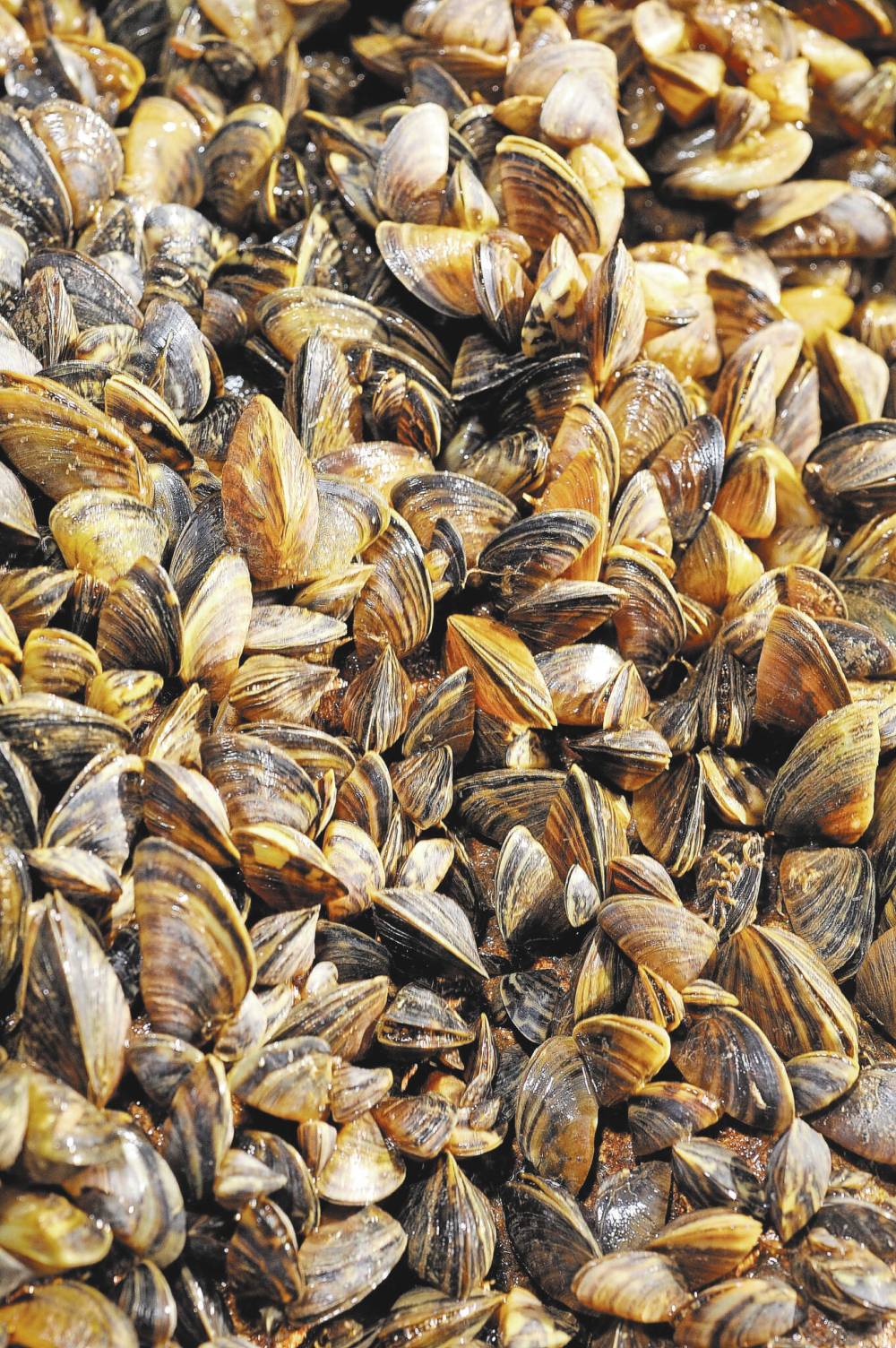
A rock is covered with zebra mussels, which originated in Russia and have spread across North America. If Manitoba's government wants to keep lakes open in the face of the threat this invasive species poses, it's going to need to provide more resources such as inspection and decontamination stations. (File)
Now, chair of the Pelican Lake Healthy Lake Committee Traver Maguire wonders how much the public really knows about AIS like zebra mussels. To find out, the committee has launched a survey to test people’s knowledge on AIS as a whole and zebra mussels more specifically.
“It’s really to gauge people’s level of knowledge on AIS, and how diverse it is,” Maguire told the Sun. “I want to know if they even know what the [AIS] acronym means.”
The Healthy Lake Committee’s website says that AIS are fish, invertebrate or plant species that have been introduced into a new aquatic environment outside of their natural range. Once introduced, AIS populations can grow in their new environments quickly due to a lack of natural predators. As a result, they can out compete and harm native species and can even alter habitats to make them inhospitable to native species.
Zebra mussels are small freshwater mussels that originated from the lakes of southern Russia and Ukraine and were introduced to many countries worldwide in 1980. They’re transferred from one body of water to another by boat or other watercrafts if they’re not cleaned properly.
Daryl Kines, chairperson of the Riding Mountain Biosphere Reserve, said zebra mussels have become more of a problem in Manitoba over the last few years, and are the “poster child” of AIS.
“If we do things that prevent zebra mussels from invading a water body, that will do the same things for other species,” he said.
The AIS survey by the Pelican Lake Healthy Lakes Committee will go over a lot of information on zebra mussels and other AIS, but will also ask some more thought-provoking questions, Kines said.
“It’s hopefully going to give us a better handle on it,” he said. “There’s two sort of main points — where are they finding their information [on AIS] and what’s the best method to inform the public?”
Kines and Maguire believe the level of knowledge and awareness in lake-goers varies from lake to lake, so both are hoping that the survey will point towards a direction that any future AIS education campaigns will need to go.
In general, there are three groups of people regarding AIS knowledge — those who are aware of AIS, those who aren’t, and those people who just don’t care, Kines said.
“They just want to do what they want to do,” Kines said. “You’ve got the people who might avoid going by a watercraft inspection station, either by looking up the hours [they operate] that are online … or they just take a different route.”
Kines suggests that those who ignore AIS rules and regulations should be subject to harsher fines.
“The province does have really good invasive species laws,” he said. “So, these individuals that just want to do what they want to do — nothing is going to stop them from doing it. You can’t really protect yourself from them, the only thing you can do is to make sure they pay a heavy penalty if they decide not to obey the law.”
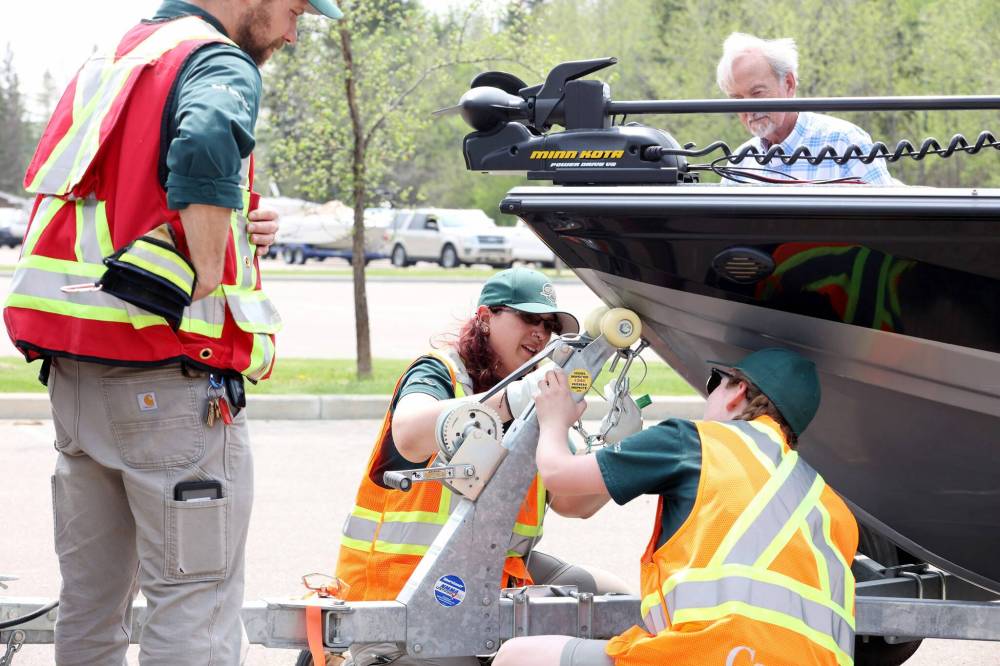
Parks Canada staff are shown inspecting and tagging boats in Wasagaming last year as part of an effort to keep zebra mussels out of Clear Lake. So far this year, Clear Lake water samples have tested negative for the presence of the invasive species. (File)
However, the province hasn’t done everything it could to stop the spread of AIS in Manitoba waters, Kines believes.
“There’s only two [watercraft inspection stations in the area] … because it’s very expensive. And in general, it’s not a concern for most of the public … so we’ve tried to do something on that front to bring a lot more awareness to the fore.”
Kines and Maguire hope that enough people share their survey on social media on different websites so that the amount of people taking it can be as large as possible.
Maguire also hopes that people will take their concerns about AIS in Manitoba lakes a step further.
“Call your MLAs,” he said. “Talk about it.”
The Riding Mountain Biosphere Reserve has applied for funding from Fisheries and Oceans Canada’s AIS Prevention Fund. The fund supports projects and partnerships that help prevent the introduction and spread of aquatic invasive species and provides $8.75 million over five years to create such partnerships. The application process is now closed.
“The basic idea is to improve awareness by first supporting and enhancing the provincial program, and then inspecting watercraft before they launch at a location,” Kines said. “And then, providing locations where a watercraft could be decontaminated if they were deemed to be high risk without having to travel a long distance.”
The Government of Canada’s website says that applicants will be informed about the status of their proposals by Nov. 30.
» mleybourne@brandonsun.com
» X: @miraleybourne