
Rainy May brings much-needed moisture
Advertisement
Read this article for free:
or
Already have an account? Log in here »
We need your support!
Local journalism needs your support!
As we navigate through unprecedented times, our journalists are working harder than ever to bring you the latest local updates to keep you safe and informed.
Now, more than ever, we need your support.
Starting at $15.99 plus taxes every four weeks you can access your Brandon Sun online and full access to all content as it appears on our website.
Subscribe Nowor call circulation directly at (204) 727-0527.
Your pledge helps to ensure we provide the news that matters most to your community!
To continue reading, please subscribe:
Add Brandon Sun access to your Free Press subscription for only an additional
$1 for the first 4 weeks*
*Your next subscription payment will increase by $1.00 and you will be charged $20.00 plus GST for four weeks. After four weeks, your payment will increase to $24.00 plus GST every four weeks.
Read unlimited articles for free today:
or
Already have an account? Log in here »
Hey there, time traveller!
This article was published 06/06/2024 (665 days ago), so information in it may no longer be current.
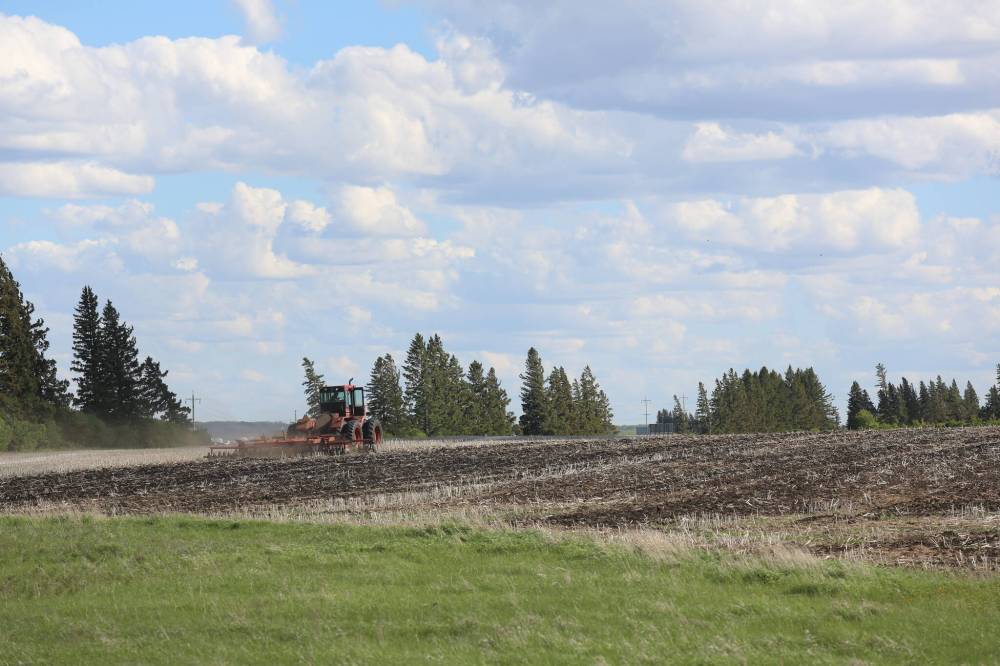
Southern Manitoba has seen a significantly higher amount of rain this May than average, temporarily slowing down seeding progress.
The province is currently 64 per cent seeded with the five-year average being 75 per cent. The May 24 weather system is particularly to blame, bringing more than 30 millimetres of rain and snow to parts of southwest Manitoba, according to crop specialist Dennis Lange from Manitoba Agriculture.
“With that rain we got last week, it’s just kind of shut things down for a few days … Rain and snow was present in a lot of different areas in the west. So that moisture has kind of stopped seeding for the time being. We’re hoping over the next few days, we’re going to get some more drying weather,” he said.
The 30-year precipitation average for Brandon in May is 64.5 millimetres according to Environment and Climate Change Canada’s 1991-2020 climate normals. Manitoba had 103.6 millimetres as of May 29. In May 2023, only 20 millimetres of precipitation was recorded. However, 2022 was another year of significant precipitation, coming in at 125 millimetres by the end of the month.
The Brandon A weather station reported almost two centimetres of snow on May 24. The snow was a surprise, but Lange said it wouldn’t have a negative affect on crops.
“It has snowed, but … after probably a day or so it all melted off … And the crops that we’re just starting to see the emergence of like cereals, anything that’s in the ground, it’s fine because that’s just going to go in as moisture,” Lange said.
“Right now, there are no frost-sensitive crops that are really poking through yet.”
Lange doesn’t expect the snow to be problematic to the crops and even went so far as to suggest it might actually be beneficial, referencing a snowfall that occurred in early May 2004. He noted that was a particularly good year for canola crops.
The significant rainfall this May might turn out to be a good thing, too. Southwest Manitoba has faced many periods of drought since at least 2018, according to the North American Drought Monitor. Warning preparedness meteorologist Natalie Hasell said that the moisture was definitely needed.
“The fact that we’ve had a lot of precipitation this last month, almost double what you would normally have in the month of May, might mean that the drought conditions are alleviated,” she said.
Some areas between Regina and Dauphin, where the April drought monitor indicated some severe and moderate drought, were shown to have received 85 to 150 per cent of the average precipitation on the Agriculture and AgriFood Canada agroclimate map.
Kendall Heise, a canola, wheat, and soybean producer near Isabella, said that while the rain and snow from this May delayed his seeding slightly, the moisture was welcome.
“It delayed us a little bit but moisture is needed, so we put up with that. It’s not unusual. We’ve been through a few years, we’ve had very little rain in the spring and so this is back to more normal.”
Heise pointed out that while there had been some drought, it has varied greatly depending on location in the province.
“Western Manitoba last year, you could travel just a few miles and go from people who have got very little rainfall to people who have gotten excessive rainfall.
“I know our neighbours to the west along the Assiniboine Valley, they went most of the growing season last year with an inch of rainfall and yet you go to the east of us, and two hail storms and multiple-inch rain storm events … yet there probably wouldn’t be 25 or 30 miles different in those locations,” he said.
For now, there is no consensus on where the summer is headed for growers. Both Lange and Hasell said that it was too early to predict what summer precipitation levels, or weather systems, will consist of.
» cmcconkey@brandonsun.com