Rain fails to stop Swan Lake powwow
Advertisement
Read this article for free:
or
Already have an account? Log in here »
We need your support!
Local journalism needs your support!
As we navigate through unprecedented times, our journalists are working harder than ever to bring you the latest local updates to keep you safe and informed.
Now, more than ever, we need your support.
Starting at $15.99 plus taxes every four weeks you can access your Brandon Sun online and full access to all content as it appears on our website.
Subscribe Nowor call circulation directly at (204) 727-0527.
Your pledge helps to ensure we provide the news that matters most to your community!
To continue reading, please subscribe:
Add Brandon Sun access to your Free Press subscription for only an additional
$1 for the first 4 weeks*
- Enjoy unlimited reading on brandonsun.com
- Read the Brandon Sun E-Edition, our digital replica newspaper
*Your next Free Press subscription payment will increase by $1.00 and you will be charged $20.95 plus GST for four weeks. After four weeks, your payment will increase to $24.95 plus GST every four weeks.
Read unlimited articles for free today:
or
Already have an account? Log in here »
Hey there, time traveller!
This article was published 11/07/2024 (826 days ago), so information in it may no longer be current.
SWAN LAKE FIRST NATION — After the first grand entry of the First Nation’s annual powwow had to be postponed due to rain on June 28, they quickly got back on schedule the next day to enjoy a weekend full of community connection and celebration.
Vice-president of the powwow committee Wanda McKinney-Cameron said that even though it was not heavily raining at the time the grand entry was planned to begin, the ground was still too saturated. The regalia and moccasins that Indigenous dancers wear at powwows, which can be generations old, would have been damaged by the mud and water.
“We’re going to run a little walk-in bingo this evening, keep the people that are camping and community members, giving them something to do throughout the evening,” McKinney-Cameron said on Friday, June 28.
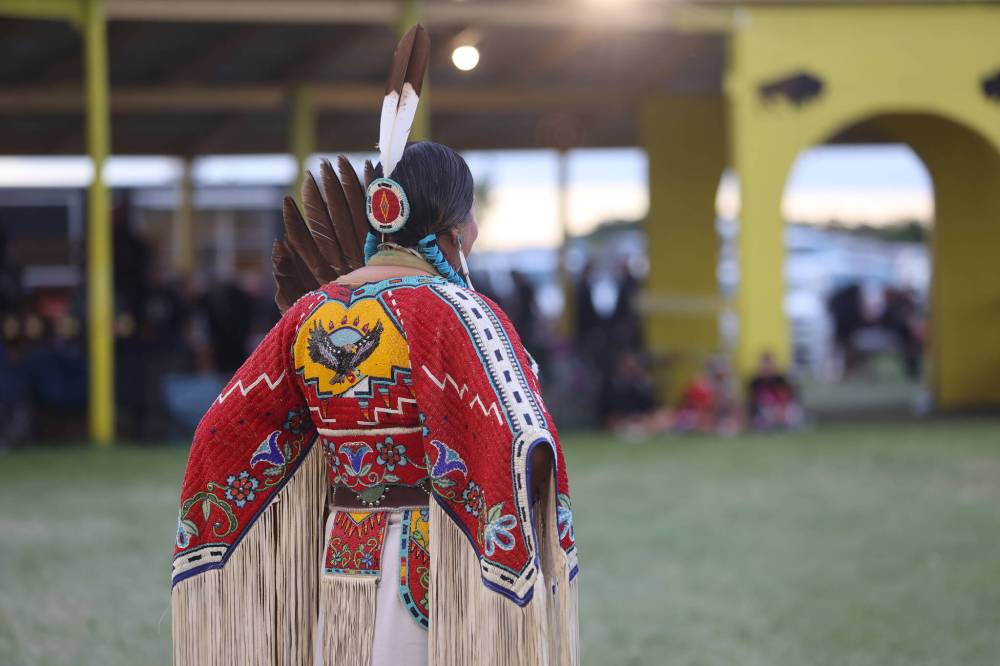
Houston Kay and his family were some of the people already setting up camp that Friday night. He built a fire while his family sat in nearby lawn chairs playing UNO!
“I am bummed out that I can’t dance, a little sad. But other than that, I think it’s a good turnout to see how many campers or how many people that came from far,” he said.
Kay is a grass dancer who had already been to one powwow this season. He said that one was even wetter. Kay was nervous to dance the next day, but also excited.
“As soon as I get out there I know I’m just going to feel right at home.”
Although Friday’s dancing was rescheduled due to the weather, the Swan Lake Singers drum circle performed anyway. As they began to play, people gravitated towards the drums to watch and listen.
Like Houston Kay’s family, Tawnee Flett and her family went to the Swan Lake powwow grounds on Friday to set up and get ready for the next morning. Flett had five children dancing that weekend — two grass dancers, one boys’ traditional, and two jingle dress dancers.
“Somebody told us it was cancelled and we were on our way, and we just ended up wanting to come anyway, just to have it set up like this so we’ll be ready for tomorrow … We’re so excited, even though it’s raining. We’re going to make the best of it — the kids are having fun, it’s all fun,” she said.
With the conditions of the powwow grounds having improved overnight, McKinney-Cameron said organizers integrated Friday’s program into Saturday’s. She said that it didn’t seem like the rain affected attendance at all. Food trucks began to run out of stock on Saturday, and by Sunday many of them were fully out. McKinney-Cameron said that roughly 1,000 people attended the powwow at some point during the weekend.
The grounds were packed on Sunday night. RVs and tents lined the field surrounding the powwow circle. Surrounding the circle, rows of lawn chairs were full of people.
On Sunday, emcee Bill Taylor announced that day’s grand entry would start precisely at 7 p.m. Just before, elder Alice McKinney walked to the wooden steps below the emcee booth. She said a prayer to the Creator without a microphone, eyes lifted to the sky while turning a cigarette over in her left hand.
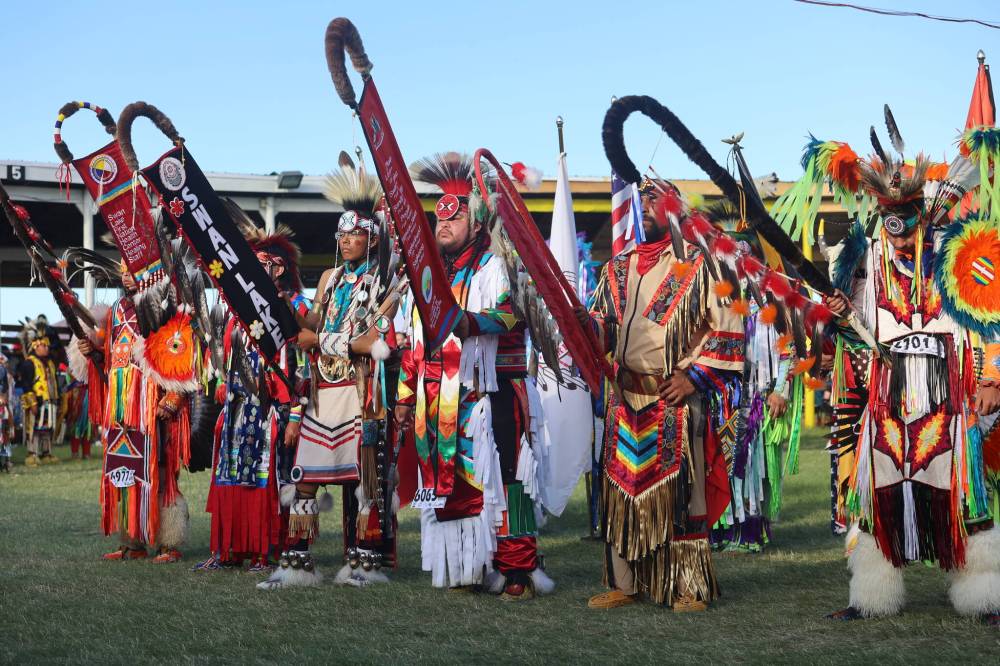
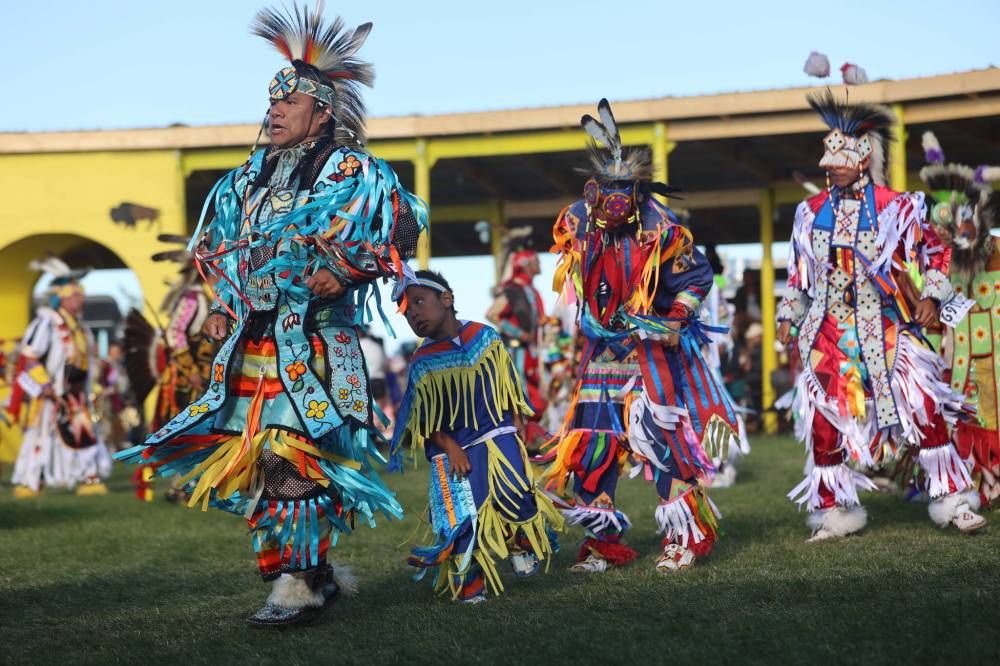
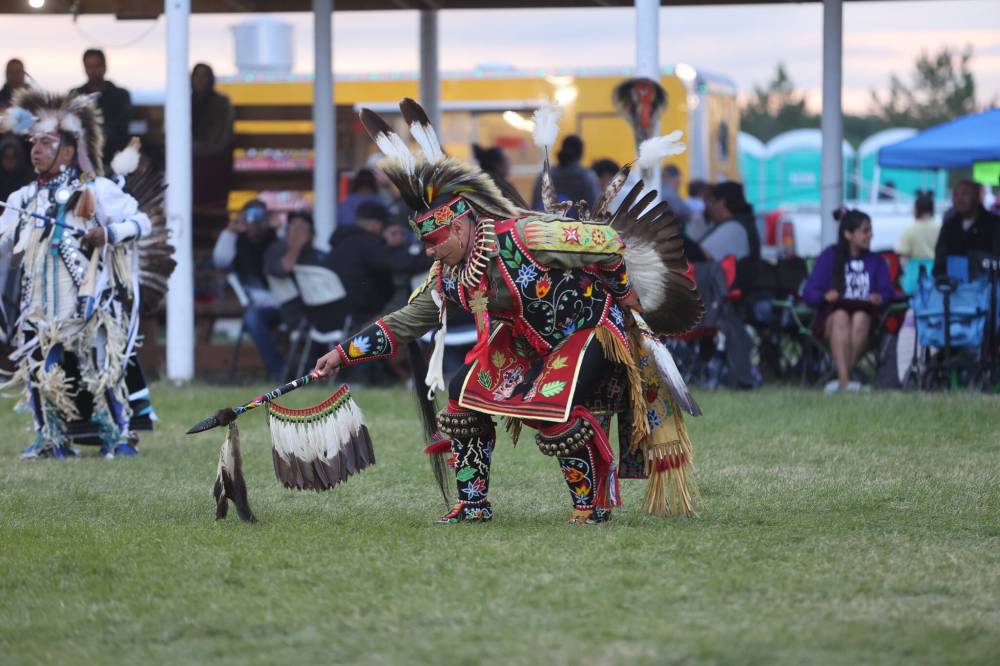
The entry began right after. Men in regalia entered the circle first carrying eagle staffs, an Indigenous equivalent to flags. There was a staff for Swan Lake First Nation, all Treaty 1 nations, as well as the Swan Lake health centre healing staff.
After the dancers of all the different age groups and categories entered the circle, the staffs were ceremonially lowered to represent the end of the powwow, athough there was still dancing to be done.
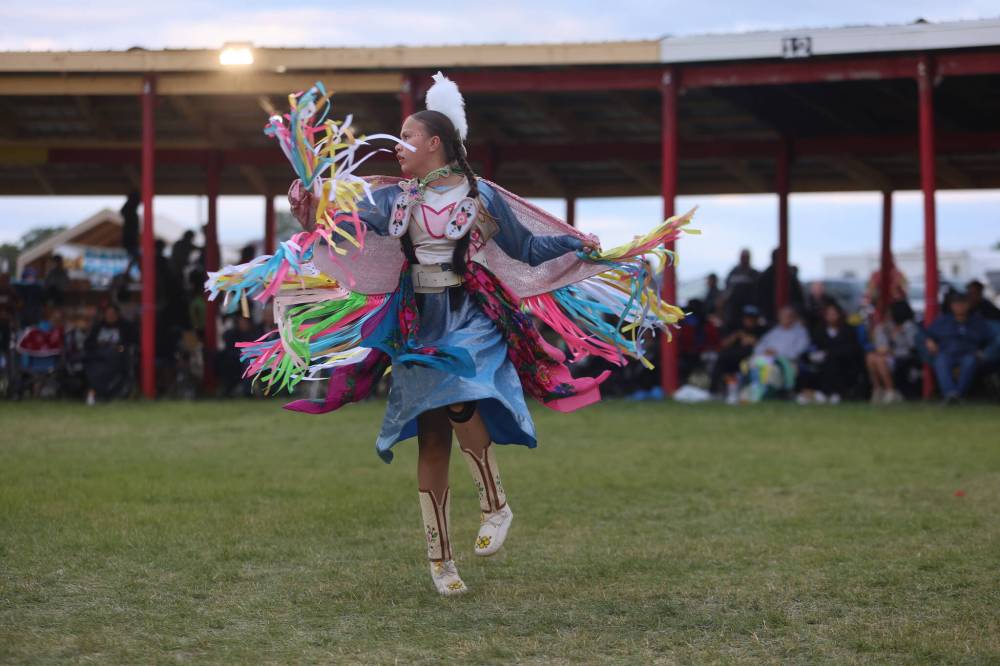
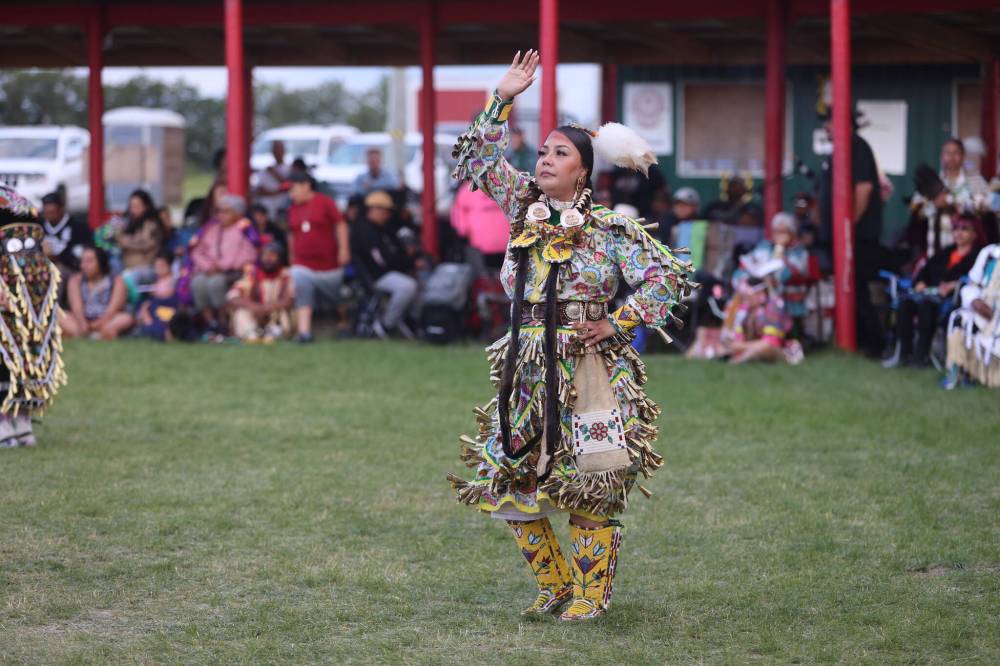
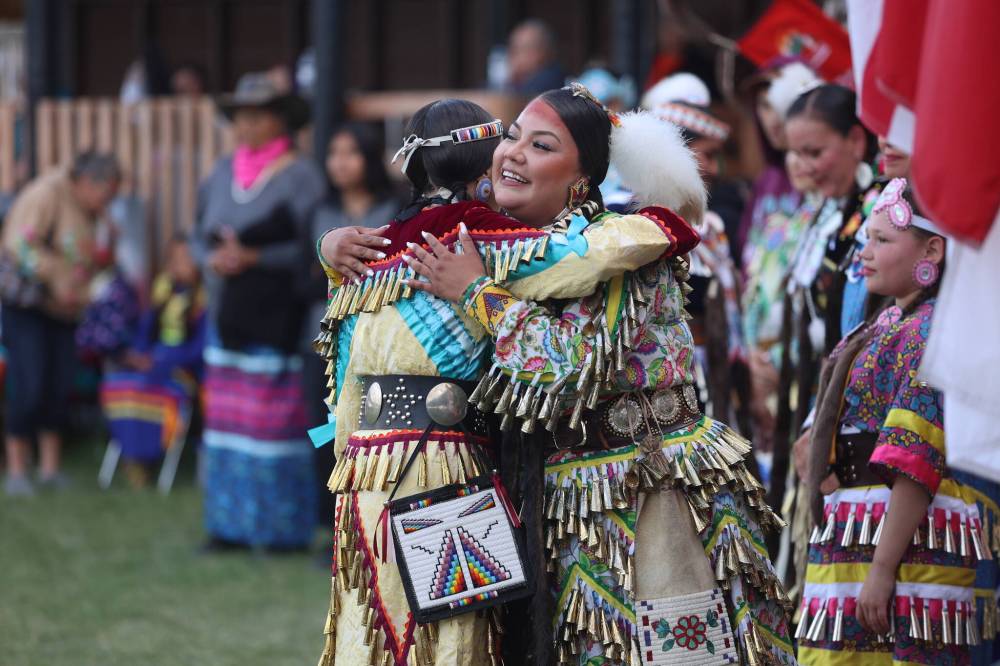
Women’s jingle dancers were first. Judges stood in the middle of the circle while the women performed. After each round, a smaller and smaller number of women were selected until there were only six in the final. The dancers hugged and shook hands after every round.
During the final round, Ashleigh Bonaise was selected as the winner. First prize was a denim jacket adorned with flowers on the arms, which she accepted and hung over her arm before re-entering the circle to finish dancing.
“I’ve had some hardships in the past few years where I stopped dancing, so this is my first summer back full time. I’m just going wherever the wind takes me … This is where my heart belongs. This is my calling,” she said.
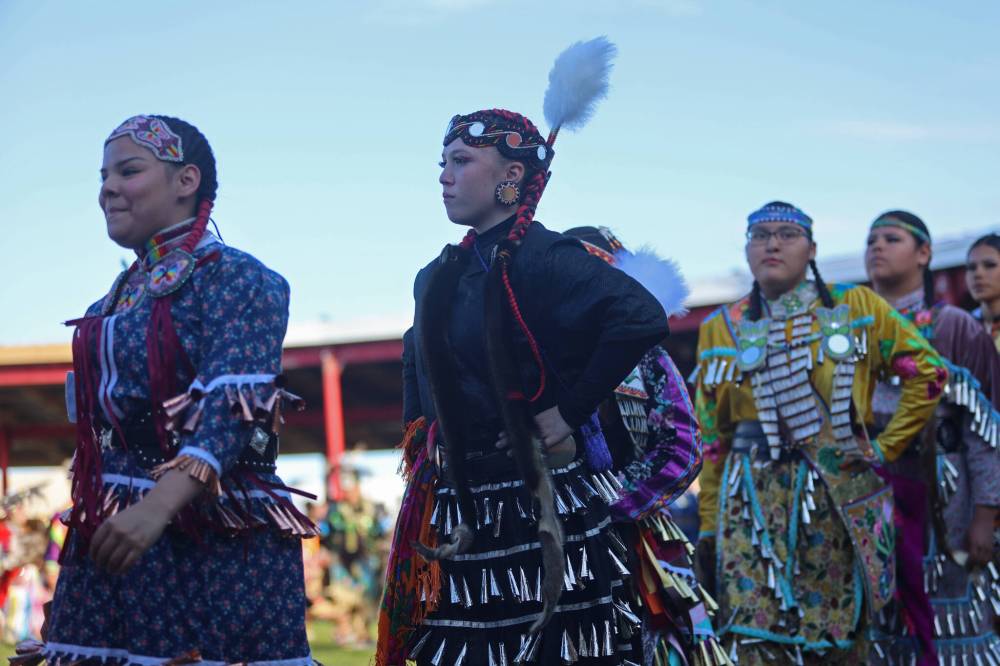
Jingle is thought of as a healing dance. Bill Taylor said that negativity is repelled by each of the cones and the sounds they make. The women’s dresses are often customized to represent their individuality, much like Talia Martin’s.
Martin is from Swan Lake First Nation and lives on the reserve. She’s going away for the summer so this will be the only powwow she’ll be able to attend. Her jingle dress is primarily black, with orange, red and yellow details and beading.
“I got it all gifted for me from my elders, so everything you see on me is gifted or custom made for me. They’re my spirit colours, so it’s really, really important that I keep that to me and make sure that I show everyone how proud I am to dance,” Martin said.
She said that spirit colours represent who you are, and sometimes represent things like birthdays, culture, or ethinicity, like Cree or Ojibwe. They can also be familial.
“They make me feel proud to wear them as they’re so bright, and they’re the colours given to me and passed on to me that I feel like it makes me unique,” she said.
It is dancing with girls like Martin that makes Bonaise feel so at home.
“It feels good to be out there with all these women. I grew up with them. Some of them are older, some of them are younger. I’m kind of getting to that age where younger girls look up to me just how I did for the women that are older than I am,” Bonaise said.
McKinney-Cameron said that most powwows in the province are open to the public and don’t have admission fees, making for an unforgettable experience where people can learn about and appreciate Indigenous culture.
»cmcconkey@brandonsun.com