
A ribbiting tale of frogs and toads
Advertisement
Read this article for free:
or
Already have an account? Log in here »
We need your support!
Local journalism needs your support!
As we navigate through unprecedented times, our journalists are working harder than ever to bring you the latest local updates to keep you safe and informed.
Now, more than ever, we need your support.
Starting at $15.99 plus taxes every four weeks you can access your Brandon Sun online and full access to all content as it appears on our website.
Subscribe Nowor call circulation directly at (204) 727-0527.
Your pledge helps to ensure we provide the news that matters most to your community!
To continue reading, please subscribe:
Add Brandon Sun access to your Free Press subscription for only an additional
$1 for the first 4 weeks*
- Enjoy unlimited reading on brandonsun.com
- Read the Brandon Sun E-Edition, our digital replica newspaper
*Your next Free Press subscription payment will increase by $1.00 and you will be charged $20.95 plus GST for four weeks. After four weeks, your payment will increase to $24.95 plus GST every four weeks.
Read unlimited articles for free today:
or
Already have an account? Log in here »
Hey there, time traveller!
This article was published 08/08/2024 (639 days ago), so information in it may no longer be current.
NOTE: The column title is “Moments in Riding Mountain.” The headline is separate.
ONANOLE — It’s baby frog season, which means, if you are like me, that mowing the lawn has moved from a mere annoyance to an event fraught with tension. I must be getting soft in my old age as I cringe at the thought of the lawn mower being a mobile guillotine, slicing up its amphibian victims indiscriminately.
As a result, I spend an inordinate amount of time shooing the baby frogs out of the way or avoiding them entirely by cutting around them. Midway through the process, the lawn has a distinct ragged look to it, with well-groomed patches interspersed with lank frog-rich areas.
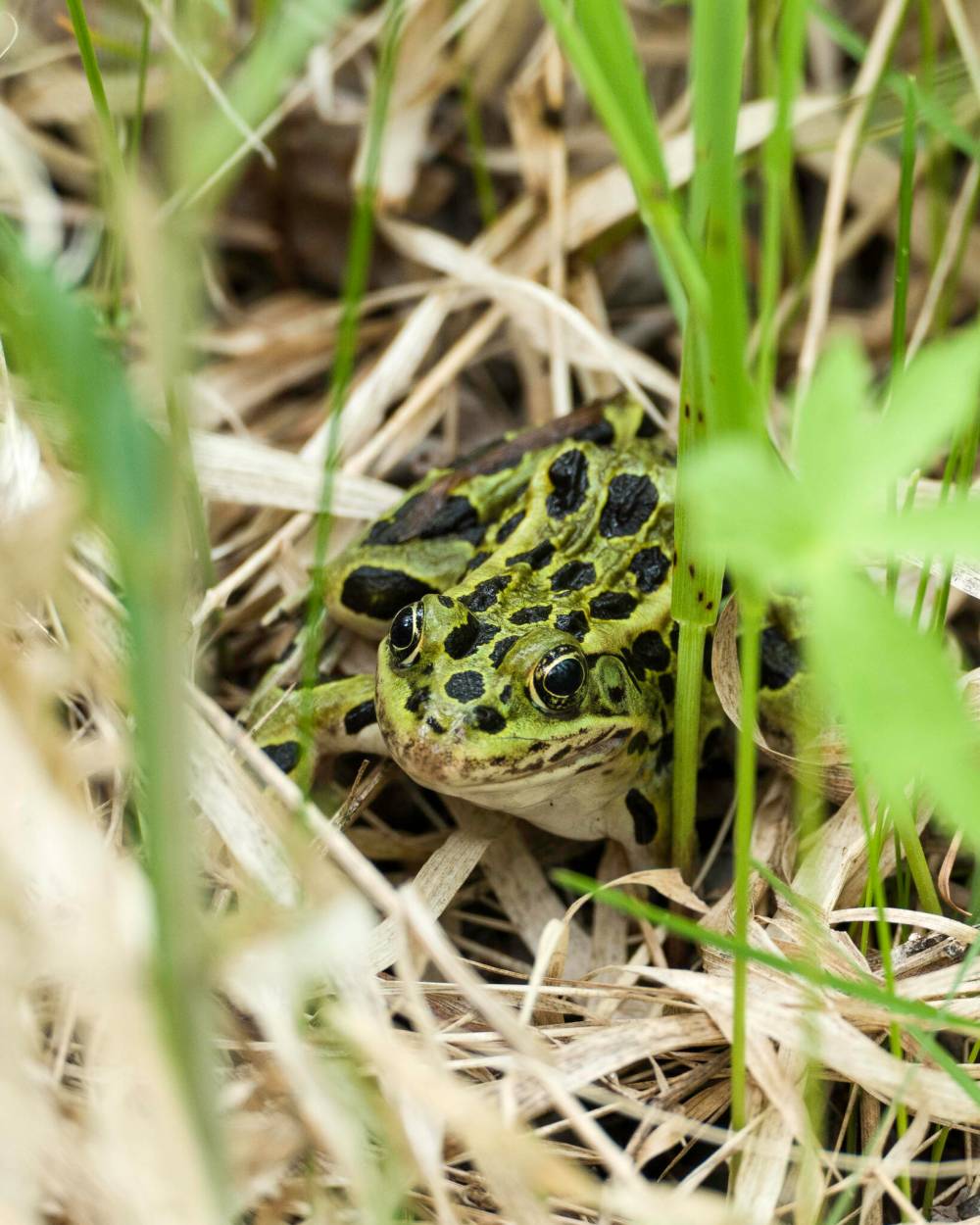
A spotted frog hides in the brush near Riding Mountain National Park in this file image. (The Brandon Sun)
I find frogs relatively easy to wrangle, so the lawn ends up getting mowed eventually, hopefully with few casualties. Admittedly, I don’t look too hard in the grass when I am done, for fear of what I might see.
On a related note, we just got back from a visit to Newfoundland. Historically, Newfoundland was not home to any reptiles nor amphibians due to the isolation from the mainland created by the Strait of Belle Isle.
In relatively recent times, though, several frog and snake species have been introduced to the island, whether intentionally or by accident. Like many introductions into novel territory, these non-native species are either going to die out, or else they will thrive.
For American toads, the cold and wet climate of western Newfoundland seems to be to their liking. We were camping in Gros Mourne National Park and were amazed to see hundreds of American toads living their best lives.
Toads, in general, are funny creatures. They are highly uncoordinated, seemingly too fat to hop, yet their stubby legs mean walking appears just as awkward for them. In short, they appear to be a convenient snack, waiting to be eaten by even the most inept predator.
Their superpower, however, is that they are mildly poisonous. Their “warts” are glands which exude a chemical which makes them unpalatable to many predators, although the poison isn’t strong enough to kill. And speaking from experience, they also “pee” a lot when you pick them up, making them even less attractive.
Their other superpower is that they can reproduce like crazy. Toads lay their eggs in long strands, with up to 7,000 eggs in a single, long, slimy ribbon.
In our recent interactions with them, the toads generally avoided us, preferring to stick to the lush undergrowth of the forest. During the night, though, they occasionally bounced off the outside of the tent, apparently attracted to the slugs that were busy coating our tent with their slime.
I haven’t seen that many toads in recent times, so I really enjoyed their company. Yes, they are warty and slightly creepy looking, but their positives easily outweighed these negatives.
Toads are the ultimate garden custodian. They don’t eat your plants, but boy do they like to eat slugs and other garden pests. I was tempted to bring some back with us for just that reason, but Rae said that a toad in the carry-on luggage would likely be frowned upon.
Which brings us full circle to the local front. I have previously reported, ad nauseum, that our local toads are facing some difficulties. The resident Canadian toad population crashed in the 1970s and has yet to recover.
However, this spring I was amazed to hear a large number of toads calling this spring near McCreary. A while back I wrote that several people reported having seen a toad in RMNP, near the Agassiz ski hill, so I went on the hunt to find one in the same area.
I was skunked, but on the way out of the park, near the McCreary Golf Course, I heard the distinct burr call of a toad. Then I heard another, and another. It turns out that the ditches, dugouts, and sloughs along Highway 361 between the Park and McCreary are full of toads.
Interestingly, these are American toads, rather than the native Canadian toads. You may be wondering how the two types of toads differ. The Canadian toads apologize for keeping you up all night with their calls, of course. Just kidding.
First off, the two toads are the same species, but are considered to be different sub-species. The easiest way to tell the difference is through their calls. American toads have a “sweeter” trill, while the Canadian toad sounds like an air compressor rattling away. There can also be some differences in colouration, but in general they pretty much look the same.
The switch from one species to another is intriguing. Historically, American toads were found east of Lake Winnipeg, while Canadian toads were primarily found in the drier areas of Manitoba, including the aspen parkland and dry prairies of the southwest.
It appears that American toads are now moving into the area, perhaps filling in the ecological vacuum left by the Canadian toads. Time will only tell whether this is a permanent and long-lasting trend, but in the meantime, I would be happy to hear about your recent encounters with toads.
» Ken Kingdon lives in the heart of the Riding Mountain Biosphere Reserve, in Onanole. Send him a text at (204) 848.5020 if you have wildlife stories to share.