
International Peace Garden reopens its conservatory
Advertisement
Read this article for free:
or
Already have an account? Log in here »
We need your support!
Local journalism needs your support!
As we navigate through unprecedented times, our journalists are working harder than ever to bring you the latest local updates to keep you safe and informed.
Now, more than ever, we need your support.
Starting at $15.99 plus taxes every four weeks you can access your Brandon Sun online and full access to all content as it appears on our website.
Subscribe Nowor call circulation directly at (204) 727-0527.
Your pledge helps to ensure we provide the news that matters most to your community!
To continue reading, please subscribe:
Add Brandon Sun access to your Free Press subscription for only an additional
$1 for the first 4 weeks*
*Your next subscription payment will increase by $1.00 and you will be charged $20.00 plus GST for four weeks. After four weeks, your payment will increase to $24.00 plus GST every four weeks.
Read unlimited articles for free today:
or
Already have an account? Log in here »
Hey there, time traveller!
This article was published 22/08/2024 (621 days ago), so information in it may no longer be current.
BOISSEVAIN — The one-of-a-kind succulent and cacti collection was the star of the show during the grand re-opening weekend of the International Peace Garden’s renowned Conservatory building on Aug. 10, following a major renovation.
Among the myriads of attractions in the International Peace Garden, the Conservatory is “one of the newest and most-visited buildings” on site. The main reason for that is the fact that the Conservatory houses the world’s largest privately owned collection of cacti and succulents.
Currently, Don Vitko’s collection, which is comprised of 5,500 plants, requires not only specific conditions but also a lot of space to hold and show.
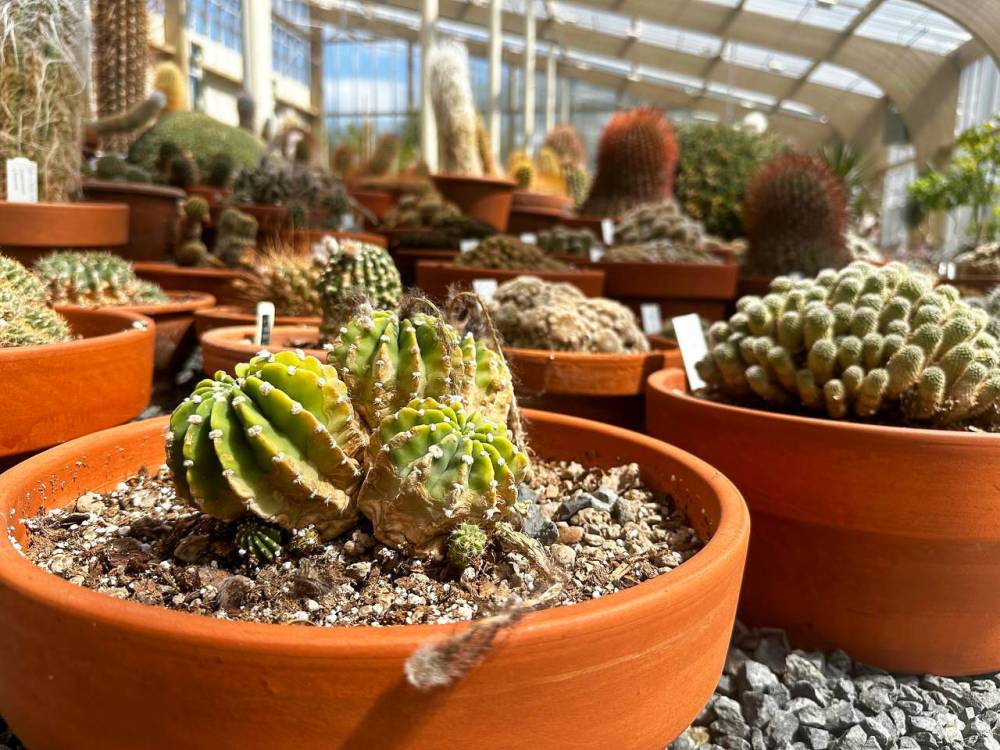
While the approximate number of those who visited the Peace Gareen for the opening weekend was not available by press time, the crowded parking lot and bustling activity in the garden indicated a significant turnout. On the opening day, the entrance hall was abuzz with activity as attendees explored various attractions before reaching the Conservatory’s main exhibit.
Kids and adults had a chance to unleash their imagination and creativity by painting the stones with all sorts of patterns and pictures. For shopping fans, several vendors presented the creations of their craftsmanship.
A group of people gathered near one of these outlets, looking at the goods on the counter: various products, including jewelry made of distinct types of wood. In the flow of the group’s small talk, the merchant asked members of the group where they were from.
“I have been to the markets in the garden several times, and I really enjoy this work,” said David Smith, Boissevain resident and craftsman. “You can never know who you can meet here. That is why I always ask people where they are from. And I think it is exciting.”
Upon entering the Conservatory, visitors are greeted with exotic plants not typically found in the prairies of Manitoba and North Dakota. In spacious flowerbeds grow all kinds of succulents, cacti, and other plants that, to the average person’s eye, do not resemble any of the aforementioned vegetation. Near one of the many plantings, Johannes Olwage, the curator of Living Collections, answers visitors’ questions about the plants, their habitats and other peculiarities of the Conservatory’s green inhabitants.
Often these kinds of exhibitions have the plants placed by the regions of their habitat. But the Conservatory organizers in the Peace Garden have chosen an alternative display.
“Before, we had plants in their families, in their genera, and then kind of loosely by continent, and it’s not a very natural way to divide things up,” said Conservatory curator Johannes Olwage. “And we wanted to show how these regions transcend borders because if you’re just talking about a country’s political borders, it doesn’t tell you anything about the ecology.”
By placing plants in this specific way, Conservatory staff can tell a story of how one species can grow on a mountain top and can be found in tropical rainforests at the same time.
The Conservatory allows visitors to experience a journey through various climate zones, including those of Africa and North and South America, with a focus on North American species.
All the present plants in the Conservatory come from a private collection by Don Vitko, who is still involved in acquiring hard-to-find species. However, the organizers emphasize that building a collection is not only about just getting the plant.
“We always want to make sure that we source our plants ethically. So, if you tell us you want to give us a plant, I want to know where you got it. Especially when it is a rare and endangered plant,” Olwage told the Sun.
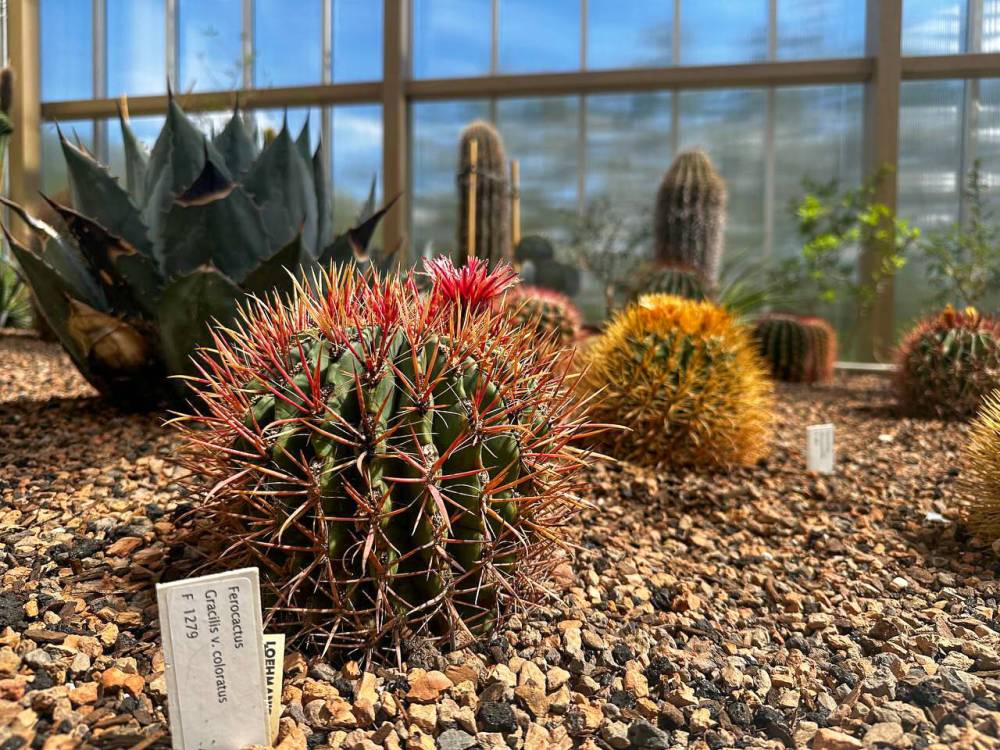
Most of the plants are either seed-grown or sourced from nurseries in Arizona or California. The curator pointed out that over half of the collection belongs to the family of Cactaceae. For reference, all cactus species are CITES Level 2 (CITES is a Conservation International Trade on Endangered Species designation). As such, they are all considered threatened in some way.
The collection’s value is heightened by its rarity and diversity, and the primary challenge for the caretakers is to maintain optimal conditions for plants not suited for the harsh North American prairie winters.
“That’s why this building is such a sigh of relief,” Olwage said. “And we were always worried about it before. The winters are so tough here. You can’t sleep right in the night because of it.”
The Conservatory at the International Peace Garden stands as a testament to dedication and passion for botanical preservation and education. The grand re-opening underscores the successful collaboration between professionals and enthusiasts in the field.
“I have always specifically liked dry land plants, and this is a dry land collection, just the quirkiness of them all,” Olwage said. “I enjoy seeing the changes when they grow, when they’re happy, you know, and they show you that and just the changes through the seasons in here.
The newly re-opened Conservatory is open 9:30 a.m. to 6:30 p.m., seven days a week. The International Peace Garden opens at 8 a.m. and close at 8 p.m. daily.
» sonya100903sf@gmail.com