
Proposed wind turbine project faces blowback
Advertisement
Read this article for free:
or
Already have an account? Log in here »
We need your support!
Local journalism needs your support!
As we navigate through unprecedented times, our journalists are working harder than ever to bring you the latest local updates to keep you safe and informed.
Now, more than ever, we need your support.
Starting at $15.99 plus taxes every four weeks you can access your Brandon Sun online and full access to all content as it appears on our website.
Subscribe Nowor call circulation directly at (204) 727-0527.
Your pledge helps to ensure we provide the news that matters most to your community!
To continue reading, please subscribe:
Add Brandon Sun access to your Free Press subscription for only an additional
$1 for the first 4 weeks*
- Enjoy unlimited reading on brandonsun.com
- Read the Brandon Sun E-Edition, our digital replica newspaper
*Your next Free Press subscription payment will increase by $1.00 and you will be charged $20.95 plus GST for four weeks. After four weeks, your payment will increase to $24.95 plus GST every four weeks.
Read unlimited articles for free today:
or
Already have an account? Log in here »
POLONIA – A farmer took charge of an open house in Polonia last week by initiating a group question period on stage about the ‘Fleury Winds’ project that is proposed to install dozens of wind turbines in the farming community.
Matthew Atkinson, a Neepawa-area farmer, walked on stage during the open house and called for everybody’s attention, stated that he did not believe one-on-one conversations were accountable to the public, and initiated a group format question-and-answer at the meeting of roughly 80 people.
“I don’t think it’s all that transparent,” Atkinson said. “That’s the problem I have with this. It’s not a consultation, it’s a bunch of side questions that are off the record.”
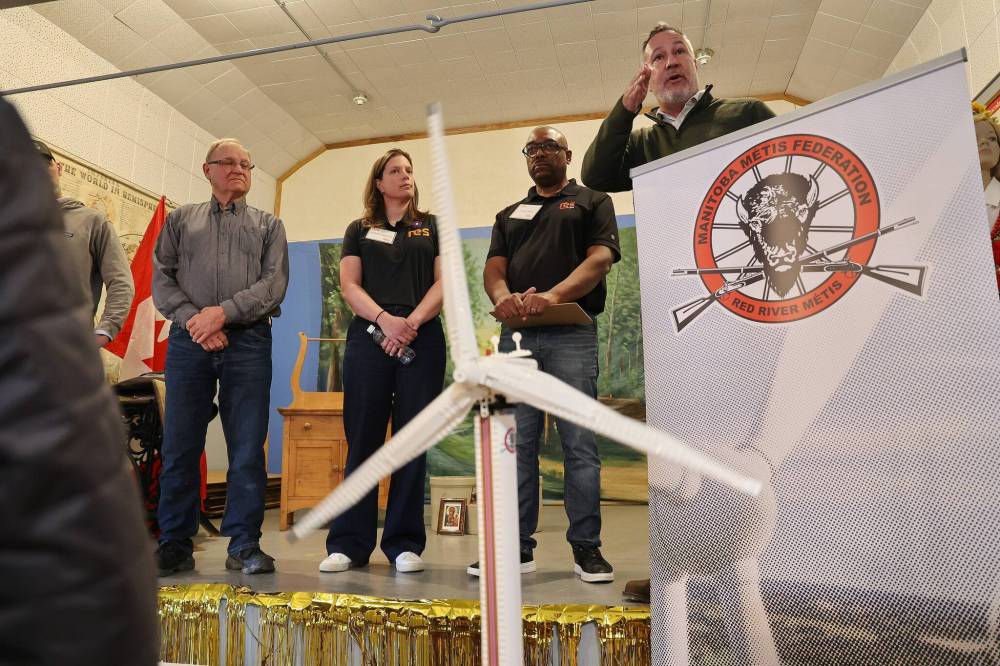
A number of area residents at the meeting told the Sun they don’t want the wind project, arguing it would chew up tax dollars, spoil their view and may hurt property values.
But a representative of the Manitoba Metis Federation, which would be a partner in the project, said it would boost local businesses and family incomes, and provide jobs. The project is expected to employ roughly 300 people during peak construction. It would also be a financial boon for the MMF with long-term impacts.
“This will be a major revenue generator to support our government and support our citizens,” MMF senior economic advisor Lorne Pelletier told the Sun at the open house.
The MMF announced its proposal last week to install 28 to 36 wind turbines in the hills around Polonia that would generate enough electricity to power roughly 59,000 average homes per year. The federation would partner with Renewable Energy Systems, the company that would build the turbines.
The MMF stands to own 51 per cent of the project, and a RES staff member said that the other 49 per cent would be owned by the renewable energy company. Farmers would be paid to supply their land for turbines, and according to a local reeve, the rural municipalities would earn revenue by taxing the turbines.
The project is a proposal to Manitoba Hydro, which is aiming to add infrastructure before 2035 to fulfill its goal of introducing up to 600 megawatts of energy production from wind projects that are Indigenous majority-owned. The utility issued a call for proposals in March for the first phase, which is slated to be up to 200 megawatts of wind power.
The MMF hosted the open house at the Polonia Community Hall the day after the project was announced. Information posters were set up around the room, staff members were on hand from Renewable Energy Systems and MMF, and a map was displayed showing possible locations across 12,000 acres in the community for the turbines.
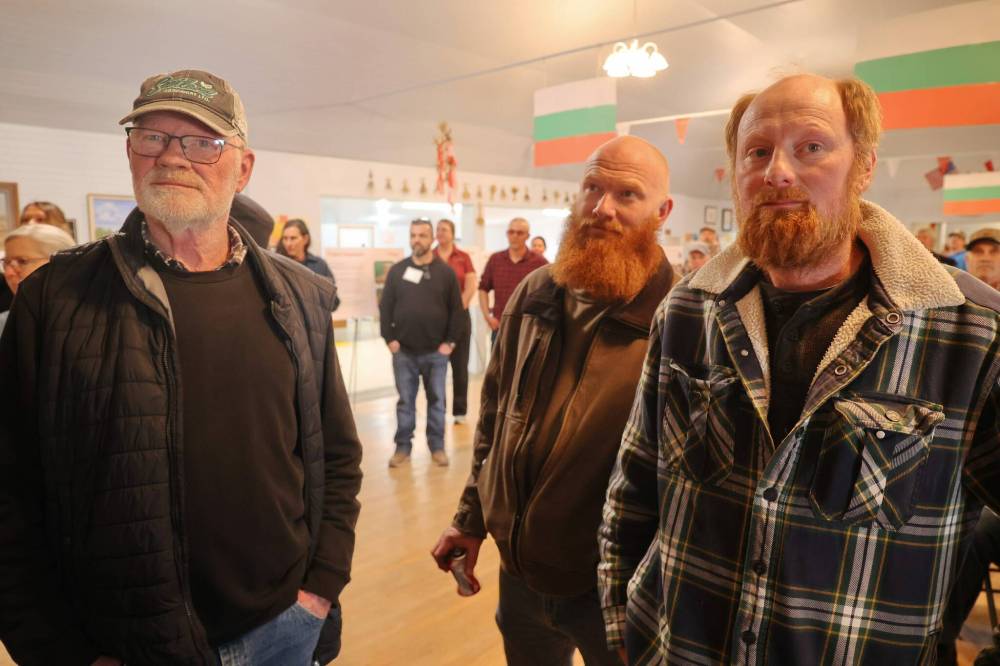
At the meeting, Atkinson drew support from roughly three dozen farmers who were opposed to the turbine project in their neighbourhood. The turbines are proposed to be in the Rural Muncipality of Rosedale and the RM of Minto-Odanah, which had a total of roughly 900 occupied private dwellings as of the most recent 2021 Census.
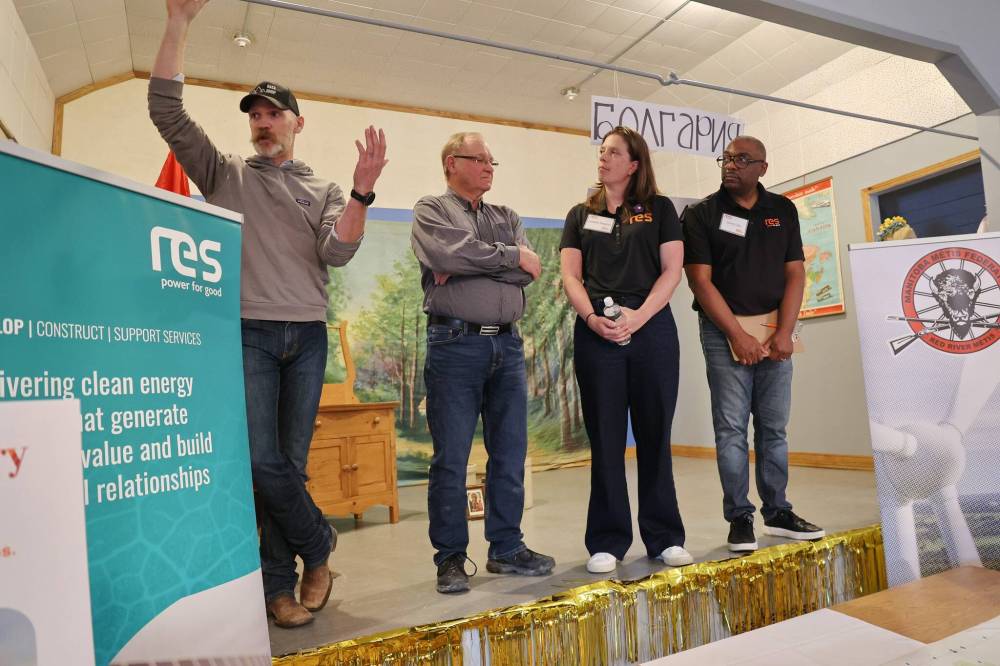
Farmers posed questions around an agreement that had been signed ahead of time with some landowners in the area. Some landowners had agreed to consider turbines on their properties in exchange for financial compensation. The questions were fielded on stage by staff from Renewable Energy Systems (RES) and Pelletier.
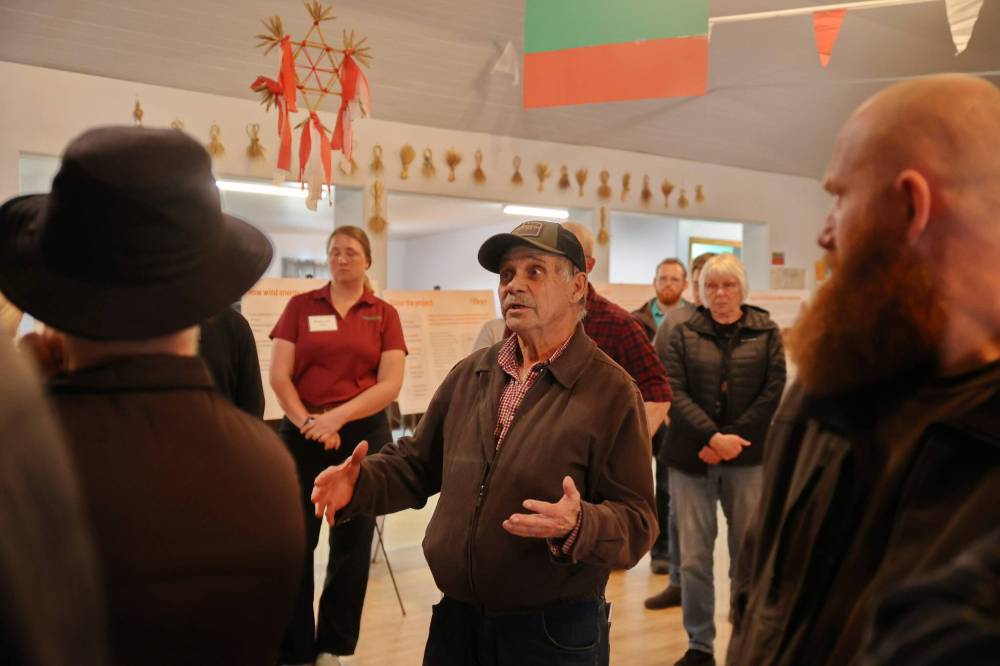
“Take your windmills and go home,” said one farmer, Joe Bialkoski, speaking to staff on stage. “What gives them the right to pollute my view? This is a beautiful place to live, and I want to keep it that way.”
Bialkoski told the MMF and RES representatives to leave and never come back.
At the open house, some residents shared their views about the project during interviews with the Sun.
Atkinson said he felt that answers given to the community were not accountable when they took place in informal discussions, rather than the public group question-and-answer period he initiated.
“I wanted to ensure this did not check a mandatory box for consultation when this was just an informal conversation,” he said. “I wouldn’t define what occurred here as a consultation.”
He said he’s protesting the project in the community because it would change the landscape and impact locals, he said.
“I definitely bias on the side of, ‘I don’t want it in my view,’” Atkinson said. “And I worry about how it affects everybody’s property values.”
Brooke Rossnagel, a beef producer in the RM of Rosedale, where some of the wind turbines are planned, backed Atkinson on the decision to take charge of the open house.
“It had to be done,” Rossnagel said. “There’s no accountability here unless it is brought to a formal meeting. There’s no accountability unless it’s brought to a stage.”
Rossnagel said he didn’t want to see windmills in the countryside.
“This is an absolute eyesore for a pristine area,” Rossnagel said. “For these windmills to come in and pollute our scenery is completely wrong.”
“Were hoping that there’s enough people that will say no to this so that it won’t go through.”
Pelletier said the open-house model was used to start because they felt it was more approachable for residents. Allowing one-on-one conversations around the room is more welcoming for the first meeting, and the MMF thinks it’s a good way to give information.
“We were happy to adjust,” Pelletier told the Sun. “We are going to continue to make ourselves available.”
“For us, it’s going to continue to inform our engagement with the community,” he said. “I think theres a couple different ways to solicit input and feedback from residents.”
Bialkoski, a Polonia resident, said neighbours are being pitted against each other by the payments to put turbines on properties.
“One of my neighbours signed up,” Bialkoski said. “I didn’t. He lives right next to me. We get along … but in the future we might not.”
Bialkoski said major projects like wind turbines affect everyone in the area, and that has potential to impact relationships.
“He allowed it,” Bialkoski said. “Just ‘cause it’s on his property, doesn’t mean it ends there.”
Two property owners who agreed to offer their land as possible turbine sites declined an interview. However, one said that he believes he can do what he wants with his land, and said that the group at the hall may not be represenative of the community’s thoughts as a whole.
John Keizer, a farmer who lives west of Polonia said his issue is that wind turbines are costly. He said that the project is subsidized by tax dollars, costing residents money. He said he believes they will also increase the cost of hydro because the technology is not as efficient at generating electricity using current methods.
“People need to know the reality on this, not just a power and money thing,” Keizer said. “These things have been around for so many years already. There’s so much information on how bad they are. We are not for it at all.”
Pelletier said the Polonia area was chosen for its natural characteristics that make it suitable to service wind power. He explained that existing data was used to confirm this, as well as original research in the past nine months.
“The wind conditions in this area are exceptional,” Pelletier said. “In fact, Manitoba is one of the best in the country for renewable wind development.”
The MMF is operating a research tower in the area and has determined some areas of best conditions, however the plans are subject to change over time and it’s early in the process, Pelletier said.
He said northwesterly winds would help wind power generation, as well as the Manitoba escarpment.
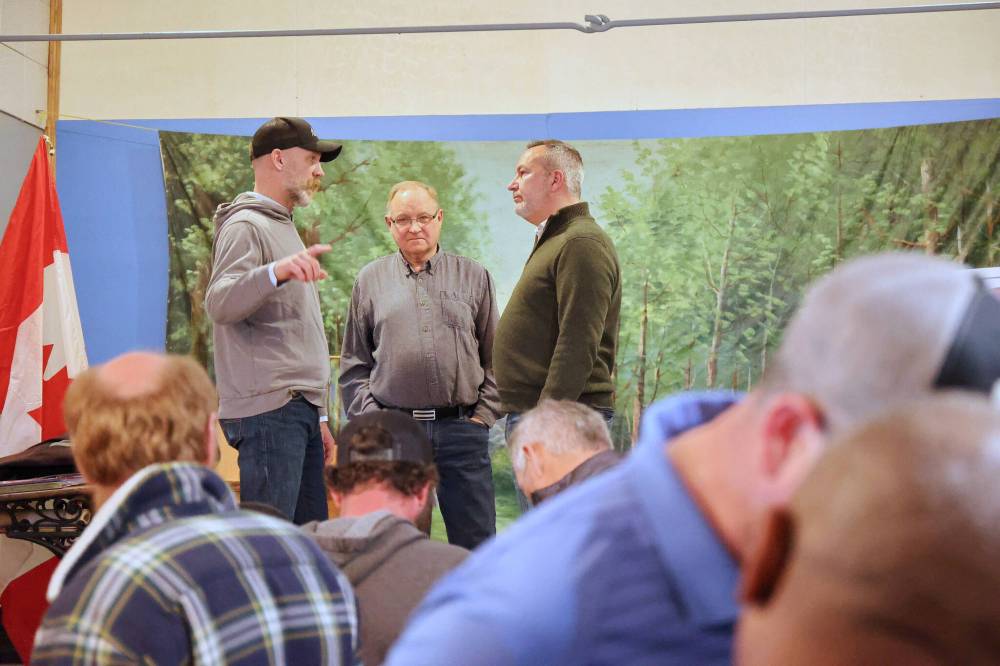
Matthew Atkinson (left), a farmer in the Neepawa area, talks with Manitoba Metis Federation representative Lorne Pelletier after a stage question and answer period last week at the Polonia Community Hall. Atkinson said he wanted to ensure that this open house did not check a mandatory box for consultation on the Fleury Wind wind turbine project that is being proposed in the area because he said it was an informal conversation. (Connor McDowell/The Brandon Sun)
Roughly 40 landowners have signed early options agreements so far, representing roughly 12,000 acres where turbines could be placed, Pelletier said.
The wind turbine project would be in place sometime in 2029 or 2030, a RES staff member told the Sun. It is expected to tie into Neepawa’s sub-station for Manitoba Hydro and to cost about $500 million.
A group of community members against the wind turbines started organizing themselves last week by compiling a list of names and contact info.
Atkinson said he will reach out to government leadership and voice his concerns going forward.
» cmcdowell@brandonsun.com