
Local data now at rural leaders’ fingertips
Advertisement
Read this article for free:
or
Already have an account? Log in here »
We need your support!
Local journalism needs your support!
As we navigate through unprecedented times, our journalists are working harder than ever to bring you the latest local updates to keep you safe and informed.
Now, more than ever, we need your support.
Starting at $15.99 plus taxes every four weeks you can access your Brandon Sun online and full access to all content as it appears on our website.
Subscribe Nowor call circulation directly at (204) 727-0527.
Your pledge helps to ensure we provide the news that matters most to your community!
To continue reading, please subscribe:
Add Brandon Sun access to your Free Press subscription for only an additional
$1 for the first 4 weeks*
- Enjoy unlimited reading on brandonsun.com
- Read the Brandon Sun E-Edition, our digital replica newspaper
*Your next Free Press subscription payment will increase by $1.00 and you will be charged $20.95 plus GST for four weeks. After four weeks, your payment will increase to $24.95 plus GST every four weeks.
Read unlimited articles for free today:
or
Already have an account? Log in here »
The Rural Manitoba Economic Development Corporation has packaged data about 125 rural municipalities and released it into a report this month to provide accessible information about the rural parts of the province.
The report, called the Pulse of Rural Manitoba 2026, compiled several sources of data and designed it to be approachable and usable, said RMED CEO Margot Cathcart. She said one potential use was for rural municipalities to have reinforcement for applications for grant funding.
“You need to be able to justify the ask. Whether it’s an ask of council, or the province or the feds,” she said. “Without it, it puts the community on the hind foot, a bit behind, because they are not able to present the best case.”
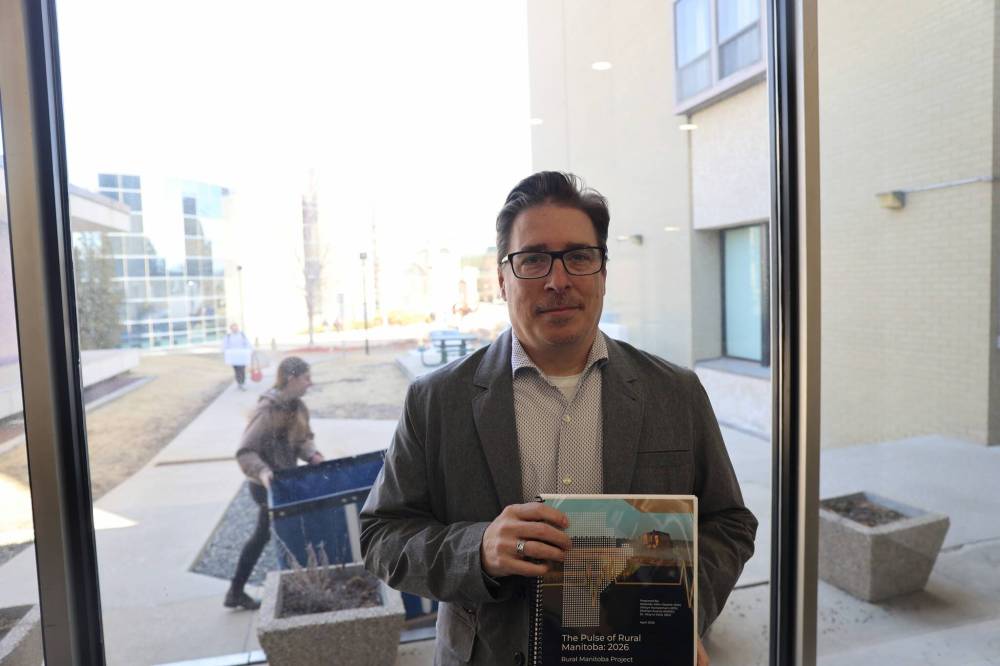
Wayne Kelly of the Rural Development Institute. Kelly said the report will help municipalities provide evidence to support grant applications when they seek funding. (Connor McDowell/The Brandon Sun)
When issuing grants, bodies like the province increasingly looking for data that convinces them of the need or the importance of projects, she said. But data is hard to come by in rural Manitoba — and so the report fills that gap, among others, she said.
The corporation also released an interactive infographic service about regions of Manitoba.
The Pulse of Manitoba report was made using existing data from Statistics Canada, and the database at RMED and data from municipalities in rural Manitoba. The report provides a look at regions and how they compare through 37 economic indicators, and offers a side-by-side look at individual municipalities.
Core themes are: demographics, housing, economy, migration, transportation, capacity and climate change.
The report in April was the first phase of the project, which stands to be an ongoing tool for municipalities to inform decision making and turn to for quick, accessible, data about rural Manitoba.
“It’s a living, breathing document,” Cathcart said. “We anticipate this as ongoing. Everytime we move forward wth the next phase, part of it will be updating the existing data (and keeping it up to date).”
The online, interactive profile service also released last week by the RMED provides data centres for the interlake, north, north central, parkland, south central, southeast, and southwest regions, and Manitoba and Winnipeg profiles.
The tool is as a way for rural communities to learn more about themselves using trusted data, and to be able to turn to provide crucial characteristics about their community to support things like investment.
Currently, the profiles include data packages about core demographics, economy and workforce, and community living, including a quality-of-life profile.
RMED had about 190 representatives from municipalities in Manitoba attend two workshops last week to learn about the service and how it can be used, Cathcart said.
“The beauty of it is you don’t need to be a statistician,” she said. “There’s a lot of power in this from a municipal perspective.”
“The beauty of it is you don’t need to be a statistician,” she said. “There’s a lot of power in this from a municipal perspective.”– Rural Manitoba Economic Development Corporation CEO Margot Cathcart
For example, a municipality may use the tool to inform decision making around spending money on playgrounds or seniors housing, by looking at data about its demographics that is compiled and organized so it can be reviewed easily, she said. The interactive tool allows for a deep look at community profiles, while the Pulse of Rural Manitoba report provides a higher look to base decision making off, she said.
“The two pieces of work go together beautifully.”
RMED worked with Localintel, an AI-powered platform that compiles and organizes data from trusted sources such as Statistics Canada into a database, and then builds infographics for communities based on that database.
Data visualizations are a very powerful way to communicate with the public, Dave Parsell, CEO of Localintel, told the Sun last week. The company purchases data from a number of trusted sources, including aviation data, ports, businesses, and takes a significant amount from Statistics Canada to create the visualizations, he said.
“We bring it all in, clean it all up, we align it, make it all work for us,” Parsell said. “Copy combined with visualizations is a really powerful way to communicate.”
The data from Census 2026 will be added to the infographics on the back end and update the information profiles, Parsell said. This process would take place as the data is released.
RMED plans to host ongoing educational workshops and produce educational content to teach parties such as municipal staff, investors and policy makers how to use the regional profile tool, Cathcart said.
In terms of the Pulse of Rural Manitoba Report: 2026, the task involved manually scrubbing information from municipal websites, and downloading and sorting data sets to extract information, and most of the work involved bringing it all together in one place, Michael Asante, who worked on the project, told the Sun.
He added that it serves to put municipalities and their data into perspective by having it together in one document.
“Most of the work was being able to bring all this data into one spot,” he said. “It’s one thing to have data, and it’s another thing to have context.”
Rural municipalities often told the RMED that one issue they face in Manitoba is having a lack of data, Cathcart said. The starting point for bridging that gap is making accessible what already exists, she said.
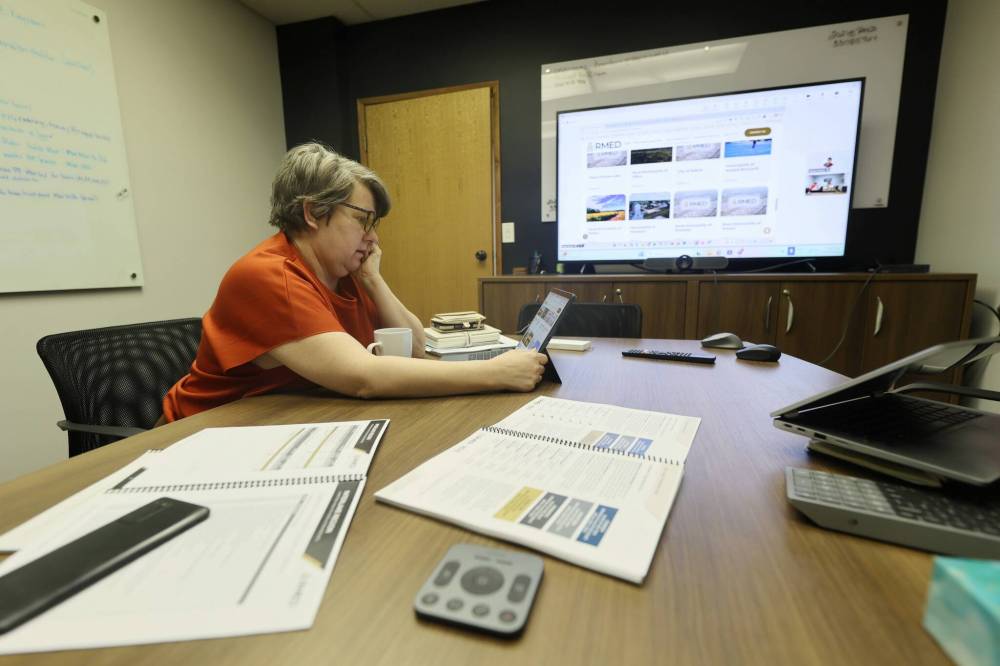
Margot Cathcart, CEO of the Rural Manitoba Economic Development corporation, scrolls through the team’s website in April. Cathcart said that two workshops were packed last week educating Reeves, mayors, and CAO’s of municipalities about how to use the RMED’s new service, an interactive tool that provides information about economic data in regions of Manitoba. (Connor McDowell/The Brandon Sun)
Wayne Kelly, of the RDI, said some rural municipalities do not have economic development staff, and this report bridges that gap. Even without their own staff, those municipalities will have access to the report and can use its contents —produced through the work of five people over a year — to support their decision making, he said.
“I think communities need this data to make decisions, and if they are submitting certain grants this data will support that,” he said. “It’s also really important for evaluating programs.”
He said that many major developments take place in rural areas, and without data it’s harder to inform those development decisions.
Compared with the Census, this report adds some more information, is more locally tailored, and easily provides comparisons between rural Manitoban communities, he said.
“It brings in a few other datasets, it combines it with a local context and then we are presenting it in a context that communities get to see themselves side by side.”
Next steps for the report is to get it into the hands of economic development staff and municipalities in rural Manitoba, Cathcart said. The evolution of the report will come through feedback provided by municipalities and updated information as it becomes more available. The themes of tourism, well-being and connectivity may also be covered in future updates.
The Pulse of Rural Manitoba: 2026 report was a collaboration between the Rural Development Institute at Brandon University and the Rural Manitoba Economic Development Corporation. It is available in its full, 144 page form on the RMED website.
»cmcdowell@brandonsun.com