
Young Afghan women, men perform whirling Sufi dance together
Advertisement
Read this article for free:
or
Already have an account? Log in here »
We need your support!
Local journalism needs your support!
As we navigate through unprecedented times, our journalists are working harder than ever to bring you the latest local updates to keep you safe and informed.
Now, more than ever, we need your support.
Starting at $15.99 plus taxes every four weeks you can access your Brandon Sun online and full access to all content as it appears on our website.
Subscribe Nowor call circulation directly at (204) 727-0527.
Your pledge helps to ensure we provide the news that matters most to your community!
To continue reading, please subscribe:
Add Brandon Sun access to your Free Press subscription for only an additional
$1 for the first 4 weeks*
- Enjoy unlimited reading on brandonsun.com
- Read the Brandon Sun E-Edition, our digital replica newspaper
*Your next Free Press subscription payment will increase by $1.00 and you will be charged $20.95 plus GST for four weeks. After four weeks, your payment will increase to $24.95 plus GST every four weeks.
Read unlimited articles for free today:
or
Already have an account? Log in here »
Hey there, time traveller!
This article was published 22/09/2020 (2162 days ago), so information in it may no longer be current.
KABUL – A group of young Afghans – both women and men – is coming together in the country’s war-torn capital to practice a mystical Sufi Islamic dance.
The group’s founder says she sees their whirling dance, known as Sema, as a way of carving out a space in the country’s deeply conservative society, particularly when it comes to expectations about gender discrimination and dancing in mixed groups.
“I just wanted to express myself and my feelings with Sema dance,” said Fahima Mirzaie, a 24-year-old economist.
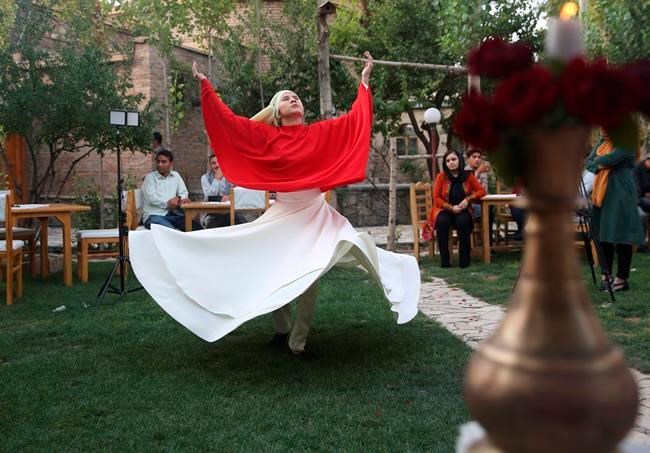
She recently danced alongside male members of her troupe at a cultural event hosted in a somewhat incongruous setting – an Italian restaurant in central Kabul. That night, she was the only women from her group dancing, although other women watched and read poetry.
As she spins, one hand reaches toward heaven and the other toward the earth, her white robe flowing, in the familiar image of a so-called “whirling dervish” seen across the Middle East and Central Asia. Dancers spin repetitively in prayer, chanting Allah and gaining in speed, seeking to lose themselves in a spiritual trance that they believe unites them with God.
But Afghanistan is not widely accepting of this mystical interpretation, and Sufism as well as dancing and singing were both rejected by the Taliban. Many Afghan women are wary of the Taliban returning to power in some form as part of a future peace deal, recalling the years of oppression under a strict form of Islamic law. But even in today’s Afghanistan, women and men dancing together in public is mostly rejected as being against the country’s culture, traditions and religious beliefs.
Most of the members of Mirzaie’s dance group, which features men and women performing in public, are Shiite Muslims. They’re a minority in Afghanistan that’s been targeted for attacks by the Islamic State group, which considers Shiites — Sufi or otherwise — to be heretics. There are other Sufi dance groups scattered across the country’s provinces too, primarily men but some women, who perform in front of mixed audiences.
Mirzaie says she’s unfazed by what people may say about her dancing. As part of the generation that’s grown up during Afghanistan’s latest war, she’s concerned about the violence in her society. She hopes she can change it through Sufism and the poems of Rumi, who’s possibly the most well-known Sufi mystic.
Afghanistan has been at war for more than four decades, first against the invading Soviet army, then warring mujaheddin groups in a bitter civil war, followed by the repressive Taliban rule and finally the latest war that began after the 2001 U.S.-led coalition invasion that toppled the Taliban government.
Her group has also used Sufi dance to help them get through the coronavirus pandemic. During a lockdown earlier this year, Mirzaie closed her centre and provided training to her students online.
Now, she’s back whirling in person. At the Italian restaurant, Abdul Ahad, a civil society activist, said he’d been to a few Sufi events in Afghanistan that perform in private, but this was the first time he’s seen women doing it.
Mirzaie’s mother Qamar says she’s worried for her daughter. “There’s no security and girls are taunted on their way out to work.”
She says she stays awake at night, waiting until Mirzaie returns home after dancing.
Mirzaie’s father, an ex-colonel in the traffic police, her sister and her mother are among her few supporters.
But despite these concerns, she says she cannot live by someone else’s rules.
“I never asked anyone’s permission for starting it and I will not need anyone’s permission to end it, so I will never stop or surrender to anyone.”