
Albanian police force open Iranian Embassy after expulsions
Advertisement
Read this article for free:
or
Already have an account? Log in here »
We need your support!
Local journalism needs your support!
As we navigate through unprecedented times, our journalists are working harder than ever to bring you the latest local updates to keep you safe and informed.
Now, more than ever, we need your support.
Starting at $15.99 plus taxes every four weeks you can access your Brandon Sun online and full access to all content as it appears on our website.
Subscribe Nowor call circulation directly at (204) 727-0527.
Your pledge helps to ensure we provide the news that matters most to your community!
To continue reading, please subscribe:
Add Brandon Sun access to your Free Press subscription for only an additional
$1 for the first 4 weeks*
*Your next subscription payment will increase by $1.00 and you will be charged $20.00 plus GST for four weeks. After four weeks, your payment will increase to $24.00 plus GST every four weeks.
Read unlimited articles for free today:
or
Already have an account? Log in here »
Hey there, time traveller!
This article was published 08/09/2022 (1261 days ago), so information in it may no longer be current.
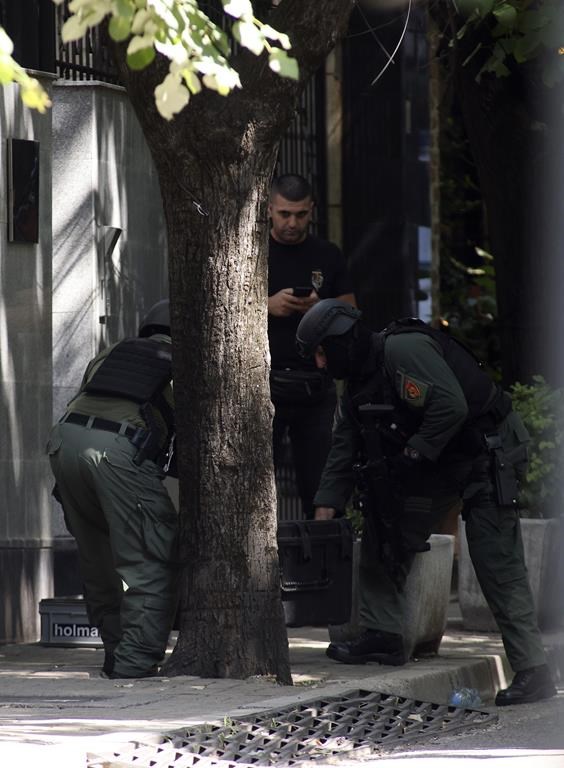
TIRANA, Albania (AP) — Albanian special forces police forced the door of the Iranian Embassy in Tirana on Thursday and officers surrounded the compound in which it stands, shortly after the last staff members left the building following the government’s order to expel them.
The officers, in full fighting gear, entered the building first and were followed by other officers carrying equipment and accompanied by a dog.
The Albanian government on Wednesday had given the embassy’s staff 24 hours to leave the country over a major cyberattack that the Albanian government blames on Iran. It is the first known case of a country cutting diplomatic relations over a cyberattack.
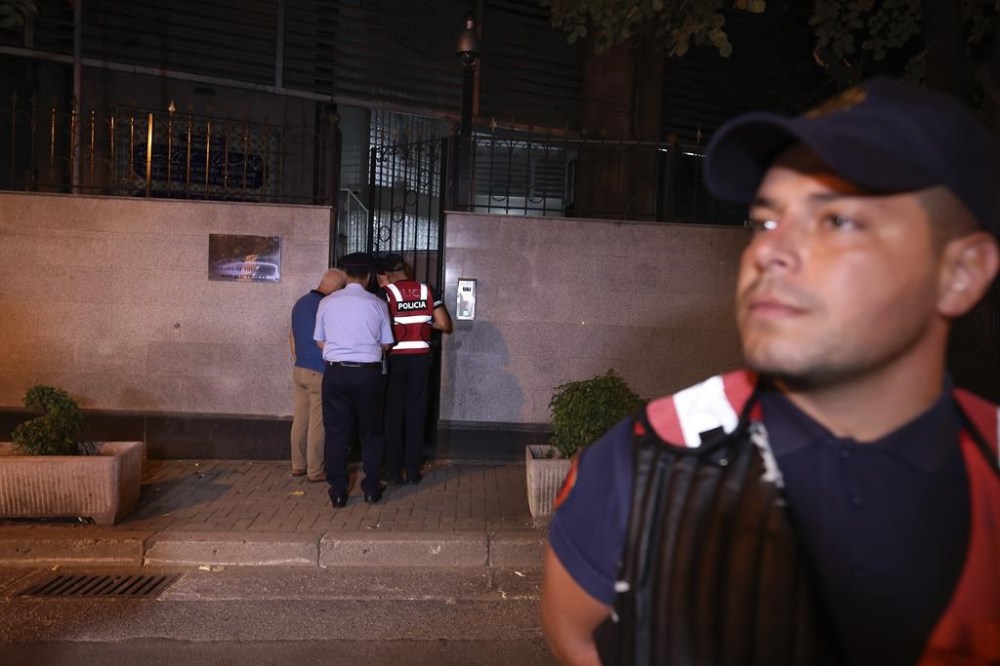
The final two embassy cars with about 10 passengers left the compound Thursday near noon after much movement inside the building overnight.
Government sources declined to say where the Iranian embassy personnel had gone, but local media said some left from the Tirana International Airport and others were likely heading for neighboring North Macedonia.
The compound area, located downtown the capital only a couple of hundred yards from the main government offices, was cordoned off by police, and passers-by were not allowed to approach.
Movement inside the Iranian embassy in Tirana had been nonstop overnight. At one point, an empty barrel was taken into the compound and a fire was started in it, apparently burning documents.
A cyberattack on July 15 temporarily shut down numerous Albanian government digital services and websites. Prime Minister Edi Rama said Wednesday that there was “undeniable evidence” that the Iranian government was behind the attack.
The United States supported the move by Albania, a NATO member, and vowed unspecified retaliation against Iran for what it called “a troubling precedent for cyberspace.”
On Wednesday National Security Advisor Jake Sullivan spoke with Rama “to express the United States’ strong support for our NATO ally.” The U.S. said they committed to continue working together on “Albania’s remediation efforts and cybersecurity measures.”
NATO also expressed its full support to Albania. A statement said it “strongly condemns such malicious cyber activities designed to destabilize and harm the security of an ally, and disrupt the daily lives of citizens.”
The alliance also pledged to raise “our guard against such malicious cyber activities in the future, and support each other to deter, defend against and counter the full spectrum of cyber threats, including by considering possible collective responses.”
Iran condemned the diplomats’ expulsion, calling the action ill-considered and short-sighted, according to Iranian state TV.
In a statement, the Iranian Foreign Ministry denied Tehran was behind any cyberattack on Albanian government websites, adding that it’s Iran which is a target of such attacks on its critical infrastructure.
Ties between Iran and Albania have been tense since 2014 when Albania sheltered some 3,000 members of the Iranian opposition group Mujahedeen-e-Khalq, or MEK, who had left Iraq.
In July, MEK had planned to hold the Free Iran World Summit in Manez, west of Tirana, with U.S. lawmakers among the invitees. The meeting was canceled “for security reasons and due to terrorist threats and conspiracies.”
In two separate instances in 2020 and 2018, Tirana expelled four Iranian diplomats for “threatening national security.”
___
Raf Casert in Brussels and Nancy Benac in Washington contributed to this report.
——-
Follow Llazar Semini at https://twitter.com/lsemini