
Wildfire threat grows as Florida drought gets steadily worse
Advertisement
Read this article for free:
or
Already have an account? Log in here »
We need your support!
Local journalism needs your support!
As we navigate through unprecedented times, our journalists are working harder than ever to bring you the latest local updates to keep you safe and informed.
Now, more than ever, we need your support.
Starting at $15.99 plus taxes every four weeks you can access your Brandon Sun online and full access to all content as it appears on our website.
Subscribe Nowor call circulation directly at (204) 727-0527.
Your pledge helps to ensure we provide the news that matters most to your community!
To continue reading, please subscribe:
Add Brandon Sun access to your Free Press subscription for only an additional
$1 for the first 4 weeks*
- Enjoy unlimited reading on brandonsun.com
- Read the Brandon Sun E-Edition, our digital replica newspaper
*Your next Free Press subscription payment will increase by $1.00 and you will be charged $20.95 plus GST for four weeks. After four weeks, your payment will increase to $24.95 plus GST every four weeks.
Read unlimited articles for free today:
or
Already have an account? Log in here »
Hey there, time traveller!
This article was published 06/04/2023 (1315 days ago), so information in it may no longer be current.
ST. PETERSBURG, Fla. (AP) — The threat of wildfires is growing in Florida over the coming weeks as more than half the state is experiencing severe to extreme drought conditions likely to persist until rainy season resumes around mid-May, state and federal officials said Thursday.
The National Weather Service’s Climate Prediction Center reported Thursday that 55% of Florida is in the severe to extreme drought category, with most of the rest of the state listed as “abnormally dry.” The driest conditions are in southwest Florida, the same region hammered by Hurricane Ian in September.
“When you look at a drought map of the state of Florida, you have very dry conditions all across the state,” said Agriculture Commissioner Wilton Simpson, whose agency includes the Florida Forest Service. “We’ve had numerous fires already.”
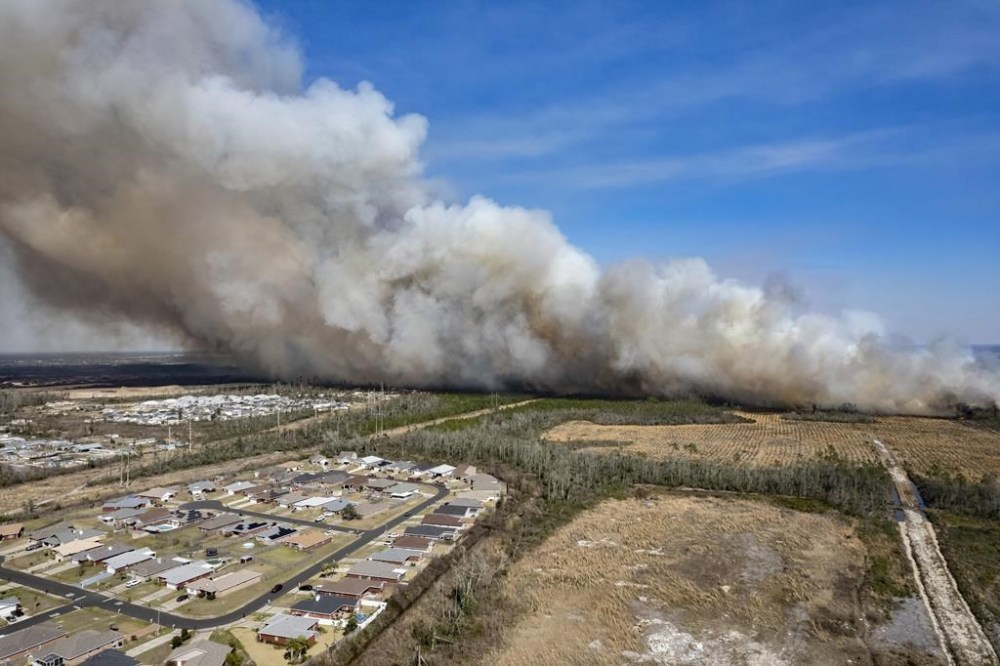
Indeed, since Jan. 1 more than 1,000 wildfires in Florida have burned over 33,000 acres (13,300 hectares), according to state statistics. No evacuations, injuries or major damage to structures have been reported from the fires so far, but that could quickly change as April temperatures heat up without the frequent rainstorms that occur in summer.
Rainfall totals so far this year are well below normal in most of Florida, agriculture department figures show. And as climate change overall raises temperatures around the world, in Florida for February alone 82% of counties were hotter than the typical levels in the 20th Century — affecting an estimated 19.5 million people.
Last year, more than 1,100 people were evacuated during huge wildfires in the Florida Panhandle, much of it the result of dead timber and forest debris left over from Hurricane Michael’s path of destruction in 2018. Officials estimated then that Michael, a Category 5 cyclone, left behind 72 million tons of fallen trees in the area around Panama City.
Two years before that, another 1,000 homes were evacuated and some destroyed by another series of fires in another part of the Panhandle.
Officials fear the southwest part of the state where Hurricane Ian’s 150 mph (241 kph) winds downed thousands of trees could also become a tinderbox. It’s also the only area in Florida in the “extreme” drought category, according to the weather service.
“The further south you go, the drier it is,” said Rick Dolan, chief of the state Forest Service. “Wildfire activity in the state is expected to increase.”
Although lightning strikes often cause wildfires, Simpson said arson and people losing control of backyard or farm fires are a bigger danger. The state Forest Service has about 1,200 employees, half of whom are certified to fight wildfires.
“Most people who start these fires, they’re unintentional,” he said. “This time of the year is when we’re more concerned.”