
Prosecutors seek the death penalty against man accused of slaying of 4 University of Idaho students
Advertisement
Read this article for free:
or
Already have an account? Log in here »
We need your support!
Local journalism needs your support!
As we navigate through unprecedented times, our journalists are working harder than ever to bring you the latest local updates to keep you safe and informed.
Now, more than ever, we need your support.
Starting at $15.99 plus taxes every four weeks you can access your Brandon Sun online and full access to all content as it appears on our website.
Subscribe Nowor call circulation directly at (204) 727-0527.
Your pledge helps to ensure we provide the news that matters most to your community!
To continue reading, please subscribe:
Add Brandon Sun access to your Free Press subscription for only an additional
$1 for the first 4 weeks*
*Your next subscription payment will increase by $1.00 and you will be charged $20.00 plus GST for four weeks. After four weeks, your payment will increase to $24.00 plus GST every four weeks.
Read unlimited articles for free today:
or
Already have an account? Log in here »
Hey there, time traveller!
This article was published 26/06/2023 (1011 days ago), so information in it may no longer be current.
BOISE, Idaho (AP) — Prosecutors say they are seeking the death penalty against a man accused of stabbing four University of Idaho students to death late last year.
Bryan Kohberger, 28, is charged with four counts of murder in connection with the deaths at a rental house near the Moscow, Idaho, university campus last November. Latah County Prosecutor Bill Thompson filed the notice of his intent to seek the death penalty in court on Monday.
A not-guilty plea was entered in the case on Kohberger’s behalf earlier this year. A hearing in the case is scheduled for Tuesday.
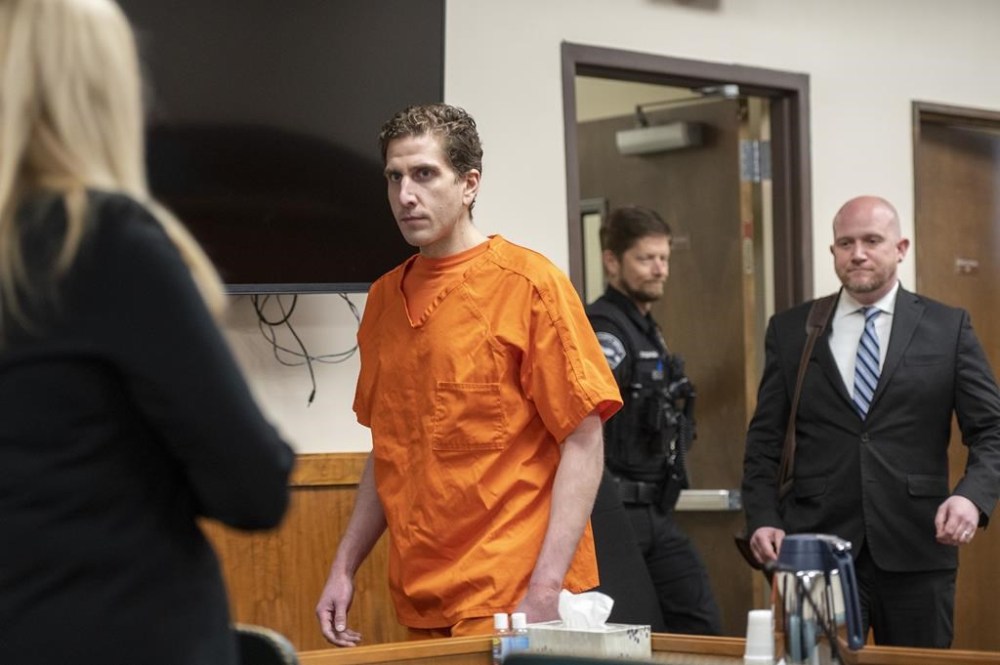
The bodies of Madison Mogen, Kaylee Goncalves, Xana Kernodle and Ethan Chapin were found on Nov. 13, 2022, at a rental home across the street from the University of Idaho campus. The slayings shocked the rural Idaho community and neighboring Pullman, Washington, where Kohberger was a graduate student studying criminology at Washington State University.
Police released few details about the investigation until after Kohberger was arrested at his parents’ home in eastern Pennsylvania early Dec. 30, 2022. Court documents detailed how police pieced together DNA evidence, cellphone data and surveillance video that they say links Kohberger to the slayings.
Investigators said traces of DNA found on a knife sheath inside the home where the students were killed matches Kohberger, and that a cellphone belonging to Kohberger was near the victims’ home on a dozen occasions before the killings. A white sedan allegedly matching one owned by Kohberger was caught on surveillance footage repeatedly cruising past the rental home around the time of the killings.
But defense attorneys have filed motions asking the court to order prosecutors to turn over more evidence about the DNA found during the investigation, the searches of Kohberger’s phone and social media records, and the surveillance footage used to identify the make and model of the car. The motions are among several that will be argued during the hearing Tuesday afternoon.
In an affidavit filed with the motions, defense attorney Anne Taylor said prosecutors have only provided the DNA profile that was taken from traces found on the knife sheath, not the DNA profiles belonging to three other unidentified males that were developed as part of the investigation.
Defense attorneys are also asking for additional time to meet case filing deadlines, noting that they have received thousands of pages of documents to examine, including thousands of photographs, hundreds of hours of recordings, and many gigabytes of electronic phone records and social media data.
Idaho law requires prosecutors to notify the court of their intent to seek the death penalty within 60 days of a plea being entered. In his notice of intent, Thompson listed five “aggravating circumstances” that he said could qualify for the crime for capital punishment under state law; including that more than one murder was committed during the crime, that it was especially heinous or showed exceptional depravity, that it was committed in the perpetration of a burglary or other crime, and that the defendant showed “utter disregard for human life.”
If a defendant is convicted in a death penalty case, defense attorneys are also given the opportunity to show that mitigating factors exist that would make the death penalty unjust. Mitigating factors sometimes include evidence that a defendant has mental problems, that they have shown remorse, that they are very young or that they suffered childhood abuse.
Idaho allows executions by lethal injection. But in recent months, prison officials have been unable to obtain the necessary chemicals, causing one planned execution to be repeatedly postponed. On July 1, death by firing squad will become an approved back-up method of execution under a law passed by the Legislature earlier this year, though the method is likely to be challenged in federal court.