
US-built pier will be removed from Gaza coast and repaired after damage from rough seas
Advertisement
Read this article for free:
or
Already have an account? Log in here »
We need your support!
Local journalism needs your support!
As we navigate through unprecedented times, our journalists are working harder than ever to bring you the latest local updates to keep you safe and informed.
Now, more than ever, we need your support.
Starting at $15.99 plus taxes every four weeks you can access your Brandon Sun online and full access to all content as it appears on our website.
Subscribe Nowor call circulation directly at (204) 727-0527.
Your pledge helps to ensure we provide the news that matters most to your community!
To continue reading, please subscribe:
Add Brandon Sun access to your Free Press subscription for only an additional
$1 for the first 4 weeks*
- Enjoy unlimited reading on brandonsun.com
- Read the Brandon Sun E-Edition, our digital replica newspaper
*Your next Free Press subscription payment will increase by $1.00 and you will be charged $20.95 plus GST for four weeks. After four weeks, your payment will increase to $24.95 plus GST every four weeks.
Read unlimited articles for free today:
or
Already have an account? Log in here »
Hey there, time traveller!
This article was published 28/05/2024 (863 days ago), so information in it may no longer be current.
WASHINGTON (AP) — The U.S.-built temporary pier that has been taking humanitarian aid to starving Palestinians for less than two weeks will be removed from the coast of Gaza to be repaired after getting damaged in rough seas and weather, the Pentagon said Tuesday.
Over the next two days, the pier will be pulled from the beach and sent to the southern Israeli city of Ashdod, where U.S. Central Command will repair it, Pentagon spokeswoman Sabrina Singh told reporters. She said the fixes will take “at least over a week” and then the pier will need to be anchored back into the beach in Gaza.
“From when it was operational, it was working, and we just had sort of an unfortunate confluence of weather storms that made it inoperable for a bit,” Singh said. “Hopefully just a little over a week, we should be back up and running.”
The pier, used to carry in humanitarian aid arriving by sea, is one of the few ways that free food and other supplies are getting to Palestinians who the U.N. says are on the brink of famine amid the nearly 8-month-old war between Israel and Hamas in Gaza.
The two main crossings in southern Gaza, Rafah from Egypt and Kerem Shalom from Israel, are either not operating or are largely inaccessible for the U.N. because of fighting nearby as Israel pushes into Rafah. The pier and two crossings from Israel in northern Gaza are where most of the incoming humanitarian aid has entered in the past three weeks.
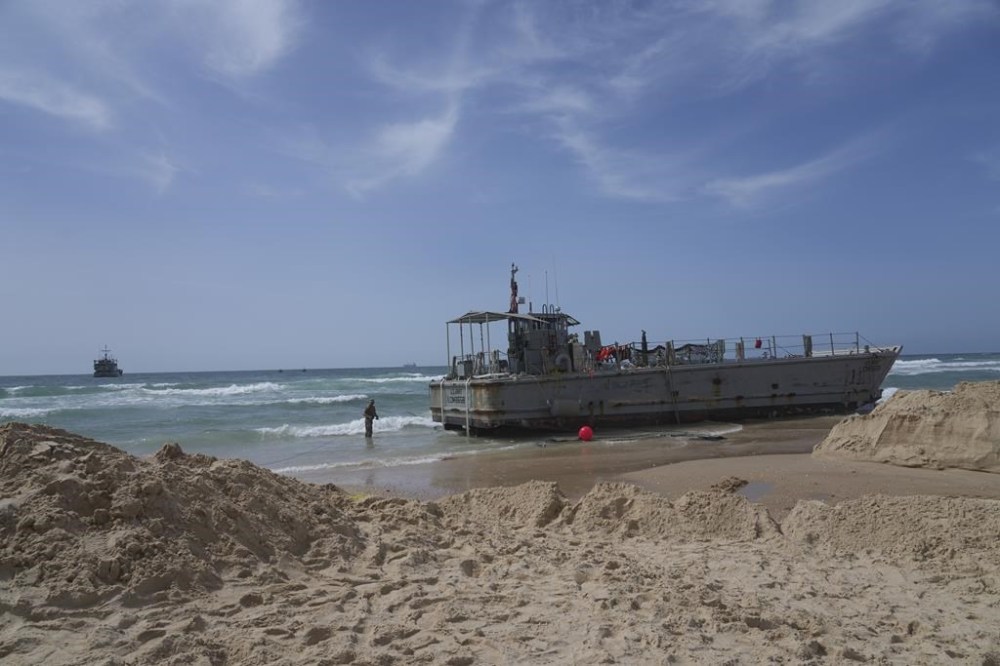
The setback is the latest for the $320 million pier, which only began operations in the past two weeks and has already had three U.S. service members injured and had four vessels beached due to heavy seas. Two of the service members received minor injuries but the third is still in critical condition, Singh said.
Deliveries also were halted for two days last week after crowds rushed aid trucks coming from the pier and one Palestinian man was shot dead.
The pier was fully functional as late as Saturday when heavy seas unmoored four of the Army boats that were being used to ferry pallets of aid from commercial vessels to the pier. The system is anchored into the beach in Gaza and provided a long causeway for trucks to drive that aid onto the shore.
Two of the vessels got stuck on the coast of Israel. One has already been recovered and the other will be in the next 24 hours with the help of the Israeli military, Singh said. The other two boats were stranded on the beach in Gaza and were expected to be recovered in the next two days, she said.
The suspension of the pier comes after the new sea route had begun to pick up steam, with more than 1,000 metric tons of food aid delivered.
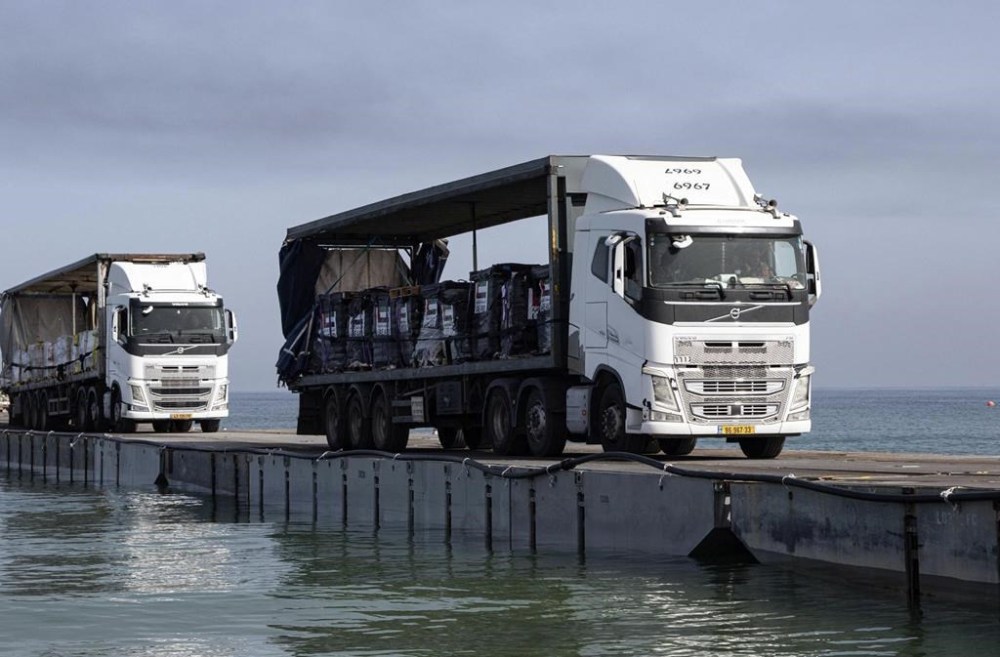
U.S. officials have repeatedly emphasized that the pier cannot provide the amount of aid that starving Gazans need and said that more checkpoints for humanitarian trucks need to be opened. At maximum capacity, the pier would bring in enough food for 500,000 of Gaza’s people, and U.S. officials have stressed the need for open land crossings for the remaining 1.8 million.
The U.S. also has planned to continue to provide airdrops of food, which likewise cannot meet all the needs.
A deepening Israeli offensive in the southern city of Rafah has made it impossible for aid shipments to get through the crossing there, which is a key source for fuel and food coming into Gaza. Israel says it is bringing aid in through another border crossing, Kerem Shalom, but humanitarian organizations say Israeli military operations make it difficult for them to retrieve the aid there for distribution.