
Florida’s ‘Alligator Alcatraz’ detention center is set to receive its first group of immigrants
Advertisement
Read this article for free:
or
Already have an account? Log in here »
We need your support!
Local journalism needs your support!
As we navigate through unprecedented times, our journalists are working harder than ever to bring you the latest local updates to keep you safe and informed.
Now, more than ever, we need your support.
Starting at $15.99 plus taxes every four weeks you can access your Brandon Sun online and full access to all content as it appears on our website.
Subscribe Nowor call circulation directly at (204) 727-0527.
Your pledge helps to ensure we provide the news that matters most to your community!
To continue reading, please subscribe:
Add Brandon Sun access to your Free Press subscription for only an additional
$1 for the first 4 weeks*
*Your next subscription payment will increase by $1.00 and you will be charged $20.00 plus GST for four weeks. After four weeks, your payment will increase to $24.00 plus GST every four weeks.
Read unlimited articles for free today:
or
Already have an account? Log in here »
Hey there, time traveller!
This article was published 02/07/2025 (268 days ago), so information in it may no longer be current.
OCHOPEE, Fla. (AP) — The first group of immigrants were scheduled to arrive Wednesday night at a new detention center deep in the Florida Everglades that officials have dubbed “Alligator Alcatraz,” the state’s attorney general said.
“Alligator Alcatraz will be checking in hundreds of criminal illegal aliens tonight,” Florida Republican Attorney General James Uthmeier said on the X social media platform. “Next stop: back to where they came from.”
It wasn’t immediately clear precisely when the detainees would arrive or where they were coming from. They were being brought to the facility on buses, officials said.
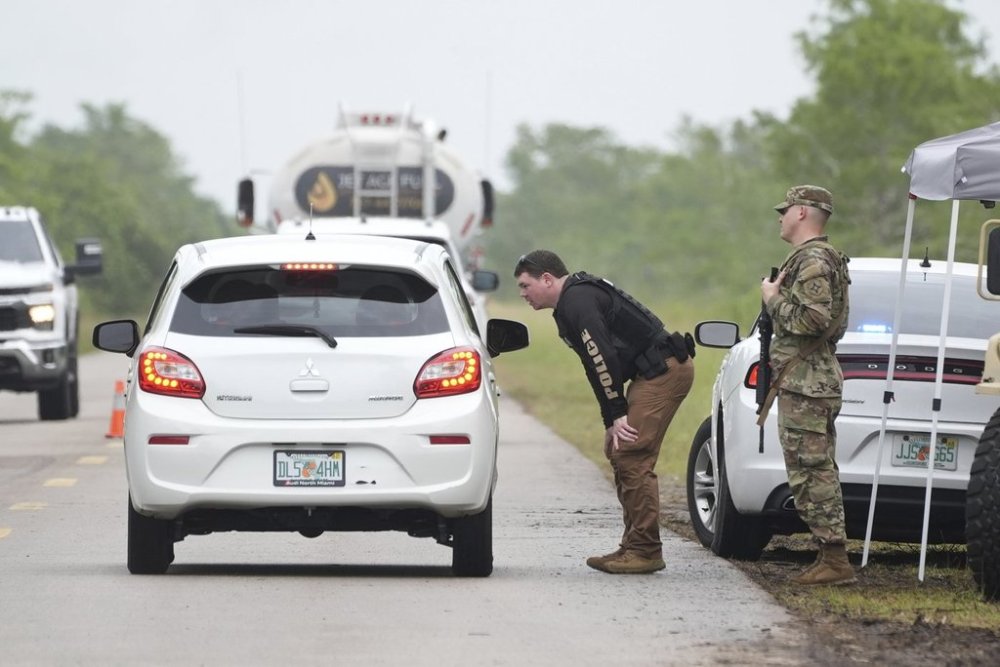
The facility, at an airport used for training, will have a capacity of about 3,000 detainees when fully operational, according to Republican Gov. Ron DeSantis said. The center was built in eight days over 10 miles (16 kilometers) of Everglades. It features more than 200 security cameras, 28,000-plus feet (8,500 meters) of barbed wire and 400 security personnel.
Environmental groups and Native American tribes have protested against the center, contending it is a threat to the fragile Everglades system, would be cruel to detainees because of heat and mosquitoes, and is on land the tribes consider sacred.
It’s also located at a place prone to frequent heavy rains, which caused some flooding in the tents Tuesday during a visit by President Donald Trump to mark its opening. State officials say the complex can withstand a Category 2 hurricane, which packs winds of between 96 and 110 mph (154-177 kph), and that contractors worked overnight to shore up areas where flooding occurred.
DeSantis and other state officials say locating the facility in the rugged and remote Florida Everglades is meant as a deterrent, and naming it after the notorious federal prison of Alcatraz, an island fortress known for its brutal conditions, is meant to send a message. It’s another sign of how the Trump administration and its allies are relying on scare tactics to try to persuade people in the country illegally to leave voluntarily.
State and federal officials have touted the plans on social media and conservative airwaves, sharing a meme of a compound ringed with barbed wire and “guarded” by alligators wearing hats labeled “ICE” for Immigration and Customs Enforcement. The Republican Party of Florida has taken to fundraising off the detention center, selling branded T-shirts and beer koozies emblazoned with the facility’s name.
_____
Anderson reported from St. Petersburg, Florida.