
Rubio reassures somewhat on trans-Atlantic ties after a year of deepening differences with Europe
Advertisement
Read this article for free:
or
Already have an account? Log in here »
We need your support!
Local journalism needs your support!
As we navigate through unprecedented times, our journalists are working harder than ever to bring you the latest local updates to keep you safe and informed.
Now, more than ever, we need your support.
Starting at $15.99 plus taxes every four weeks you can access your Brandon Sun online and full access to all content as it appears on our website.
Subscribe Nowor call circulation directly at (204) 727-0527.
Your pledge helps to ensure we provide the news that matters most to your community!
To continue reading, please subscribe:
Add Brandon Sun access to your Free Press subscription for only an additional
$1 for the first 4 weeks*
*Your next subscription payment will increase by $1.00 and you will be charged $20.00 plus GST for four weeks. After four weeks, your payment will increase to $24.00 plus GST every four weeks.
Read unlimited articles for free today:
or
Already have an account? Log in here »
MUNICH (AP) — U.S. Secretary of State Marco Rubio delivered a calm and reassuring message to America’s allies on Saturday, striking a far less aggressive but still firm tone about the Trump administration’s intent to reshape the trans-Atlantic alliance after more than a year of President Donald Trump’s often-hostile rhetoric toward traditional allies.
Reminding his audience at the annual Munich Security Conference about America’s centuries-long roots in Europe, Rubio said the United States would remain forever tied to the continent even as it pushes for changes in the relationship and the international institutions that have been the bulwark of the post-World War II world order.
Rubio addressed the conference a year after Vice President JD Vance stunned the same audience with a harsh critique of European values. A series of statements and moves from the Trump administration targeting allies followed, including Trump’s short-lived threat last month to impose new tariffs on several European countries in a bid to secure U.S. control of Greenland, a semiautonomous territory of NATO ally Denmark.
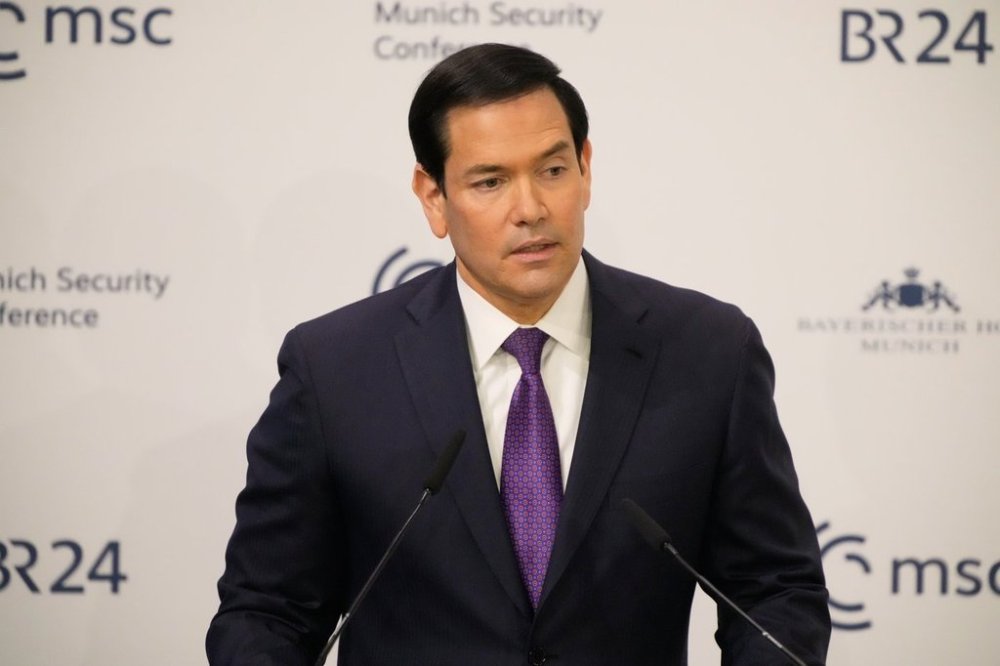
On Friday, German Chancellor Friedrich Merz opened this year’s gathering by calling for the United States and Europe to “repair and revive trans-Atlantic trust together,” saying that even the U.S. isn’t powerful enough to go it alone in an world whose old order no longer exists. He made clear that Europe will stand by its approach to free speech and climate change, and rejects a “culture war” and protectionism.
Rubio argued that the “euphoria” of the Western victory in the Cold War led to a “dangerous delusion that we had entered ‘the end of history,’ that every nation would now be a liberal democracy, that the ties formed by trade and by commerce alone would now replace nationhood … and that we would now live in a world without borders where everyone became a citizen of the world.”
“We made these mistakes together and now together we owe it to our people to face those facts and to move forward to rebuild,” Rubio said. He said that, under Trump, the U.S. “will once again take on the task of renewal and restoration.”
“This is why we Americans may sometimes come off as a little direct and urgent in our counsel,” he said. “This is why President Trump demands seriousness and reciprocity from our friends here in Europe.”
“In a time of headlines heralding the end of the trans-Atlantic era, let it be known and clear to all that this is neither our goal nor our wish,” Rubio said. “Because for us Americans, our home may be in the Western hemisphere, but we will always be a child of Europe.”
“We have fought against each other, then reconciled, then fought and reconciled again. And we have bled and died side-by-side on battlefields from Kapyong to Kandahar,” Rubio said. “And I’m here today to make it clear that America is charting the path for a new century of prosperity. and that once again, we want to do it together with you, our cherished allies and our oldest friends.”
Rubio said that the United Nations “still has tremendous potential” but that, on today’s most pressing matters, “it has no answers and has played virtually no role.”

Speaking directly after Rubio, Chinese Foreign Minister Wang Yi offered a contrasting view.
“The main reason for the inadequacy of the current international system is not the United Nations itself, but the fact that some countries magnify differences, pursue national priorities … and even revive the Cold War mentality,” he argued. “All these have undermined the basis of trust, worsened the atmosphere of cooperation, and made the operation of international mechanisms difficult.”
___
Geir Moulson in Berlin contributed to this report.