
An arts panel made up of Trump appointees approves his White House ballroom proposal
Advertisement
Read this article for free:
or
Already have an account? Log in here »
We need your support!
Local journalism needs your support!
As we navigate through unprecedented times, our journalists are working harder than ever to bring you the latest local updates to keep you safe and informed.
Now, more than ever, we need your support.
Starting at $15.99 plus taxes every four weeks you can access your Brandon Sun online and full access to all content as it appears on our website.
Subscribe Nowor call circulation directly at (204) 727-0527.
Your pledge helps to ensure we provide the news that matters most to your community!
To continue reading, please subscribe:
Add Brandon Sun access to your Free Press subscription for only an additional
$1 for the first 4 weeks*
*Your next subscription payment will increase by $1.00 and you will be charged $20.00 plus GST for four weeks. After four weeks, your payment will increase to $24.00 plus GST every four weeks.
Read unlimited articles for free today:
or
Already have an account? Log in here »
WASHINGTON (AP) — The U.S. Commission of Fine Arts, a panel made up of President Donald Trump’s appointees, on Thursday approved his proposal to build a ballroom larger than the White House itself where the East Wing once stood.
The meeting was supposed to be on the design, with a final vote expected at next month’s session. But the chairman, Rodney Mims Cook Jr., made a motion to also vote on final approval, and six of the seven commissioners who were all installed by the Republican president since the start of the year voted in favor twice. One commissioner, James McCrery, did not vote because he was the initial architect on the project.
“Our sitting president has actually designed a very beautiful structure,” Cook said before the voting. “The United States just should not be entertaining the world in tents.”
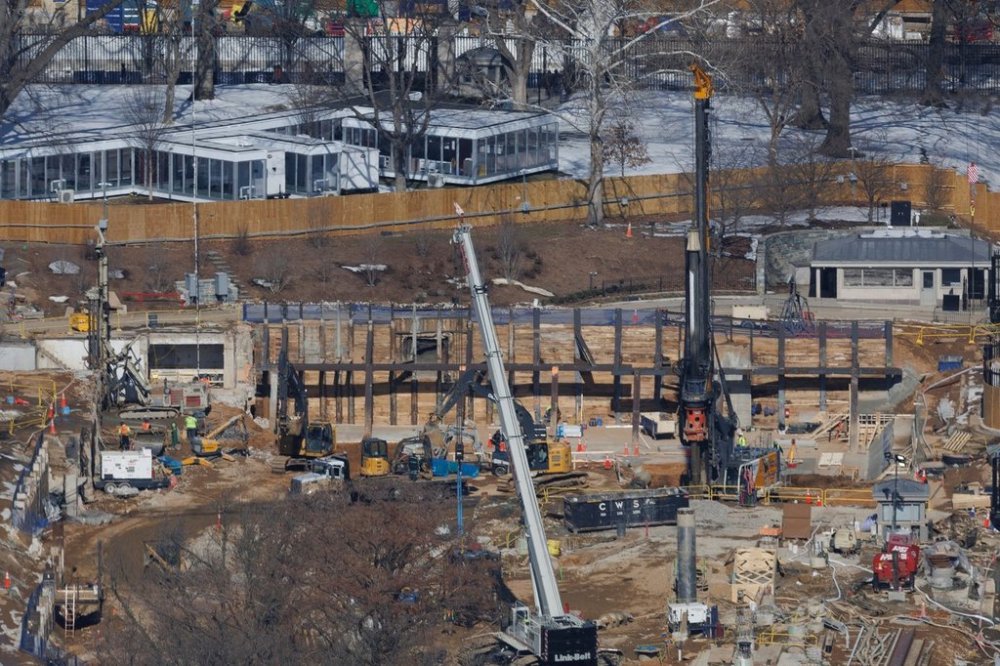
Cook echoed one of Trump’s arguments for adding a ballroom to the White House: It would end the long-standing practice of erecting temporary structures that Trump calls tents on the South Lawn to host visiting dignitaries for state dinners and other functions.
Cook said no other president had taken steps to correct that “until President Trump.”
The project will be the subject of additional discussion by the National Capital Planning Commission in March.
At the fine art’s commission’s January meeting, some commissioners questioned the lead architect about the “immense” design and scale of the project even as they broadly endorsed Trump’s vision for a ballroom roughly twice the size of the White House itself.
Some changes suggested at that meeting were made and were welcomed by the commissioners on Thursday.
Trump’s decision in October to demolish the East Wing prompted a public outcry when it began without the independent reviews, congressional approval and public comment that are typical even for relatively minor modifications to historic buildings in Washington.
The National Trust for Historic Preservation has sued in federal court to halt construction of the ballroom. A court decision in the case is pending.
The project is scheduled for additional discussion at a March 5 meeting of the National Capital Planning Commission, which is led by one of Trump’s top White House aides. The commission has jurisdiction over construction and major renovations to government buildings in the region.
___
This story has been corrected to reflect that the ballroom was approved by six of the seven commissioners and that one commission did not vote because he was the initial architect on the project.