
International Criminal Court opens hearings into former Philippine President Rodrigo Duterte
Advertisement
Read this article for free:
or
Already have an account? Log in here »
We need your support!
Local journalism needs your support!
As we navigate through unprecedented times, our journalists are working harder than ever to bring you the latest local updates to keep you safe and informed.
Now, more than ever, we need your support.
Starting at $15.99 plus taxes every four weeks you can access your Brandon Sun online and full access to all content as it appears on our website.
Subscribe Nowor call circulation directly at (204) 727-0527.
Your pledge helps to ensure we provide the news that matters most to your community!
To continue reading, please subscribe:
Add Brandon Sun access to your Free Press subscription for only an additional
$1 for the first 4 weeks*
*Your next subscription payment will increase by $1.00 and you will be charged $20.00 plus GST for four weeks. After four weeks, your payment will increase to $24.00 plus GST every four weeks.
Read unlimited articles for free today:
or
Already have an account? Log in here »
THE HAGUE, Netherlands (AP) — Prosecutors at the International Criminal Court told judges on Monday that former Philippine President Rodrigo Duterte encouraged death squads to carry out extrajudicial killings using fear and financial rewards.
The court in The Hague is holding pretrial hearings for the ex-leader, who is facing three counts of crimes against humanity for deadly anti-drugs crackdowns he oversaw while in office.
According to prosecutors, police and hit squad members carried out dozens of murders at Duterte’s behest, motivated by the promise of money or to avoid becoming targets themselves. “For some, killing reached the level of a perverse form of competition,” deputy prosecutor Mame Mandiaye Niang said in his opening statement.
Duterte, 80, was not present in the courtroom, having waived his right to appear. He has described the charges as an “outrageous lie.”
Last month, judges found he was fit to stand trial, after postponing an earlier hearing over concerns about his health.
The Hague hearing is not a trial, but allows prosecutors to outline their case in court. After weighing the evidence, judges have 60 days to decide whether it is strong enough to merit putting Duterte on trial.
The charges date from Duterte’s time as mayor of the southern Philippine city of Davao and later as president, and include dozens of killings as part of his so-called war on drugs.
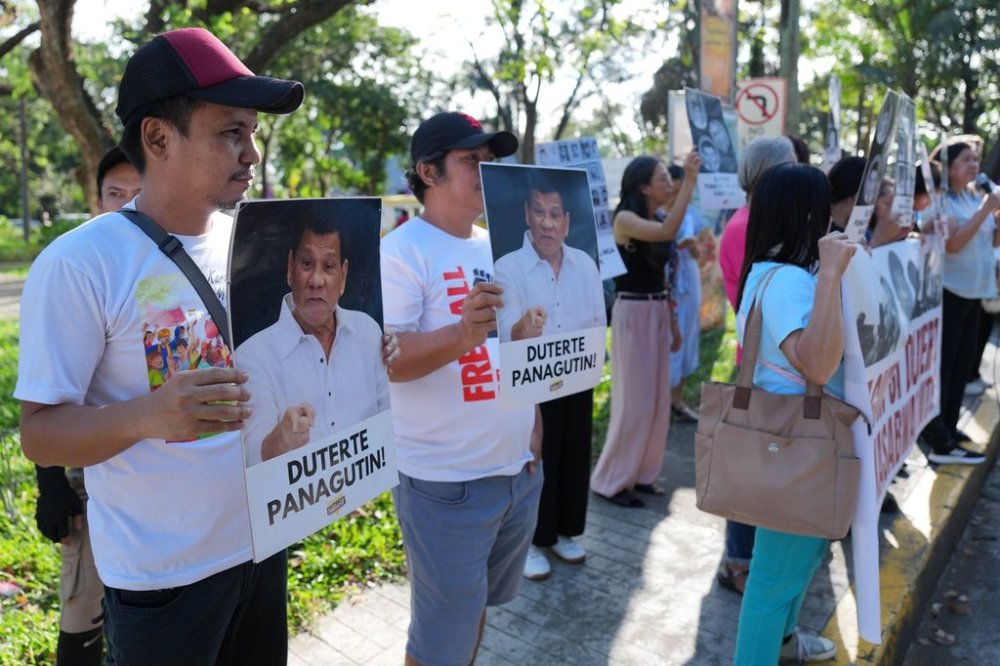
In the Philippines, dozens of activists with relatives of suspects killed in Duterte’s anti-drugs crackdowns held a noisy protest in metropolitan Manila on Monday. More than 100 relatives gathered to watch the pretrial hearings on big TV screens in three venues organized by civic groups in the capital region.
“We’re hoping that the ICC, even if it’s thousands of miles away, will finally render justice to all these families,” said Randy delos Santos, a volunteer in a charity shelter which was hosting one event.
The 17-year-old nephew of delos Santos was shot and killed by three police officers in a purported drug raid in August 2017. The killing sparked a public outcry. The officers were found guilty of murder in a rare conviction by a Manila court the following year.
Duterte supporters criticized the administration of current Philippine President Ferdinand Marcos Jr., Duterte’s political rival, for arresting and surrendering the former leader to a court whose jurisdiction they dispute. Detractors include Duterte’s daughter, current Philippine Vice President Sara Duterte who announced last week that she would seek the presidency in the 2028 elections.
ICC prosecutors said in February 2018 that they would open a preliminary investigation into the violent drug crackdowns. In a move that human rights activists say was aimed at escaping accountability, Duterte, who was president at the time, announced a month later that the Philippines would leave the court.
Judges rejected a request from Duterte’s legal team to throw out the case on the grounds that the court did not have jurisdiction because of the Philippine withdrawal. Countries can’t “abuse” their right to withdraw from the court’s foundational Rome Statute “by shielding persons from justice in relation to alleged crimes that are already under consideration,” the September decision says.
An appeal of that decision is still pending.
Estimates of the death toll during Duterte’s presidential term vary, from the more than 6,000 that the national police have reported to up to 30,000 claimed by human rights groups.
———
Associated Press journalist Jim Gomez in Manila contributed to this report