
Former President Win Myint freed in broad Myanmar prisoner amnesty
Advertisement
Read this article for free:
or
Already have an account? Log in here »
We need your support!
Local journalism needs your support!
As we navigate through unprecedented times, our journalists are working harder than ever to bring you the latest local updates to keep you safe and informed.
Now, more than ever, we need your support.
Starting at $15.99 plus taxes every four weeks you can access your Brandon Sun online and full access to all content as it appears on our website.
Subscribe Nowor call circulation directly at (204) 727-0527.
Your pledge helps to ensure we provide the news that matters most to your community!
To continue reading, please subscribe:
Add Brandon Sun access to your Free Press subscription for only an additional
$1 for the first 4 weeks*
- Enjoy unlimited reading on brandonsun.com
- Read the Brandon Sun E-Edition, our digital replica newspaper
*Your next Free Press subscription payment will increase by $1.00 and you will be charged $20.95 plus GST for four weeks. After four weeks, your payment will increase to $24.95 plus GST every four weeks.
Read unlimited articles for free today:
or
Already have an account? Log in here »
BANGKOK (AP) — Myanmar’s former President Win Myint was freed Friday as part of a broad prisoner amnesty by newly inaugurated President Min Aung Hlaing to mark the traditional New Year, state-run media reported.
The pardon order applied to more than 4,500 prisoners, but it was not immediately clear how many people imprisoned for opposing military rule were included and there was no sign that 80-year-old former leader Aung San Suu Kyi would be freed.
Win Myint is Suu Kyi’s longtime loyalist and was elected as president in 2018. He was arrested on Feb. 1, 2021, the same day the military seized power and detained Suu Kyi. He was later given 12-year combined prison sentences for several offenses, which was reduced to eight years in 2023.
State-run MRTV television reported that Win Myint, who was in a prison in Taungoo township in Bago region, had received amnesty.
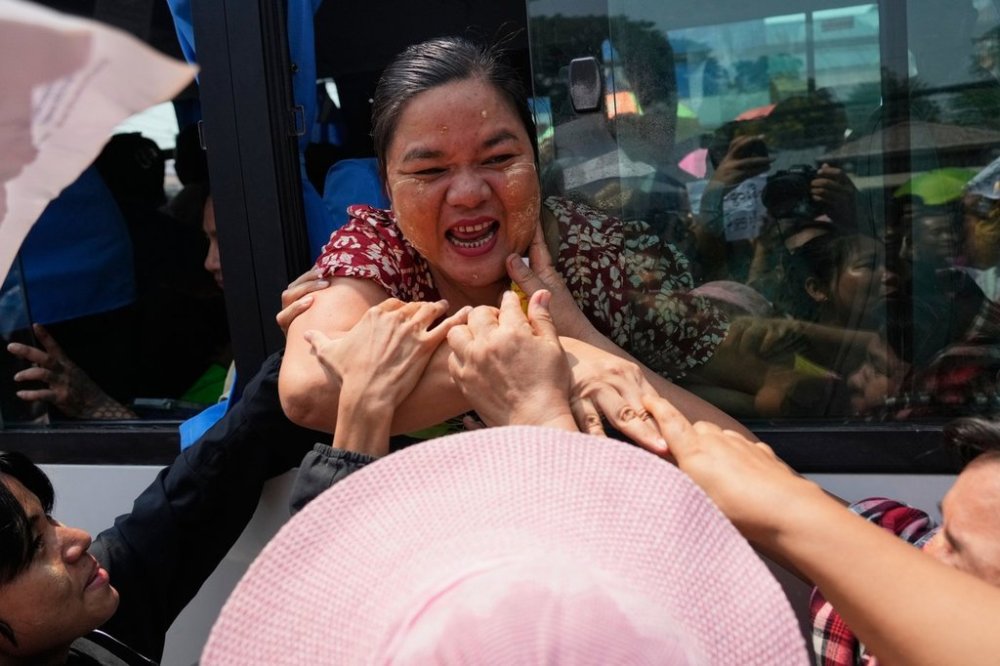
Outside Insein Prison in Yangon, buses carrying prisoners were welcomed by relatives and friends who had been waiting since early morning. Among those released was filmmaker Shin Daewe, who was sentenced to life imprisonment under a counterterrorism law in January 2024.
The amnesty comes a week after Min Aung Hlaing was sworn into office following an election that critics say was neither free nor fair and was orchestrated to keep the military’s iron grip on power.
State media said in addition to the 4,335 prisoners pardoned, nearly 180 foreigners would be released and deported.
If the freed prisoners reoffend, they will have to serve the rest of their original sentences in addition to any new sentence, according to the terms of their release. A separate report said death sentences were commuted to life imprisonment, life sentences were reduced to 40 years and prison terms of less than 40 years were cut by one-sixth.
Under that measure, Suu Kyi’s 27-year sentence would be reduced by 4 1/2 years, leaving her with 22 1/2 years still to serve.
A senior military officer from the capital, Naypyitaw told the Associated Press on Friday that Suu Kyi will be transferred to house arrest as part of the clemency. He spoke on condition of anonymity because he wasn’t authorized to release information.
Suu Kyi has been serving a prison term on a variety of criminal convictions at an undisclosed location in Naypyitaw and has been moved to house arrest at least once in April 2024.
In his inauguration speech last week, Min Aung Hlaing said his government would implement amnesties that contribute to social reconciliation, justice and peace and support the country’s overall development.
Prisoner releases are common on holidays and other significant occasions in Myanmar.
Since the 2021 army takeover, nearly 8,000 civilians have been killed and some 22,170 political detainees, including Suu Kyi, remain jailed, according to the Assistance Association for Political Prisoners, a rights monitoring group. Total deaths in the ongoing conflict are estimated to be much higher.
Many political detainees have been held on incitement charges, a law widely used to arrest critics of the government or military and punishable by up to three years in prison. Others have been prosecuted under a counterterrorism law that carries a potential death penalty and has been used to target political and armed opponents, journalists and other dissenters.