
Maryland court rules Democratic-backed redistricting amendment cannot go on November ballot
Advertisement
Read this article for free:
or
Already have an account? Log in here »
We need your support!
Local journalism needs your support!
As we navigate through unprecedented times, our journalists are working harder than ever to bring you the latest local updates to keep you safe and informed.
Now, more than ever, we need your support.
Starting at $15.99 plus taxes every four weeks you can access your Brandon Sun online and full access to all content as it appears on our website.
Subscribe Nowor call circulation directly at (204) 727-0527.
Your pledge helps to ensure we provide the news that matters most to your community!
To continue reading, please subscribe:
Add Brandon Sun access to your Free Press subscription for only an additional
$1 for the first 4 weeks*
- Enjoy unlimited reading on brandonsun.com
- Read the Brandon Sun E-Edition, our digital replica newspaper
*Your next Free Press subscription payment will increase by $1.00 and you will be charged $20.95 plus GST for four weeks. After four weeks, your payment will increase to $24.95 plus GST every four weeks.
Read unlimited articles for free today:
or
Already have an account? Log in here »
A Maryland court has ruled against a proposed constitutional amendment that could have paved the way for Democrats to redraw the state’s congressional districts ahead of the 2028 elections.
The ruling Wednesday by a judge in the state’s capital city marks another setback in Democrats’ national attempts to counter a Republican redistricting movement pushed by President Donald Trump ahead of this year’s elections. The judge ruled that the amendment cannot appear on the November ballot, but he paused the effect of that ruling to allow for an appeal to the state Supreme Court.
Democrats already control seven of Maryland’s eight congressional seats. Democratic Gov. Wes Moore called lawmakers into a special session in August with a goal of making it easier to claim that final seat.
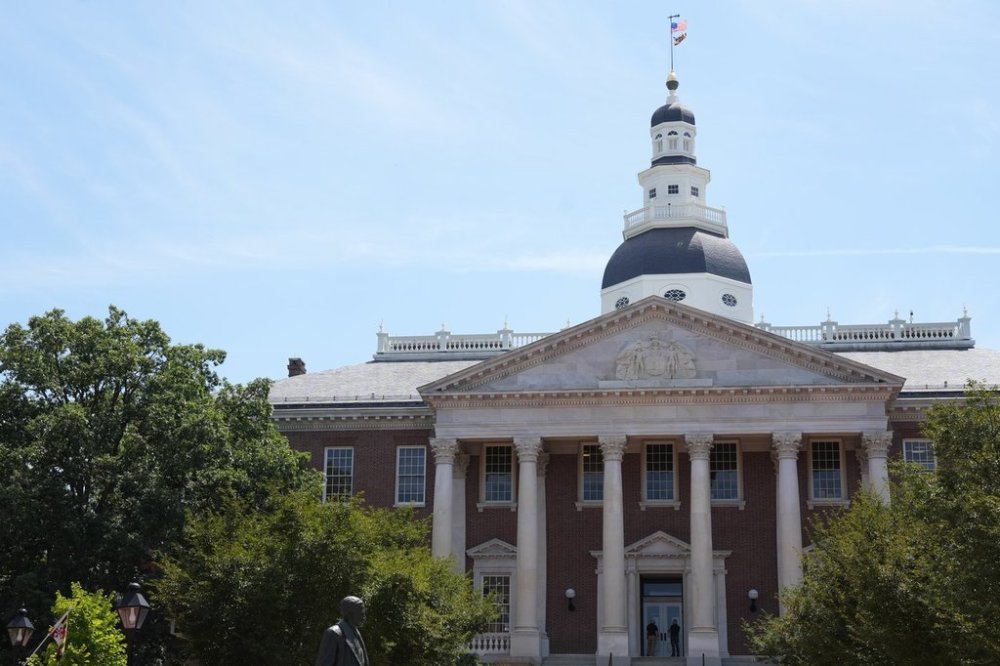
An amendment referred to the ballot by lawmakers seeks to sidestep a court ruling that struck down a previous Democratic redistricting plan in 2022. It would declare that a constitutional requirement for districts to be compact and take into account “natural boundaries” applies only to state legislative districts, not congressional ones.
That would allow Democratic state lawmakers to draw congressional districts that cross the Chesapeake Bay, reshaping a district east of the bay that is held by Republican Rep. Andy Harris, chair of the conservative House Freedom Caucus.
Anne Arundel County Circuit Court Judge Robert Thompson ruled that lawmakers violated their own deadlines for ballot measures. Earlier this year, lawmakers passed a law signed by Moore that set a July 1 deadline for the secretary of state to certify summaries of all statewide ballot questions to the Maryland State Board of Elections.
The state attorney general’s office argued that deadline didn’t apply to the redistricting amendment because lawmakers wrote their own ballot summary for it, using their constitutional authority. The judge disagreed, instead siding with arguments by the conservative Oversight Project and Republican state lawmakers who sued.
Thompson also ruled that lawmakers used “intentionally misleading” wording in the ballot question by stating that it merely “clarifies” the Constitution’s redistricting standards. And Thompson said the amendment violates a single-issue requirement in the Constitution by also including a provision that would give the state Supreme Court original jurisdiction in lawsuits over congressional redistricting.
“The court has no choice but to enjoin the board of elections from including ballot Question 3 on the general election ballot for November 3, 2026,” Thompson wrote.
Earlier this year, the Virginia Supreme Court also invalidated a redistricting ballot measure because of procedural violations by state lawmakers. In that case, voters had already approved an amendment in April authorizing mid-decade redistricting when the court ruled that lawmakers last year had waited too long to take an initial step necessary to qualify it for the ballot.
Virginia and Maryland both were seeking to follow the path of California, where voters approved a Democratic-backed amendment authorizing mid-decade redistricting. Democrats hope to gain as many as five congressional seats from California’s redrawn districts, plus an additional seat from new districts in Utah.
But Republicans hope to win as many as 16 additional seats from new U.S. House districts enacted in Alabama, Florida, Louisiana, Missouri, North Carolina, Ohio, Tennessee and Texas.
Redistricting typically happens near the beginning of each decade, after new census data is released. But a mid-decade redistricting battle broke out after Trump urged Republican-led states to redraw congressional districts in hopes that it might help Republicans hold onto a slim House majority in this year’s midterm elections.