
All 5 killed in Miami cargo jet crash were in a van used by plane cleaners
Advertisement
Read this article for free:
or
Already have an account? Log in here »
We need your support!
Local journalism needs your support!
As we navigate through unprecedented times, our journalists are working harder than ever to bring you the latest local updates to keep you safe and informed.
Now, more than ever, we need your support.
Starting at $15.99 plus taxes every four weeks you can access your Brandon Sun online and full access to all content as it appears on our website.
Subscribe Nowor call circulation directly at (204) 727-0527.
Your pledge helps to ensure we provide the news that matters most to your community!
To continue reading, please subscribe:
Add Brandon Sun access to your Free Press subscription for only an additional
$1 for the first 4 weeks*
- Enjoy unlimited reading on brandonsun.com
- Read the Brandon Sun E-Edition, our digital replica newspaper
*Your next Free Press subscription payment will increase by $1.00 and you will be charged $20.95 plus GST for four weeks. After four weeks, your payment will increase to $24.95 plus GST every four weeks.
Read unlimited articles for free today:
or
Already have an account? Log in here »
MIAMI (AP) — The five people killed when an Amazon cargo jet ran off the runway at Miami International Airport were all inside a van used to shuttle cleaning crews to planes to clean them, authorities said.
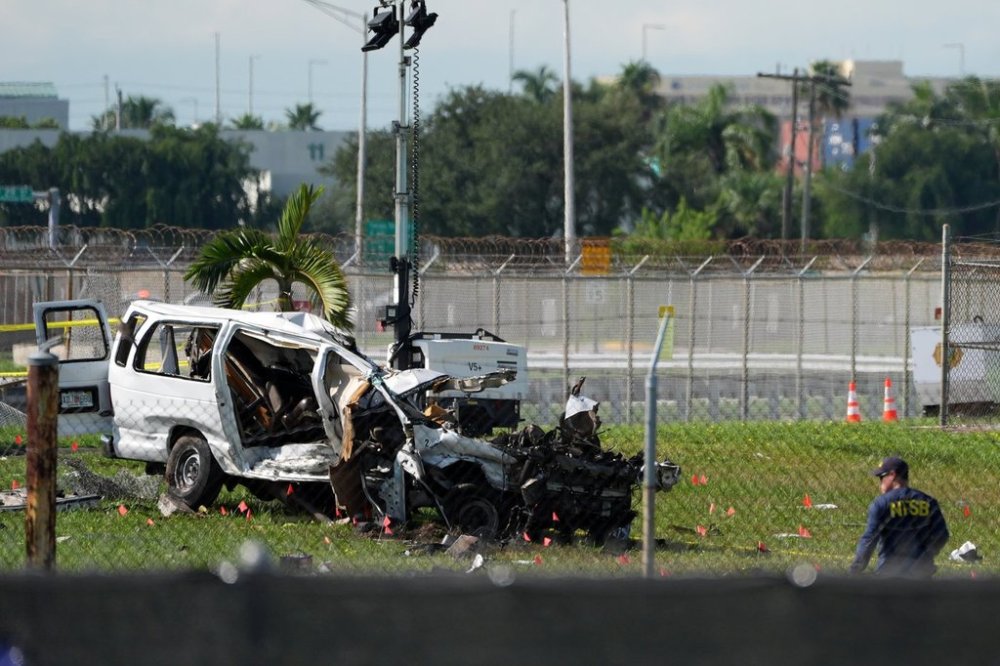
The jet overran the runway while landing Sunday. It slammed into the van on airport property, careened through a fence and then smashed an SUV on a city street.
Five other people were injured. The pilot and co-pilot have been released from the hospital, Miami-Dade County Sheriff Rosie Cordero-Stutz said Tuesday. Two people remain in critical condition and a third is in stable condition.
Cordero-Stutz said the deceased ranged in age from 47 to 75.
The National Transportation Safety Board is investigating the crash. One focus will be on the lack of a system to slow and stop speeding jets.
Miami is not one of the 120 airports in the U.S. with lightweight, crushable material at the end of runways that the Federal Aviation Administration says have saved around 500 lives.
Experts said even without a runway excursion system, Miami’s airport appears to be compliant with federal rules because it has a 1,000-foot (305-meter) safety buffer at the end of its runways.
NTSB Chairwoman Jennifer Homendy said Monday her agency’s goal is to prevent tragedies, but runway excursions continue to happen even after the board has suggested installing the systems in the past.
“Our recommendations must be implemented or we’re going to be here again,” she said at a Monday news conference.
The five people killed were all in a van owned by Professional Ocean Service Corp., a company that cleans planes. The company said it wouldn’t comment on the crash out of respect for the families who lost loved ones.
“Our employees are far more than the people who work beside us each day, they are family, and they are deeply loved. Our hearts and prayers are with every employee and every family whose lives have been forever changed,” the company said in a statement Tuesday.
The Amazon jet was landing after a two-hour flight from Puerto Rico as storms brewed around the Miami airport.
The NTSB said the plane barreled roughly 1,300 feet (396 meters) past the end of the runway.
Homendy called the scene “utter devastation,” with pieces of the vehicles, air bags, destroyed navigational equipment and fencing along the plane’s route. She said she had to be careful because jet fuel was still all around 24 hours after the crash.
Strong winds over 25 knots were reported Saturday afternoon. Experts who viewed video of the landing said it appears that a strong tail wind propelled the plane far down the runway past the point where it was supposed to land. The plane remained airborne without flaring the nose to force the wheels onto the ground.
It is not immediately clear why the pilot didn’t abort landing and go around to try again.
Air traffic controllers also had not changed the approach to the runway to allow the plane to land into a headwind. Airports routinely change which direction planes land on a runway when the winds shift.
The flight had been operated by 21 Air, a cargo carrier based in North Carolina. The 32-year-old Boeing 767 was originally built to carry passengers and flew for several airlines in foreign countries for more than two decades before being converted to a cargo plane in 2015, according to flight-tracking site Flightradar24.
___
Funk reported from Omaha, Nebraska, and Collins reported from Columbia, South Carolina.