
Republican Byron Donalds is elected Florida’s first Black governor
Advertisement
Read this article for free:
or
Already have an account? Log in here »
We need your support!
Local journalism needs your support!
As we navigate through unprecedented times, our journalists are working harder than ever to bring you the latest local updates to keep you safe and informed.
Now, more than ever, we need your support.
Starting at $15.99 plus taxes every four weeks you can access your Brandon Sun online and full access to all content as it appears on our website.
Subscribe Nowor call circulation directly at (204) 727-0527.
Your pledge helps to ensure we provide the news that matters most to your community!
To continue reading, please subscribe:
Add Brandon Sun access to your Free Press subscription for only an additional
$1 for the first 4 weeks*
- Enjoy unlimited reading on brandonsun.com
- Read the Brandon Sun E-Edition, our digital replica newspaper
*Your next Free Press subscription payment will increase by $1.00 and you will be charged $20.95 plus GST for four weeks. After four weeks, your payment will increase to $24.95 plus GST every four weeks.
Read unlimited articles for free today:
or
Already have an account? Log in here »
Republican Rep. Byron Donalds was elected Florida’s first Black governor on Tuesday, defeating Democrat David Jolly in an unexpectedly competitive race that tested the GOP’s grip on President Donald Trump ‘s adopted home state.
Donalds, a staunch Trump ally, will succeed outgoing Republican Gov. Ron DeSantis, who used the office to fan presidential ambitions and steer the nation’s third-most populous state further to the right.
Donalds, who will become the nation’s first elected Black Republican governor, fended off Jolly, a former Republican congressman who switched parties and ran a centrist campaign. Donalds thanked Trump in his victory speech to supporters in South Florida.
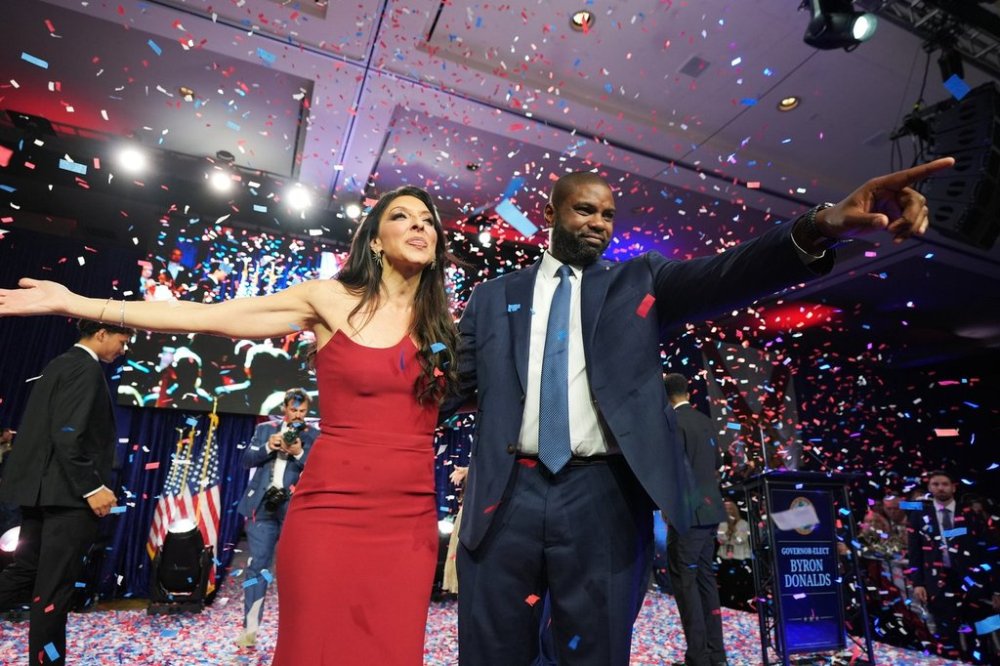
“I want you to hear from Florida that we are still red,” Donalds told the crowd. “Mr. President, I also want to tell you thank you for your support and thank you for being in my corner.”
The race presented a test of whether Trump’s unpopularity, which has dragged down Republicans across the U.S., would extend to his backyard and endanger an office in Florida that a Democrat hasn’t won in more than 30 years.
Donalds had sought to define Jolly as an out-of-touch liberal, and he reached out to Black voters who traditionally side with Democrats.
Beyond the national political environment, the race centered on issues including high prices and the cost of homeowners insurance, a particularly salient issue in a state with a history of being ravaged by hurricanes.
Florida spent a generation as America’s prized political battleground, where the interests of big cities, agricultural towns, freshly arrived retirees and diverse Latino communities collided in elections often decided by fractions of a percentage point.
That reputation faded under DeSantis, who won his first race in 2018 by less than half a percentage point. But once he was in office, he leaned into culture wars centered on race and gender — signing, for instance, legislation often labeled by critics as “ Don’t Say Gay ” that bars instruction on sexual orientation and gender identity in kindergarten through the third grade. By the time he ran for reelection in 2022, DeSantis won in a nearly 20-point landslide that left the state’s Democrats in shambles.
Jolly faced steep hurdles in his effort to lead the party’s rebound. Republicans have a roughly 1.5 million voter registration advantage, and Donalds dominated Jolly in fundraising.
Seeking to overcome those challenges, Jolly campaigned in Florida’s Democratic strongholds, like Broward County, along with traditionally Republican parts of central Florida and the state’s Panhandle.
Donalds maintained a steady confidence throughout the campaign, balancing his support for Trump with efforts to create some distance, including minimizing references to the president on his website.