
Assassinated: The shot that started it all 100 years ago
Advertisement
Read this article for free:
or
Already have an account? Log in here »
We need your support!
Local journalism needs your support!
As we navigate through unprecedented times, our journalists are working harder than ever to bring you the latest local updates to keep you safe and informed.
Now, more than ever, we need your support.
Starting at $15.99 plus taxes every four weeks you can access your Brandon Sun online and full access to all content as it appears on our website.
Subscribe Nowor call circulation directly at (204) 727-0527.
Your pledge helps to ensure we provide the news that matters most to your community!
To continue reading, please subscribe:
Add Brandon Sun access to your Free Press subscription for only an additional
$1 for the first 4 weeks*
*Your next subscription payment will increase by $1.00 and you will be charged $20.00 plus GST for four weeks. After four weeks, your payment will increase to $24.00 plus GST every four weeks.
Read unlimited articles for free today:
or
Already have an account? Log in here »
Hey there, time traveller!
This article was published 28/06/2014 (4299 days ago), so information in it may no longer be current.
One hundred years ago today, a single, low-powered bullet fired by a teenager kicked off one of the deadliest conflicts in history.
Gavrilo Princip was just shy of 20 when he shot and killed Archduke Franz Ferdinand of Austria-Hungary, setting into motion a series of events that would culminate in the First World War.
Princip was one of a half-dozen Serbian nationalists who were determined to assassinate the archduke while he was in Sarajevo — a city they believed should be under Serbian, not Austro-Hungarian, rule.
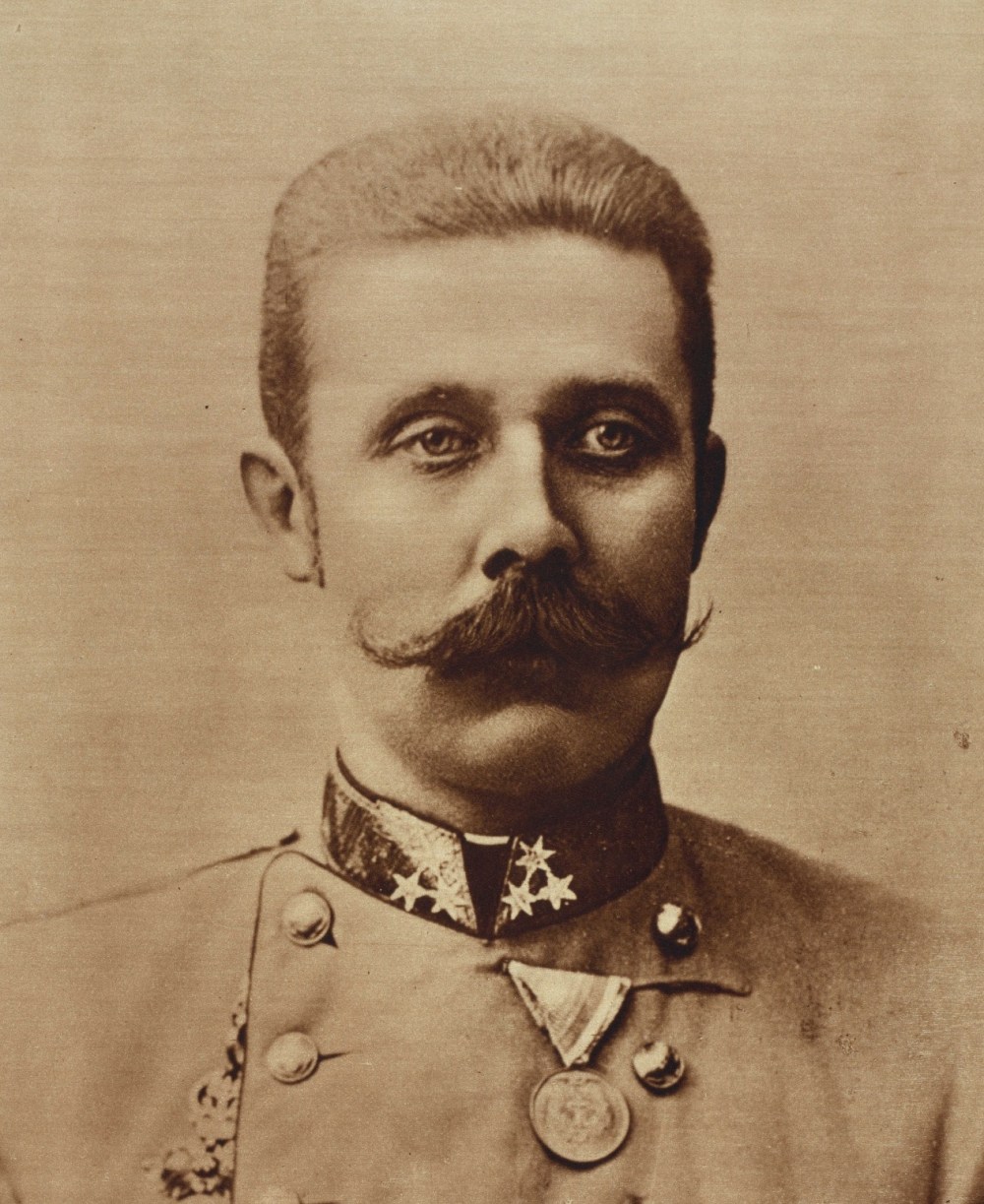
Ferdinand and his wife Sophie, the Duchess of Hohenberg, had arrived in Sarajevo by train that morning, and were on their way into the city by car when one of Princip’s co-conspirators threw a grenade at the motorcade.
The archduke escaped this first attempt, which wounded two people in the fourth car and about a dozen spectators.
Ferdinand was rattled, interrupting a welcome speech at the Sarajevo Town Hall, before giving his own speech — his notes had been in the bombed car, and were wet with blood.
It was a rare occasion for Sophie — although a noblewoman, she was considered a commoner at the Austro-Hungarian court, and Ferdinand, the presumptive heir to the throne, had only been allowed to marry her by giving up the rights of their children to ascend after him.
In what’s known as a morganatic marriage, Sophie was only able to enjoy the privileges of her husband’s rank during his military duties, like his Sarajevo visit.
As such, it was unusual that she would be sitting in the car beside him when, after the town hall reception, they drove back through the city to visit those wounded in the earlier bombing.
Unusual, but perhaps understandable, given that the day was the 14th anniversary of their morganatic oath (the wedding itself had been on July 1).
On the trip to the hospital, however, less than 45 minutes after the first assassination attempt, Princip was still waiting.
He lucked out — the archduke’s driver took a wrong turn and stalled the car while backing out.
Princip, armed with a semi-automatic pistol, jumped up to the car and shot twice.
His first shot went through Ferdinand’s neck; Sophie bent over him and the second shot hit her in the abdomen.
Reportedly, Ferdinand’s last words were “Sophie, Sophie! Don’t die! Live for our children!” then a muttering of “It is nothing.”
But Sophie was dead before the car could reach medical treatment. Ferdinand died some 10 minutes later.
Princip had been almost immediately arrested, but not before swallowing cyanide and trying to shoot himself in the head.
The gun was wrested from his hand; he vomited up the expired poison.
Eventually, he was sentenced to 20 years in prison, but he died of tuberculosis less than four years later.
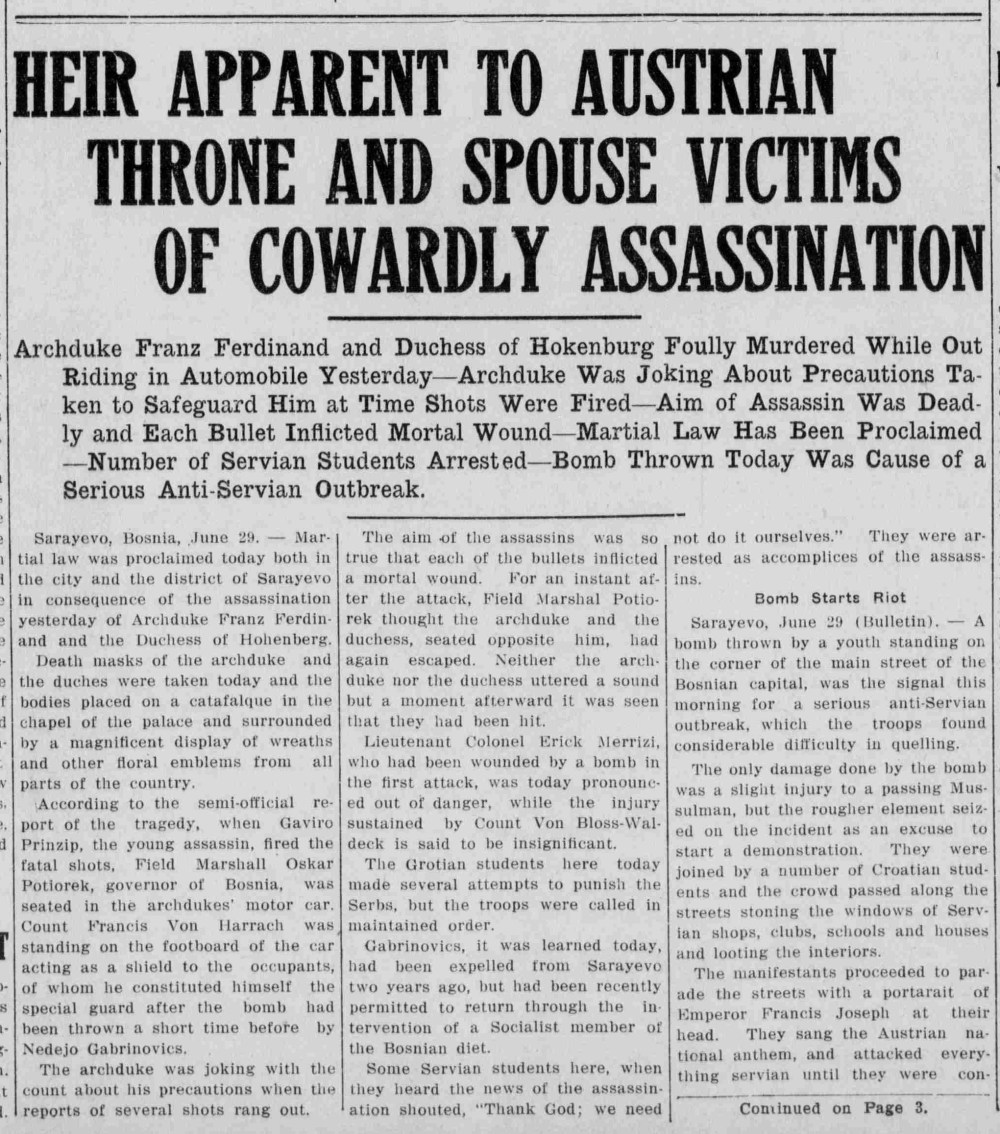
In Brandon, news of the assassination flashed onto the front page on Monday.
The political inclinations of the newspaper at that time were clear: It was a “cowardly assassination” of the couple, who were “foully murdered” — and that was just the headlines.
The story had an impressive amount of detail, including the assassin’s name, although they spelled it as “Gaviro Prinzip,” and the news that a large amount of money was reportedly found in his apartment.
The story also noted that the two injured from the earlier bomb attack were expected to recover, and included context from the Russian press, which was largely anti-Austrian.
In Sarajevo, martial law was declared to quell anti-Serbian rioting that had broken out after the assassinations. But after initial success, anti-Serb demonstrations erupted that evening and the next day.
Some sources say that two Serbs were killed and 1,000 homes and businesses were razed during the first day of the protests.
On a larger scale, tensions climbed between Serbia and Austria-Hungary.
Serbia refused to open an investigation of the assassination and in July, Austria-Hungary issued an ultimatum.
The ultimatum, to which Serbia had just 48 hours to comply, was seen as bullying and humiliating — Winston Churchill called it “insolent” — but Serbia was prepared to gave in on all but one point.
It proved to not be enough.
» ghamilton@brandonsun.com
» Twitter: @Gramiq