First World War at 100

Stories of the year 2024

By Connor McDowell and Matt Goerzen 51 minute read Tuesday, Dec. 31, 2024

Questions over taxation, budgets and declining services in both health care, and city and provincial infrastructure overshadowed much of the news cycle for Manitobans in 2024, as governments and taxpayers alike grappled with rising costs, and tried to find novel ways to address them.

For Premier Wab Kinew, it was a year he could talk about the 14 per cent gas tax holiday he promised during the 2023 election and delivered upon from Jan. 1 to the end of the 12-month cycle — only to announce in December that he would bring it back to 12.5 per cent in the new year.

For Brandon City Hall, it was a year of having to come to terms with a decision to raise taxes by 9.4 per cent in February, while it sought to be guided by the “growth pays for growth” adage by increasing development fees for new construction in the city.

As a college and university town, Brandon began to register the fallout from the federal government’s decision last January, to implement a temporary two-year cap on international students to reduce levels by 35 per cent in 2024, with a further 10 per cent cut planned for 2025. International student enrolment at Brandon University was down 20.3 per cent in September of this year, and Assiniboine College in December reported a huge drop in revenue from international student enrolment, and cancellation of several courses as a result.

Advertisement

Advertise With Us

Weather

Apr. 3, 6 PM: 0°c Cloudy with wind Apr. 4, 12 AM: -2°c Cloudy

Brandon MB

1°C, Windy

Full Forecast

First World War colours celebrate history

Graeme Bruce 3 minute read Preview

First World War colours celebrate history

Graeme Bruce 3 minute read Monday, Nov. 10, 2014

The colours of a local First World War battalion were honoured during a Sunday church service.

The original battalion flag of the 45th Battalion now stands high above the pews of St. Matthew’s Cathedral in Brandon alongside the Union Jack.

“It’s reminding ourselves of the custodians of the colours that were deposited here in 1915,” said Rev. James Njegovan. “We’re celebrating our history, they are memorials to those of the 45th Battalion.”

Military colours are traditionally held in “sacred” places such as churches, other public spaces and on display, he said.

Read
Monday, Nov. 10, 2014

Colin Corneau/Brandon Sun
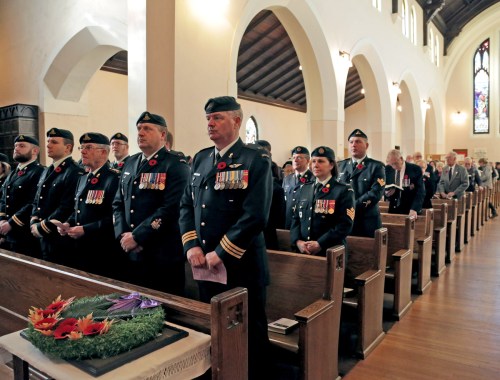
Members of the 26th Field Regiment and the XII Manitoba Dragoons are seen during a rededication ceremony for the 45th Battalion's colours, Sunday morning at St. Matthew's Cathedral. The service started off the church's Remembrance Sunday service.
(Colin Corneau/Brandon Sun)

Colin Corneau/Brandon Sun
Members of the 26th Field Regiment and the XII Manitoba Dragoons are seen during a rededication ceremony for the 45th Battalion's colours, Sunday morning at St. Matthew's Cathedral. The service started off the church's Remembrance Sunday service.
(Colin Corneau/Brandon Sun)

Remembering the dead, in McCrae’s other poetry

Grant Hamilton 7 minute read Preview

Remembering the dead, in McCrae’s other poetry

Grant Hamilton 7 minute read Monday, Nov. 10, 2014

You’ve heard “In Flanders Fields,” of course. It’s not just one of the best-known Canadian poems, and not just one of the best-known war poems, it might be one of the best-known poems, period, at least in the English-speaking world.

Sure, many people may get tripped up on whether the poppies “blow” or “grow” in between those famous crosses, row on row (they blow in the poem, though they do both in reality, of course), and fewer people know the pro-war third verse than who can recite the funereal first verse.

But it’s still a poem that, nearly a century after it was first printed, continues to ring with contemporary feeling.

“In Flanders Fields” was first published anonymously in Punch magazine, a British weekly, in late 1915, and immediately became incredibly popular, not just among those in the military but also with civilians back home.

Read
Monday, Nov. 10, 2014

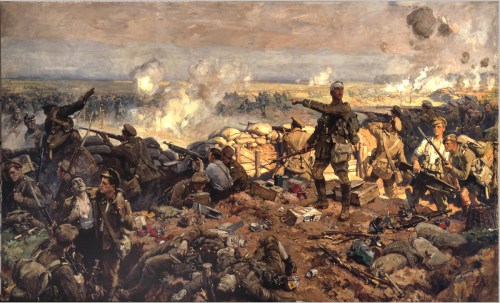
he Second Battle of Ypres, in the spring of 1915, was the first major engagement of Canadians in the First World War. Lt-Col. John McCrae, a doctor from Guelph with a sister in Brandon, was at the battle. What he saw inspired him to write poetry — some famous, like “In Flanders Fields,” some less so, like “The Anxious Dead,” featured here. McCrae would not live out the war and died of pneumonia in 1918.
However, his words live on, inspiring people nearly a century later with their themes of duty, honour and loss. The battle is imagined here by artist Richard Jack, in what was the first-ever commission of the Canadian War Memorials Fund. The original canvas, in the collection of the Canadian War Museum, is nearly six metres wide and nearly four metres tall.

he Second Battle of Ypres, in the spring of 1915, was the first major engagement of Canadians in the First World War. Lt-Col. John McCrae, a doctor from Guelph with a sister in Brandon, was at the battle. What he saw inspired him to write poetry — some famous, like “In Flanders Fields,” some less so, like “The Anxious Dead,” featured here. McCrae would not live out the war and died of pneumonia in 1918.
However, his words live on, inspiring people nearly a century later with their themes of duty, honour and loss. The battle is imagined here by artist Richard Jack, in what was the first-ever commission of the Canadian War Memorials Fund. The original canvas, in the collection of the Canadian War Museum, is nearly six metres wide and nearly four metres tall.

John McCrae’s Brandon connection

Uncredited 2 minute read Preview

John McCrae’s Brandon connection

Uncredited 2 minute read Monday, Nov. 10, 2014

Although he was born in Guelph, there is a Brandon connection with Lt-Col. John McCrae.

According to history researcher Christian Cassidy, McCrae’s sister married a Brandon lawyer, and they lived here for about 20 years before moving to Winnipeg in the late 1920s. McCrae did visit his sister in Manitoba.

Today, some of that local connection remains at the Royal Canadian Artillery Museum in Shilo.

Among their collections is an original copy of the December 1915 “Punch” magazine with the first publication of “In Flanders Fields,” as well as a printing plate featuring his hand-written submission.

Read
Monday, Nov. 10, 2014

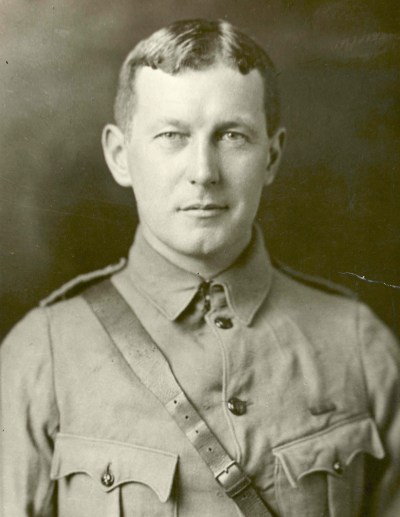
Lt-Col. John McCrae was a surgeon in the Canadian army during the First World War, and is remembered today for his poetry.

CP
Lt-Col. John McCrae was a surgeon in the Canadian army during the First World War, and is remembered today for his poetry.

1914’s mysterious aeroplane

Grant Hamilton 4 minute read Preview

1914’s mysterious aeroplane

Grant Hamilton 4 minute read Monday, Nov. 10, 2014

It had been less than a dozen years since brother Orville and Wilbur Wright had made the first powered flight, and it had taken years more for the Ohio bicycle manufacturers to establish their legitimacy and to perfect their machines.

So in 1914, although biplanes and monoplanes were beginning to make some stir in military circles, especially for forward observation, most airships were still of the unpowered variety — mainly the hydrogen-filled blimps that were, even generically, then called Zeppelins.

But there were powered planes in the air. And Brandon Daily Sun readers would have read of the first attempts of anti-aircraft attacks on powered planes in early fall of 1914.

A couple of years earlier, in 1912, demonstrations of the first-ever powered airplane flight in Westman had thrilled visitors to the Interprovincial Fair with twice-daily flights. And within a couple of years, pretty much everyone would know of the exploits of Dauphin flying ace Billy Barker.

Read
Monday, Nov. 10, 2014

File
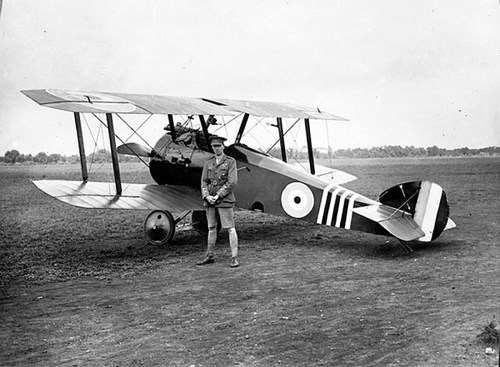
Dauphin-born William (Billy) Barker poses with an airplane in this undated photo. The First World War ace and recipient of the Victoria Cross was an early pioneer of aerial battle tactics during the war. He’d taken up flying to get out of the trenches, having signed up as a calvaryman but finding little use for horses on the battlefields of Europe.

File
Dauphin-born William (Billy) Barker poses with an airplane in this undated photo. The First World War ace and recipient of the Victoria Cross was an early pioneer of aerial battle tactics during the war. He’d taken up flying to get out of the trenches, having signed up as a calvaryman but finding little use for horses on the battlefields of Europe.

Brandon boys trained in the shadow of Stonehenge

Grant Hamilton 14 minute read Preview

Brandon boys trained in the shadow of Stonehenge

Grant Hamilton 14 minute read Wednesday, Nov. 12, 2014

The first Nov. 11 during the Great War was just another day. It was a Wednesday.

No one knew that, four years later, it would be the date of the Armistice. No one knew that, a 100 years later, it would still be marked, as Remembrance Day.

So there were obviously no ceremonies or celebrations. The war was just getting underway, really.

A trip acrossCanadian soldiers, including those from Brandon, had sailed from the east coast in early October.

Read
Wednesday, Nov. 12, 2014

Library and Archives Canada
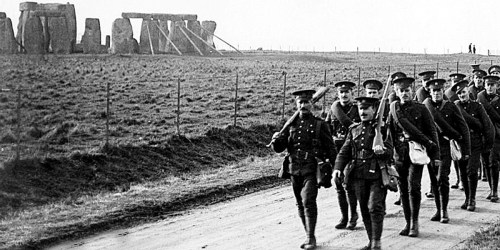
Men of the 10th Battalion, Canadian Expeditionary Force, march past Stonehenge during training for the First World War. The massive fields of Salisbury Plain, described as Canada-like in their terrain but not so much in their weather, were turned into an enormous training camp between 1914–18.

Library and Archives Canada
Men of the 10th Battalion, Canadian Expeditionary Force, march past Stonehenge during training for the First World War. The massive fields of Salisbury Plain, described as Canada-like in their terrain but not so much in their weather, were turned into an enormous training camp between 1914–18.

Minto soldier killed in 1918 finally ID’d

Jillian Austin 6 minute read Preview

Minto soldier killed in 1918 finally ID’d

Jillian Austin 6 minute read Friday, Nov. 7, 2014

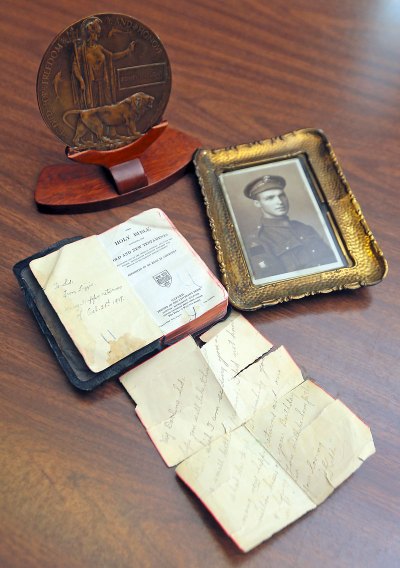
A love note tucked into a small Bible for Pte. Sidney Halliday is one of the few items that remain from the soldier’s time in the First World War.

“Wishing you many very happy returns and one million kisses,” Halliday’s sweetheart, Lizzie Walmsley, wrote back in 1917.

The brittle paper is now falling apart, but it was that young love that eventually led to the successful identification of his remains nearly a century after he was killed.

Halliday was a member of Canada’s 78th Battalion, the Winnipeg Grenadiers. He was killed in action at the age of 22 in the Battle of Amiens in 1918.

Read
Friday, Nov. 7, 2014

Bruce Bumstead/Brandon Sun
A letter from his sweetheart, Lizzie Walmsley, dated October 1917, was tucked away inside a Bible given to First World War soldier Sidney Halliday, whose remains were identified from a locket found among his personal effects in Europe.

Bruce Bumstead/Brandon Sun
A letter from his sweetheart, Lizzie Walmsley, dated October 1917, was tucked away inside a Bible given to First World War soldier Sidney Halliday, whose remains were identified from a locket found among his personal effects in Europe.

Local family’s historic war medals languish on eBay

Graeme Bruce 5 minute read Preview

Local family’s historic war medals languish on eBay

Graeme Bruce 5 minute read Friday, Nov. 7, 2014

The war medals of a Brandon family of soldiers who fought in both world wars are up for auction online, and an Ontario man hopes a local purchaser will bring them back to the city.

“If the community rallies together and manages to secure these, not only do they bring them home ... their valour is no longer for sale,” said Dave Thomson of St. George, Ont., nicknamed the “Medal Detector,” who spends much of his free time scouring eBay and the like for war medals for sale.

“You may hear from family, you may not. Sometimes you hear from local residents that are absolutely disgusted that their heroes’ medals are being for sale and sometimes you just get people who rally together and pledge money and end up buying them. Once in a while you get nothing.”

The opening bid is US$345 for the collection of medals from the Brandon “family with three generations of military service who has showed great courage, patriotism and sacrifice,” as the seller states in the eBay description. There were no bidders as of Thursday night and it closes on Sunday.

Read
Friday, Nov. 7, 2014

eBay
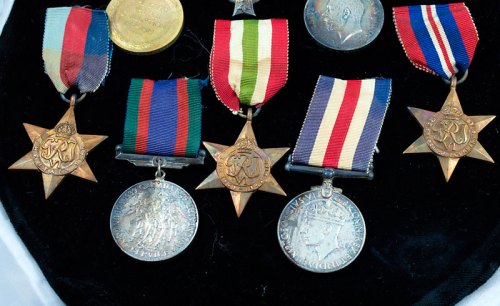
Seven of eight medals belonging to a Brandon family of soldiers who served in both world wars appeared on eBay, and they’re being auctioned starting at US$345.

eBay
Seven of eight medals belonging to a Brandon family of soldiers who served in both world wars appeared on eBay, and they’re being auctioned starting at US$345.

First World War remains identified as Manitoban

2 minute read Preview

First World War remains identified as Manitoban

2 minute read Wednesday, Nov. 5, 2014

A fifth unidentified Canadian soldier from the First World War has been identified.

The federal National Defence Department said today that remains found in Hallu, France in 2006 and 2007 are Private Sidney Halliday. Four other remains found at the same time were previously identified.

The department and the Canadian Armed Forces are now working with the families of Halliday and four other soldiers and the Commonwealth War Graves Commission to find a final resting place for all of them.

Halliday, 22, moved to Manitoba in 1915, and fought with the 78th Battalion, also known as the Winnipeg Grenadiers.

Read
Wednesday, Nov. 5, 2014

DND
Private Sidney Halliday

DND
Private Sidney Halliday

First World War documentaries to be shown for Remembrance Day

3 minute read Preview

First World War documentaries to be shown for Remembrance Day

3 minute read Tuesday, Oct. 28, 2014

A pair of documentaries about Westman soldiers in the First World War will be shown back-to-back on Remembrance Day.

Admission is free, donations will go to the Legion's poppy campaign.

The two films, 'Warpaths: Every Town Had Soldiers,' and 'Warpaths: Ghost Camps,' will be shown Nov. 11 at the Evans Theatre at Brandon University, starting at 2 p.m.

A new, third documentary in the series, 'Warpaths: Silver Crosses,' will also be shown at the Evans, but on Nov. 7, at 7:30 p.m.

Read
Tuesday, Oct. 28, 2014

A still from one of the Warpaths series of documentaries.

A still from one of the Warpaths series of documentaries.

Despite a death, final weeks of training an ‘excellent time’ for Brandon troops

Cathy Arthur 7 minute read Preview

Despite a death, final weeks of training an ‘excellent time’ for Brandon troops

Cathy Arthur 7 minute read Thursday, Sep. 25, 2014

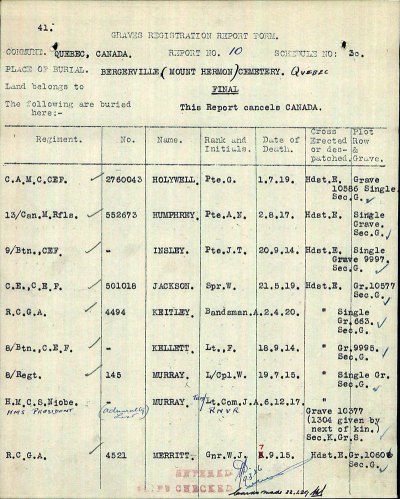
Possibly the first Brandon military death during the First World War was a bookkeeper and bass singer who was ill even before heading off to war.

Fred Kellett was in his mid-30s when he died of heart disease while training at the Valcartier camp in Quebec on Sept. 18, 1914.

Kellett was a lieutenant with the 99th Manitoba Rangers, but he was also well-known in Brandon arts and business circles before heading off to war.

A brief obituary in the Brandon Daily Sun notes that he’d worked for the city as an assistant treasurer “for some time,” although he had to go to Ninette “for the benefit of his health.”

Read
Thursday, Sep. 25, 2014

CWGC
Lt. Fred Kellett’s death, as recorded by the Commonwealth War Graves Commission.

CWGC
Lt. Fred Kellett’s death, as recorded by the Commonwealth War Graves Commission.

Internee descendants call for boycott of the CMHR

By Ashley Prest 4 minute read Monday, Sep. 15, 2014

A coalition led by descendants of First World War internees issued an open letter today calling for a virtual boycott of the Canadian Museum for Human Rights.

“We, the undersigned, are profoundly dismayed by the lack of a meaningful portrayal of Canada’s first national internment operations of 1914-1920 at the Canadian Museum for Human Rights... We will be asking our affected communities to refrain from partaking in the opening ceremonies or any subsequent activities at the CMHR until this matter is resolved fairly,” the letter states.

The letter is addressed to the museum CEO Stuart Murray and signed by Andrew Hladyshevsky, president of the Ukrainian Canadian Foundation of Taras Shevchenko.

The other signatories include officials with the Ukrainian Canadian Congress, the Ukrainian Canadian Civil Liberties Association, the Ukrainian Canadian Civil Liberties Foundation, as well as the Canadian-Croatian Chamber of Commerce and the Canadian Polish Congress.

Local boys off to training

Grant Hamilton 7 minute read Preview

Local boys off to training

Grant Hamilton 7 minute read Thursday, Sep. 4, 2014

While the First World War was winding up in Europe, patriotic spirits still ran high in Brandon.

Hundreds of Brandon men had left for training camp at Valcartier, Que., and dozens more were signing up to fill their spots.

Most of the replacement recruits were married — men who couldn’t leave their dependent families behind to head off to war.

Although opinion was split on whether it would be a very quick or only a moderately long war, local authorities were adamant that Brandon needed to do its share to help the Empire.

Read
Thursday, Sep. 4, 2014

File
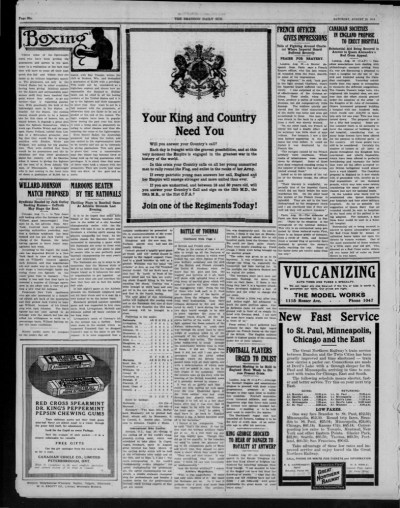
Large recruitment ads for military service were a common feature in the pages of the Brandon Daily Sun during the latter half of 1914.

File
Large recruitment ads for military service were a common feature in the pages of the Brandon Daily Sun during the latter half of 1914.

Even small memorials prove to be successes

Uncredited 5 minute read Thursday, Sep. 4, 2014

When members of the Princess Patricia’s Canadian Light Infantry stopped in Brandon yesterday, one of their stops was the veterans’ memorial at 11th Street and Victoria Avenue.

For several weeks, PPCLI has been marking its centennial with a baton relay from Edmonton to Ottawa. They’re marking the 100th anniversary by retracing the route of their initial marshalling for service, on the eve of the First World War, in 1914.

As you’ll read in today’s paper, they arrived in Brandon yesterday — part of two-day stay in the area, including Sunday in Shilo. The team set up a centennial display in both places, including a mobile museum and children’s inflatable obstacle course.

The baton itself contains the names of 1,866 people who were members of PPCLI and died during active service.

Internment camp site ‘shouldn’t go unnoticed’

Graeme Bruce 4 minute read Thursday, Sep. 4, 2014

On the grounds where Brandon’s internment camp stood now stands a small plaque to commemorate the so-called “enemy aliens” jailed during the First World War.

The plaque was unveiled yesterday outside the Brandon Police Service building on Victoria Avenue, where the former Provincial Exhibition building once stood.

The exhibition building-turned-jail held 800 to 900 people between 1914 and 1916, when it was shut down. Most prisoners were Ukrainians from Austria-Hungary.

“It’s history that shouldn’t go unnoticed,” said Rev. Michael Skrumeda of the Ukrainian Orthodox Church in Winnipeg, who was on hand for the unveiling. “It’s a privilege to stand in a place such as this.

Patriotism swept through Brandon in first weeks of war

Grant Hamilton 5 minute read Preview

Patriotism swept through Brandon in first weeks of war

Grant Hamilton 5 minute read Tuesday, Aug. 19, 2014

“Please, your honour, I was excited over the war last night and got drunk.”

That was a “first-class excuse” in police court in August 1914, according to newspaper reports in the Brandon Daily Sun.

Instead of the traditional $2 fine, the understanding magistrate — perhaps himself swept up in patriotic fervour — dismissed the charges and instead told the offender, a stranger in the city, that he had five hours to get out of town.

That’s what counted for judicial wrist-slapping in Brandon during the first few days and weeks after the declaration of war.

Read
Tuesday, Aug. 19, 2014

File photo
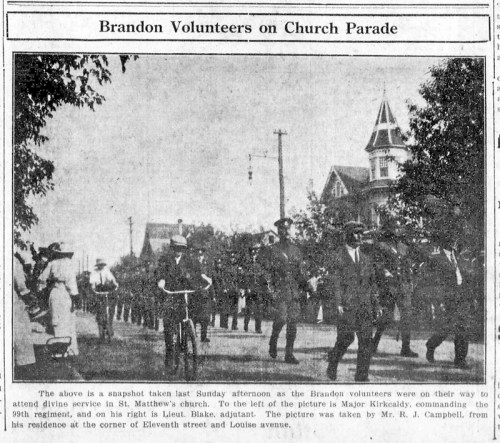
Photos from the Brandon Daily Sun in mid-August 1914 show some of the patriotic fervour that gripped the city after war was declared. Above, military volunteers march to a final city church service on Sunday, Aug. 16, 1914, prior to their departure for the front.

File photo
Photos from the Brandon Daily Sun in mid-August 1914 show some of the patriotic fervour that gripped the city after war was declared. Above, military volunteers march to a final city church service on Sunday, Aug. 16, 1914, prior to their departure for the front.

LOAD MORE