
Despite a death, final weeks of training an ‘excellent time’ for Brandon troops
Advertisement
Read this article for free:
or
Already have an account? Log in here »
We need your support!
Local journalism needs your support!
As we navigate through unprecedented times, our journalists are working harder than ever to bring you the latest local updates to keep you safe and informed.
Now, more than ever, we need your support.
Starting at $15.99 plus taxes every four weeks you can access your Brandon Sun online and full access to all content as it appears on our website.
Subscribe Nowor call circulation directly at (204) 727-0527.
Your pledge helps to ensure we provide the news that matters most to your community!
To continue reading, please subscribe:
Add Brandon Sun access to your Free Press subscription for only an additional
$1 for the first 4 weeks*
- Enjoy unlimited reading on brandonsun.com
- Read the Brandon Sun E-Edition, our digital replica newspaper
*Your next Free Press subscription payment will increase by $1.00 and you will be charged $20.95 plus GST for four weeks. After four weeks, your payment will increase to $24.95 plus GST every four weeks.
Read unlimited articles for free today:
or
Already have an account? Log in here »
Hey there, time traveller!
This article was published 24/09/2014 (4261 days ago), so information in it may no longer be current.
Possibly the first Brandon military death during the First World War was a bookkeeper and bass singer who was ill even before heading off to war.
Fred Kellett was in his mid-30s when he died of heart disease while training at the Valcartier camp in Quebec on Sept. 18, 1914.
Kellett was a lieutenant with the 99th Manitoba Rangers, but he was also well-known in Brandon arts and business circles before heading off to war.
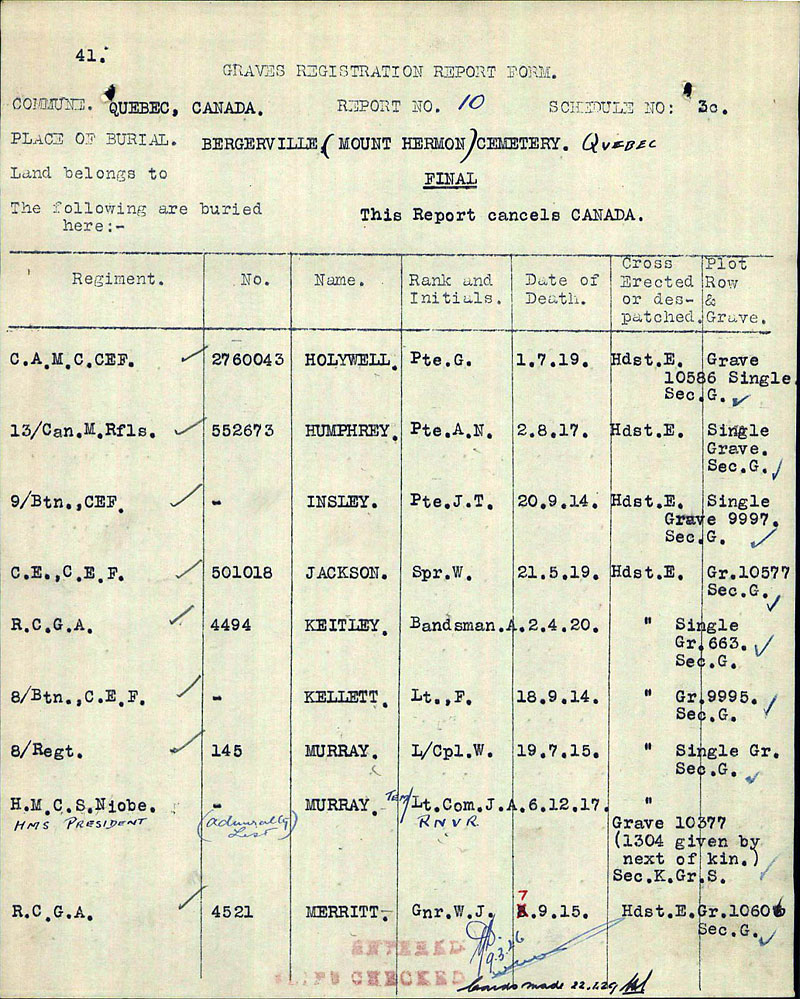
A brief obituary in the Brandon Daily Sun notes that he’d worked for the city as an assistant treasurer “for some time,” although he had to go to Ninette “for the benefit of his health.”
It says he was “about 35” when he died, and although his name is included on the archived rolls of the Canadian Expeditionary Force, there is no digitized version of his Attestation Papers on file.
There’s plenty about him in the pages of the Sun, however, where his name was a regular feature for years before the war, mostly as a vocalist who accompanied theatre shows at the downtown Starland Theatre at 715 Rosser Ave.
He was also a member of the St. Paul’s church choir, which was lauded for its shows at the Brandon asylum — “for a real good, hospitable evening the asylum is the place to go,” wrote a reviewer.
In those endeavours, Kellett was often joined by his sister, Edith, a piano teacher who also sang at a theatre: the competing Bijou Theatre, at 124 Ninth St., just around the corner from her brother’s gig.
They were both members of the Brandon Amateur Operative Society, which put on such shows as “Yeoman of the Guard” in 1911 and “The Pirates of Penzance” in 1907 (“Fred Kellett makes an ideal Pirate King,” wrote the Sun).
But to modern eyes, some of Kellett’s performances would be looked at as questionable. He was stage manager and chorus master of the Brandon Amateur Minstrel Society, which put on productions such as “A Coontown Garden Party” — featuring dubious musical delights, including “Not Because Your Hair is Curly” — and “If the Man in the Moon Were a Coon,” a huge hit in the early 1900s.
Kellett’s performance in the minstrel show was due “especial praise,” according to a printed review. “His rendition of ‘The Deathless Army’ … was given in excellent voice and was one of the outstanding features of the program.
He would give repeated performances of that tune to audiences for months.
When not singing, Kellett apparently also had a head for figures.
In 1907, he gave his occupation merely as a bookkeeper. By 1911, he was assistant treasurer for the City of Brandon, at one point stepping in to cover a five-week illness of the normal treasurer.
At the eve of war, he was working as an accountant in the Land Titles Office, while also serving as assistant orderly in the Rangers.
The note in Kellett’s obituary that he had spent time in Ninette for his health implies tuberculosis — the Ninette Sanatorium had been built in 1909 — which might have curtailed his singing career. But that would also have caused troubles with the strict medical exams that soldiers had to pass before getting on the train to Valcartier.
The only cause of death mentioned by the Sun is heart disease. The Commonwealth War Graves Commission only says “illness.”
Kellett was survived by three sisters, including Edith, as well as both his parents and a brother, Frank.
Frank, tragically, arrived at the Valcartier camp just a day or two after Fred’s death, following a three-day train ride from his home in Yorkton, Sask.
Kellett was given a military funeral at Valcartier and buried in Quebec’s Mount Hermon Cemetery, now a national historic site overlooking the St. Lawrence River, near the Plains of Abraham.
His death was one of three that the Sun reported that day — the other two soliders-in-training had contracted pneumonia.
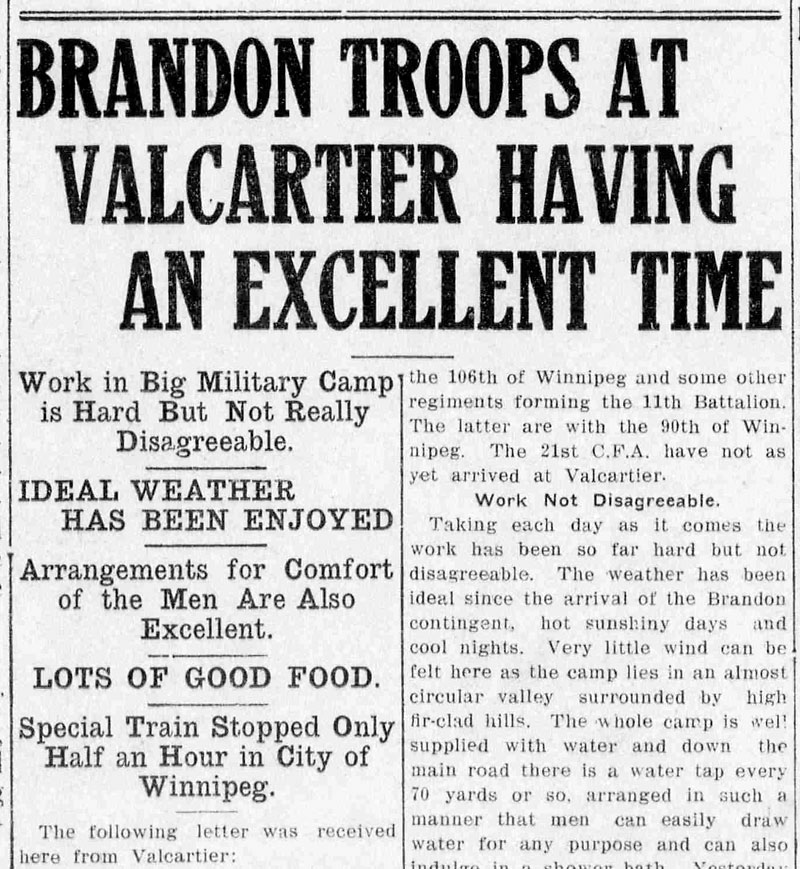
Earlier in the month, the Sun printed an extensive letter from the camp, which gave upbeat details of the training despite torrential downpours.
“The wet weather, like every other discomfort, is taken by the boys with excellent spirit,” read the letter, which the Sun printed at the top of the front page. “It was wonderful to see the men, wet to the skin, marching almost ankle deep in mud, yet singing and joking as if they were playing a game they thoroughly enjoyed.”
It was cold, too — by the end of the month, snow would be reported, apparently the earliest snow in years.
But by printed accounts, training was going very well for the majority of troops.
The camp held more than 30,000; some units were so overstrength that officers were resigning their commissions to join the ranks and boost their chances of going overseas in the first contingent.
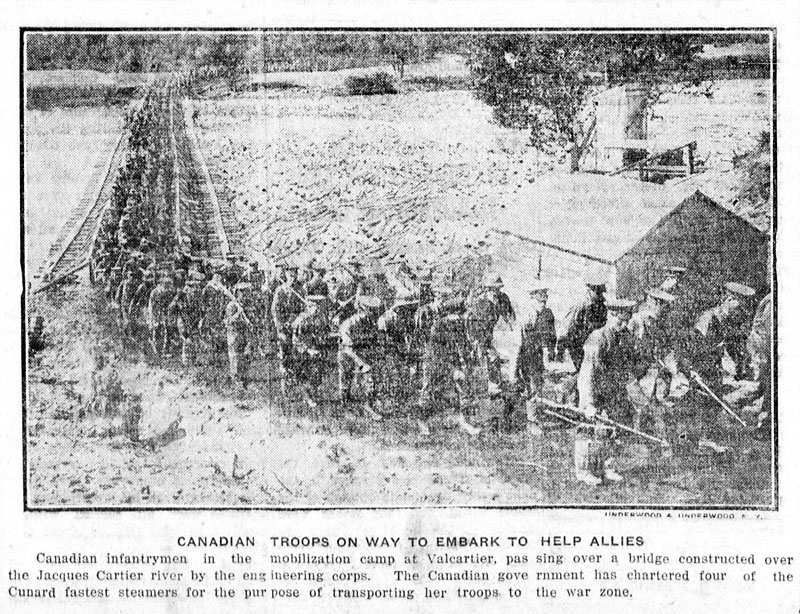
Although the departure date was supposed to be a secret, the government had commandeered ships in port, cancelling planned trips, and speculation was running high that they’d leave within a couple of weeks.
From overseas, reports of German brutality filtered into the daily war updates in the Sun — German soldiers were said to be cutting the hands off of their captives, including doctors and orderlies, so that they could never hold a gun.
On the home front, boy scouts who were enthusiasts in the then-new field of radio found themselves visited by authorities who ordered their “wireless apparatus” sealed up in a box.
Foreigners — understood to mean those of eastern European birth living north of the tracks — were ordered to give up their guns. Brandon’s police chief said he didn’t anticipate any trouble rounding up the firearms.
Meanwhile, a group of prominent citizens started taking pledges for a monthly collection so that families left behind wouldn’t be destitute, despite their wage-earners being away. The 17 or so families would require about $150 a month in support, although the city estimated that would grow as the war went on.
People stepped up admirably to the appeal.
By the end of September, Brandonites had pledged more than $5,000 monthly, with some civic employees — notably the firefighters — stepping up to donate a day’s pay every month to the cause.
» ghamilton@brandonsun.com
» Twitter: @Gramiq