
Brandon boys trained in the shadow of Stonehenge
Advertisement
Read this article for free:
or
Already have an account? Log in here »
We need your support!
Local journalism needs your support!
As we navigate through unprecedented times, our journalists are working harder than ever to bring you the latest local updates to keep you safe and informed.
Now, more than ever, we need your support.
Starting at $15.99 plus taxes every four weeks you can access your Brandon Sun online and full access to all content as it appears on our website.
Subscribe Nowor call circulation directly at (204) 727-0527.
Your pledge helps to ensure we provide the news that matters most to your community!
To continue reading, please subscribe:
Add Brandon Sun access to your Free Press subscription for only an additional
$1 for the first 4 weeks*
- Enjoy unlimited reading on brandonsun.com
- Read the Brandon Sun E-Edition, our digital replica newspaper
*Your next Free Press subscription payment will increase by $1.00 and you will be charged $20.95 plus GST for four weeks. After four weeks, your payment will increase to $24.95 plus GST every four weeks.
Read unlimited articles for free today:
or
Already have an account? Log in here »
Hey there, time traveller!
This article was published 10/11/2014 (4214 days ago), so information in it may no longer be current.
The first Nov. 11 during the Great War was just another day. It was a Wednesday.
No one knew that, four years later, it would be the date of the Armistice. No one knew that, a 100 years later, it would still be marked, as Remembrance Day.
So there were obviously no ceremonies or celebrations. The war was just getting underway, really.
A trip across
Canadian soldiers, including those from Brandon, had sailed from the east coast in early October.
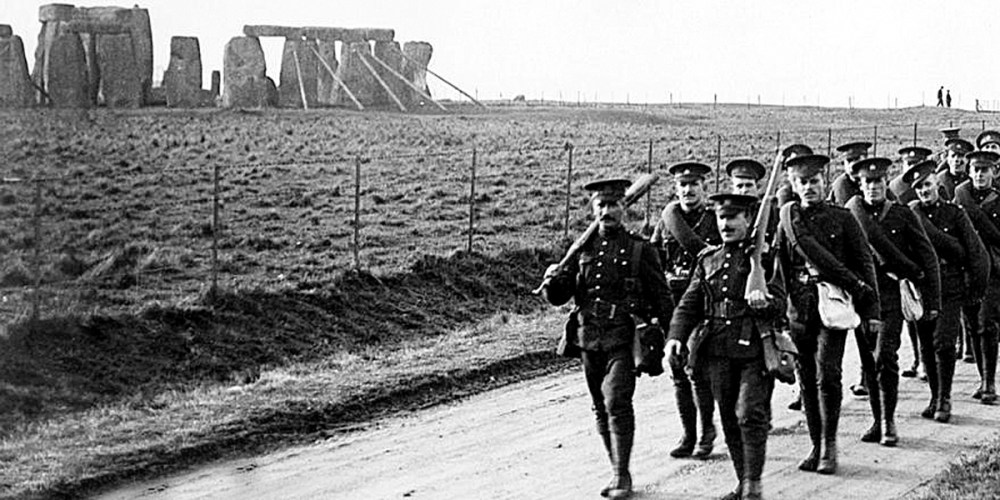
The Brandon boys had been mostly kept together, on the RMS Franconia, a nearly-new Cunard ocean liner that had been requisitioned by the government for the trip.
It was one of nearly three dozen transport ships that had sailed from Quebec down the Saint Lawrence River to the Gaspe Basin and out into the Atlantic Ocean, carrying more than 30,000 eager recruits.
Joined by 20 warships, they’d all been painted steel grey, the “battle color of the sea” according to an eyewitness, “even to the funnels.” The same utilitarian paint also covered over the names of each ship, said the witness, who was on a U.S transport about 600 km from the mouth of the Thames when the convoy steamed past.
The line of transports, with warships on each side for protection, stretched for miles: “A line so long that it laid the smudge of smoke against the sky as far as sailors could see to the east and west” on what was a clear and brilliantly sunny day.
According to a correspondent from the Montreal Gazette who was embedded with the troops on the Franconia, it had been a relatively uneventful voyage. To keep the convoy together, they had all had to travel at the speed of the slowest ship and that meant quite a bit of good-natured ribbing on the “wireless.”
At 10 knots, the trip took two weeks and calm seas meant there was no serious seasickness. Instead, the soldiers were kept active with extra training.
“The men are in great shape,” wrote the Gazette reporter. “By six a.m. they are out on deck marching at the double to the tune of Tipperary or some other ditty which makes up in liveliness what it lacks in point of diction and melody.”
Bagpipes accompanied the men as they marched and sang. Sometimes, according to the correspondent, they lined up in formation. Other times, they played games.
On board with the Brandon boys were soldiers’ pets — including a bear, possibly Winnie, and a monkey.
The trans-Atlantic trip wasn’t the last time that the Franconia would be used to haul soldiers. In 1915, it would be permanently commandeered by the British and deployed to the Mediterranean for troop transport. It was there, on Oct. 4, 1916, that she was torpedoed by the German submarine UB47, and sunk, about 300 kilometres east of Malta.
Although the Franconia could carry some 2,700 troops, only 314 crew were on her when she sank, and just 12 were lost.
On her maiden military voyage, however, there was no menace from German submarines. The biggest bout of excitement was when a man doing some work on a lifeboat on a ship just ahead lost his grip, and slipped into the sea.
Two life belts were thrown out, and the Franconia came to a halt, as sirens sounded and men rushed to the side, the Montreal correspondent wrote.
“It was the work of a few moments to launch a boat … and [the man] was drawn in, little the worse for his adventure.
“He was laughing when taken aboard, and chuckling in a quiet way at having accomplished what the sea and the Germans were unable to do, namely, break the formation of the column.”
But mostly, the men did their best to quietly pass the fortnight until landfall. They must have smoked a lot: cigarette supplies ran out after two days. Except, that is, for the hoarders who’d had the foresight to stock up. Those “wily speculators” did a brisk business selling 10 smokes for 25 cents — a huge markup from the 10 cents for 25 that they were generally sold for.
Candies and chocolate, too, went quickly, leaving the men without anything sweet to help with the nicotine cravings.
Landfall in Britain
When they landed, near midnight in Plymouth, it was without any pomp or circumstance.
A few songs were sung as the troops marched off the transports and onto a series of transport trains, but observers in Britain were said to be disappointed that the Canadians didn’t look more exotic.
“The greatest contrast between [the English] and the Canadians is the difference in physique,” wrote a Plymouth correspondent for the Canadian Associated Press, “the Canadians being on an average much larger and stronger looking than the English.”
One Canadian who didn’t impress that writer was his competitor, the “Montreal newsboy” who’d come along on the trip with the troops.
Calling him a stowaway who was “almost lost in the folds of an army coat,” the Plymouth writer nonetheless noted approvingly that the Montrealer was gamely struggling to learn the bugle, with hopes of thus making it to the front.
Once on trains — so full they had to be pulled with traction engines —the troops were taken 200 km to Salisbury, and then another 25-30 km to waiting camps set up for them on Salisbury Plain.
The camps were described as comfortable, with wooden-floored tents and straw-filled mattresses. But troops had to get used to the rainy English weather.
In the shadow of Stonehenge
Canadians were joining troops from other British territories at the huge camp.
“Salisbury Plain had been used by the military actually since the end of the 19th century, because it was just such a huge deserted area, but nothing on the scale it witnessed in the First World War,” said British Heritage’s senior historian Paul Pattison, in a short film produced for the BBC.
“There were hundreds of thousands of men in South Wiltshire in the four war years 1914-1918. It was one of the biggest training areas in the world, and certainly the biggest in England.”
The vast tract of land on had been purchased by the British Ministry of Defence in 1897, and it was right adjacent to Stonehenge.
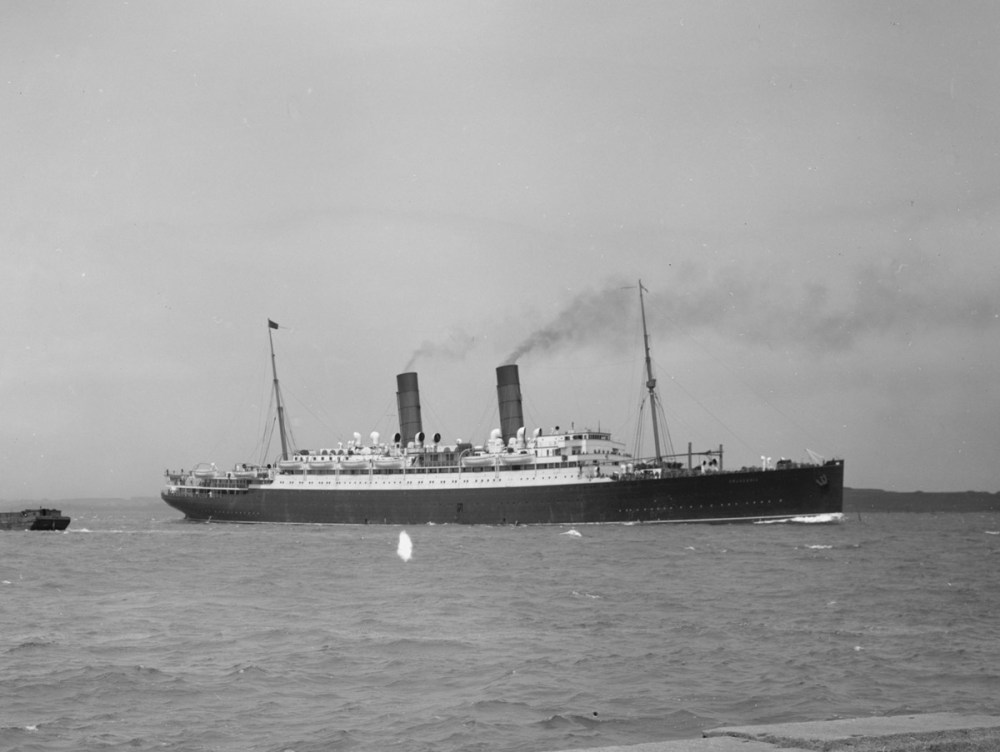
Canadian troops were among those who marched and trained in the shadow of the Neolithic stone monument.
At the time, Stonehenge was on private property, owned by a baronet. But when the family’s heir was killed in action in 1915, they put it up for auction.
It’s said that the buyer, Sir Cecil Chubbs, made his bid on the historic site on a whim, and intended it as a gift for his wife. It’s also said that she was none too pleased with the purchase. He’d dropped £6,600 on the world’s biggest fixer-upper — about the equivalent of $675,000 Canadian today.
Three years later, Chubbs gifted Stonehenge to the British government, with stipulations that the entrance fee never be increased to more than a shilling (an adult walk-up ticket is now £13.90, or about $25) and that locals be granted free access forever (still in force, although they are now limited in the number of “friends” who can accompany them).
In 1914, however, tourist development of the monument was nothing like it is now. Brandon soldiers on their training marches would have seen a monument much less restored than visitors do today. Many of the stones were propped up with huge posts — despite which, one of the upright stones and its lintel had toppled in 1900, although it had been re-erected a year later.
“The stones proved popular! Before the war they were open for the public for a small fee, and that fee was reduced during the war, so that soldiers could go and visit — and lots of them did,” Pattison told the BBC. “And actually Stonehenge becomes something of a symbol for them, something that is distinctly British and that is ancient, which they could hold on to.”
An expensive ride
Few of the Brandon contingent had actually been born in Canada. For many of the men, signing up for war also gave them a chance to visit with friends and family at home.
However, the vastness of the plains, and the camp’s distance from Salisbury itself, meant some couldn’t afford it.
One officer complained that a return trip ran as much as $25. A reporter said that it had cost him $10 for a return trip, including a stop of a couple of hours. That would be the equivalent of more than $200 today. The officer was out the equivalent of nearly $525.
Aside from family visits, there were several supplies that soldiers couldn’t get in camp that could only be obtained in Salisbury.
Along with sweets and “patent medicines” to deal with coughs and colds, for the first few weeks, the city of Salisbury was the only place where soldiers could get a drink.
The city’s three pubs were crammed full — at least until the camp director bowed to the obvious and allowed beer sales at canteens on site.
The decision was greeted with cheers.
The news at home
Meanwhile, back in Brandon, war news continued to dominate the front pages of the Brandon Daily Sun.
But war notes began to take on a personal tone, as well.
In late October, a small item noted that a former Brandonite — once a bank manager, with a large number of friends still in the city — had ended up in India, and had joined the Ninth Ghurkas. Now, it was reported, he was at the front.
Just one column over, on the same day, another note brought news of perhaps the first local link to a prisoner of war.
Few details were given, but it was said that G.F. Oglesby, whose brother lived on First Street, had been taken prisoner by the Germans while in charge of an African station for a British firm.
Elsewhere in the city, signups were being taken for an expected second contingent of soldiers — once again, many showed up. They trained repeatedly, with marches and “sham battles” at the municipal golf course, while waiting for official word calling them up.
They left with much less fanfare in early November.
Women had pitched in to knit gloves and scarves for the soldiers, to collect money for the patriotic fund, and to organize toys and other Christmas gifts for children whose fathers were away.
The general business of the city continued, with aldermen and the mayor at odds over things like bureaucrats’ salaries and consultant’s reports.
Drunks and thieves made their regular procession through the police court — but there were notably fewer vagrants.
War news ebbed and flowed with the battles, although judging by the headlines it was almost entirely good news for the British and terrible reversals for the Germans.
In reality, of course, thousands were being killed in near-stalemates like the First Battle of Ypres.
By coincidence, the headlines on that first Nov. 11, a century ago, struck a hopeful note.
“Proposals of peace,” read the banner text across the front page.
It wasn’t to be, of course. But as it turned out, Nov. 11 did prove a notable day in local war news.
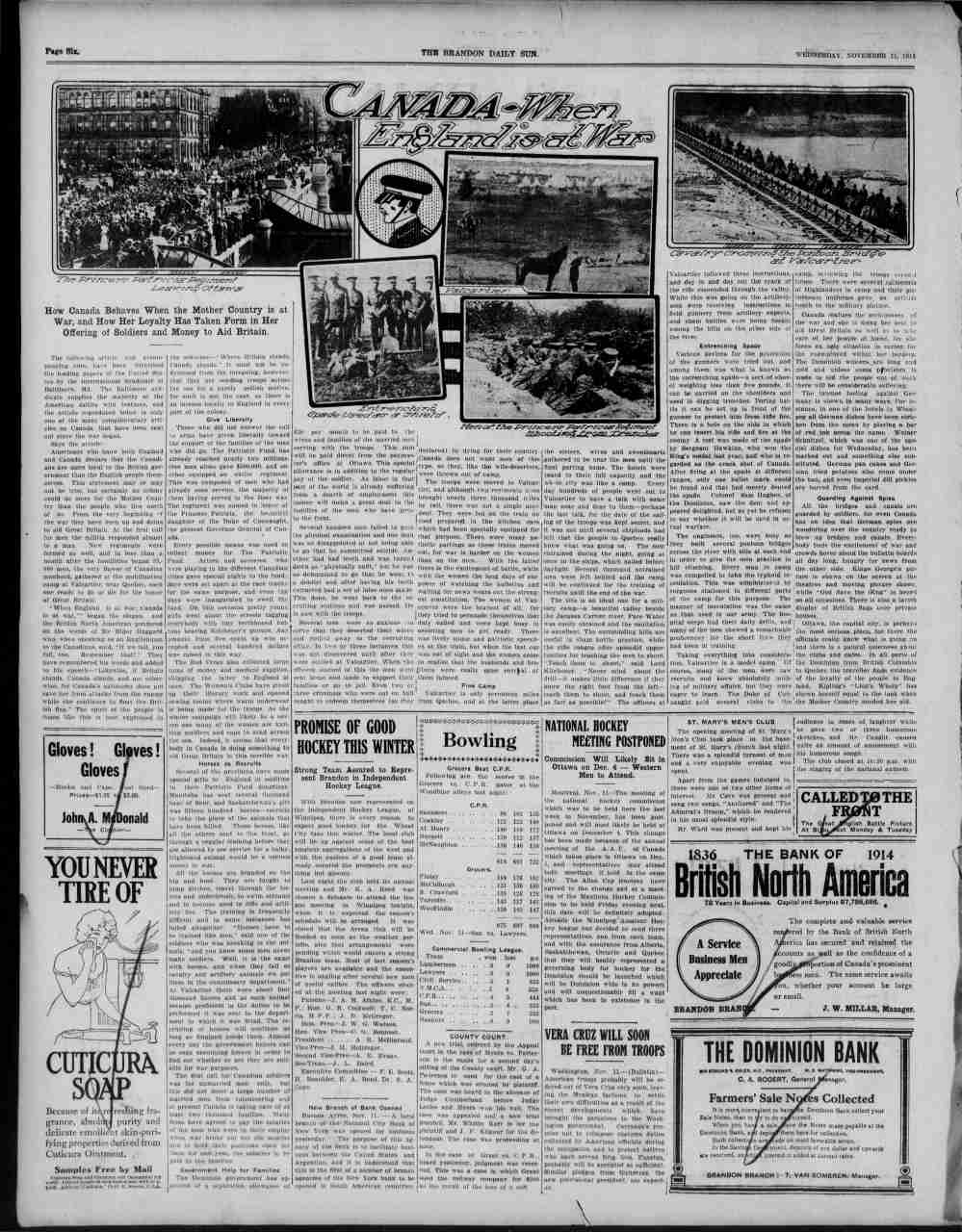
Not only did the Brandon Daily Sun feature a large profile on Canada at war, and what that meant to Brandon — a feature whose style wouldn’t have been out of place in future Remembrance Day editions —but it was the day that a large packet of letters arrived, including some news of a somewhat sobering nature.
Fireman George Watson, a Scot by birth, had been one of the first to leave Brandon for the war, departing on Aug. 18 and heading back to his native land to rejoin the Gordon Highlands, a unit he’d been part of before.
While fighting in France in mid-October, he’d been wounded in the foot. News had reached Brandon later that month of what was perhaps the first local fellow who’d been injured in battle, but details had been slim.
On Nov. 11, 1914, however, nearly a month after his injury, a letter to the fire chief arrived back in Brandon from fireman Watson.
Now that he was in hospital, at the Royal Infirmary in Edinburgh, he wrote, he was able to tell the tale a little more freely.
The fight, at Béthune, in northern France near the border with Belgium, had lasted three days, the letter said, and Watson had been wounded on the afternoon of the last day.
“I went through six battles and I was beginning to think they could not hit me but I found my mistake,” Watson wrote. A piece of shell had gone through his left foot, and he’d had to lay still for hours, until he could be evacuated in the dark, lest the Germans fire on those trying to help him.
Once back from the firing line, he wrote that he’d been quickly taken back to Scotland.
He also noted how lucky he’d been.
“It is a bit rough in France, and the Gordons get it badly,” he wrote. “After the battle of Cambrai out of out of eleven hundred next morning one hundred and seventy answered their names…
“A sergeant of our own lot got hit in the shoulder just over from me and when they went for him after dark they found him pinned up against a tree with his bayonet through him.”
It was news that maybe should have been sent right back to Britain. Also in the mailbag that day were letters from “almost every man that went from Brandon,” who were still training in Salisbury.
“The boys are having the time of their lives,” reported the Sun. “In practically every letter, however, is a reference to the anxiety to get to the scene of conflict.”
They were just months away.
» ghamilton@brandonsun.com
» Twitter: @Gramiq
Related Articles
1914’s mysterious aeroplane
Advertisement Advertise With Us
Advertisement Advertise With Us