
TEEING OFF — Killarney product finds Joye in turf care
Advertisement
Read this article for free:
or
Already have an account? Log in here »
We need your support!
Local journalism needs your support!
As we navigate through unprecedented times, our journalists are working harder than ever to bring you the latest local updates to keep you safe and informed.
Now, more than ever, we need your support.
Starting at $15.99 plus taxes every four weeks you can access your Brandon Sun online and full access to all content as it appears on our website.
Subscribe Nowor call circulation directly at (204) 727-0527.
Your pledge helps to ensure we provide the news that matters most to your community!
To continue reading, please subscribe:
Add Brandon Sun access to your Free Press subscription for only an additional
$1 for the first 4 weeks*
- Enjoy unlimited reading on brandonsun.com
- Read the Brandon Sun E-Edition, our digital replica newspaper
*Your next Free Press subscription payment will increase by $1.00 and you will be charged $20.95 plus GST for four weeks. After four weeks, your payment will increase to $24.95 plus GST every four weeks.
Read unlimited articles for free today:
or
Already have an account? Log in here »
Hey there, time traveller!
This article was published 27/05/2020 (2376 days ago), so information in it may no longer be current.
Jordan Joye does a whole lot more than cut grass.
He only wishes being a superintendent was as easy as the job he had as a 14-year-old at his hometown Killarney Lakeside Golf Club.
“The thought of putting a 14-year-old on an $80,000 fairway mower is mind-boggling. That’s what I did,” said Joye, now in his fourth season as superintendent at Glen Lea Golf Course.
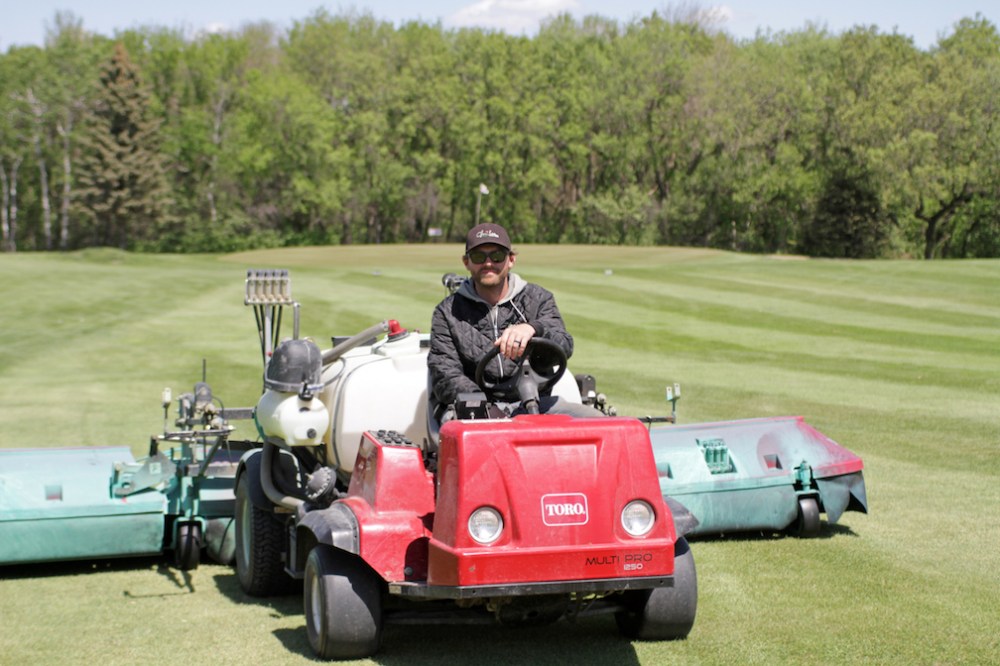
“A lot of people just can’t understand that it is more than cutting grass,” he added. “I wish I could cut grass all day, that would be so easy. But there’s a lot more that goes into it.”
Joye, who turned 32 today, started cleaning golf carts at Killarney when he was 12. He quickly took interest in the game, though it would have been tough to predict it would be his livelihood 20 years later.
Back then it was about the spending cash and perk of free golf.
“You do get a free membership out of that so you take advantage of that, slinging your bag on your bike and biking the two (kilometres) out to (the) course,” Joye said.
Joye worked on a number of courses since then, including Clear Lake Golf Course and an absolute beauty in the Fairmont Banff Springs Golf Course, where green fees are currently $259 before tax.
Along the way, Joye said the list of bosses and mentors through the years kept him coming back to a job full of early mornings and often thankless work.
“Greg Holden up in Clear Lake was huge,” Joye said. “He made me see the turf industry and the side of taking care of a property as more than a summer job or way to kill time. He took it very seriously and was really good at it.”
When Joye decided to pursue turf care as a career, he completed the two-year turfgrass management diploma program at Alberta’s Olds College.
He said the first year was fairly straightforward given his years of experience, but the eye-openers came when learning just how complicated grass truly is.
“A lot of students just thought, ‘Oh, you cut the grass, give it some water every once in a while and it’s good to go,’” Joye said. “You’re going into depth about soils and cations and it’s crazy. That’s not even including some of the pesticides and fungicides.
“… You learn things about drainage and just the guts of a sprinkler head is pretty complicated. When one of those breaks, you got to know what to do. It took a passion and summer job and turned it into more of a career.”
Like many careers, the learning is far from over upon completion of a post-secondary program. (Recent graduates might want to highlight that sentence.)
The lessons learned on the course far exceed those of a college course, and it’s no less important to have peers and mentors around to gain knowledge from. Joye said he frequently texts other superintendents around Westman and out west to share ideas and ask for advice.
Those relationships have been helpful, especially last year when Glen Lea’s greens were hit hard by a fungus called “mycelium.”
Joye opted for transparency. He consulted with Bobbie Currie, superintendent at Woodlawn Golf Club in Estevan, Sask., and tweeted out pictures of damaged putting surfaces. Joye posted regular updates as various treatments brought the greens back to normal.
“(Currie) was guiding me through this process and what worked with him, so I said, ‘Let’s try it and let’s live tweet it and let it go.’ The feedback was awesome,” Joye said.
Ultimately a lot of issues are the result of Mother Nature’s curveballs, but blame can easily fall on the ones in charge of manicuring these massive, 18-hole pieces of land.
“We’re all just doing our best,” Joye said.
“No superintendent wants to see their course struggling, whether it’s in the spring or even an irrigation break and it washes away a bunker, no one wants that to happen. So be patient and work with us.”
“I do compare us to farmers a fair bit on how we’re at the mercy (of the weather), but farmers don’t have a bunch of people judging their wheat field all the time,” he added.
Fields also don’t have constant traffic to the tune of mowers and rollers trying to keep putts rolling quick and true. They don’t get footprints of more than 100 people circling around every square inch to line up an eight-foot bogey putt.
To get courses into the fantastic shape they so often are, even after harsh winters, we have some remarkably intelligent minds behind them.
“The big thing is the stress of the plant. You don’t understand how stressed the plant is all the time,” Joye said.
“We call it the ‘Augusta effect.’ (The Masters) is in early April and that’s right (before) we’re opening, so they see Augusta (National Golf Club) on TV then come out to the course like, ‘What the hell is this?’ It’s still brown and it’s got winter kill.
“You’re going from one stress to the other. You have disease pressure all winter … it gets to minus-50 out here … It’s ready to wake up and you start beating it with mowers, you start beating it with foot traffic and it might go backwards because it wasn’t really ready to wake up.”
Course knowledge comes with playing a track enough times and the same goes for maintaining it.
“It’s just like farming: … You have to do this at this time or else this will happen,” Joye said.
“Every golf course is different, but as you’re here longer it’s like, ‘OK, if we don’t aerate by mid to end of May, by mid to end of June the greens are like this table. They’re rock hard and won’t take water.
“When you say in mid June or end of June, ‘Course is great, it’s playing nice, greens are nice and soft and it accepts a ball.’ It’s because we aerated a month ago.”
So no need to complain about those little holes on the greens in the coming weeks. Aeration helps roots grow and sets the course up nicely for the rest of the season.
And according to the United States Golf Association, those little holes impact less than 10 per cent of the putting surface, all but removing them from the list of acceptable excuses for a three-putt. While not every moment on a golf course is brilliant and there are frustrating aspects to any job, you’ll seldom find Joye complaining.
“There’s more good days than bad,” Joye said.
“The best part for me is you pull up in the morning and the sun’s just rising. When you think about it, this is my office and this is a pretty good office, even when it’s kind of cold.
“Not many people get to be outside all the time, get to interact with a good crew and good golfers and put forth a product people can see and can recognize how good it is.”