
Reckoning not easy, but it’s necessary
Advertisement
Read this article for free:
or
Already have an account? Log in here »
We need your support!
Local journalism needs your support!
As we navigate through unprecedented times, our journalists are working harder than ever to bring you the latest local updates to keep you safe and informed.
Now, more than ever, we need your support.
Starting at $15.99 plus taxes every four weeks you can access your Brandon Sun online and full access to all content as it appears on our website.
Subscribe Nowor call circulation directly at (204) 727-0527.
Your pledge helps to ensure we provide the news that matters most to your community!
To continue reading, please subscribe:
Add Brandon Sun access to your Free Press subscription for only an additional
$1 for the first 4 weeks*
- Enjoy unlimited reading on brandonsun.com
- Read the Brandon Sun E-Edition, our digital replica newspaper
*Your next Free Press subscription payment will increase by $1.00 and you will be charged $20.95 plus GST for four weeks. After four weeks, your payment will increase to $24.95 plus GST every four weeks.
Read unlimited articles for free today:
or
Already have an account? Log in here »
Hey there, time traveller!
This article was published 29/06/2021 (1875 days ago), so information in it may no longer be current.
“The department shall undertake an investigation of the loss of human life and the lasting consequences of residential Indian boarding schools. Only by acknowledging the past can we work toward a future we are all proud to embrace.”
— Deb Haaland, newly appointed U.S. secretary of the interior
Canada’s ongoing reckoning with its history of mistreatment of Indigenous peoples and the attempted destruction of their culture has had reverberations well beyond our borders, and particularly with our neighbours to the south.
As reported by The Canadian Press over the weekend, one of the first Native Americans ever elected to Congress has expressed her own dismay at the revelations of abuses and deaths with Canada’s system of residential schools. Deb Haaland’s comments above came two weeks following the discovery of the graves of 215 children in Kamloops, B.C.
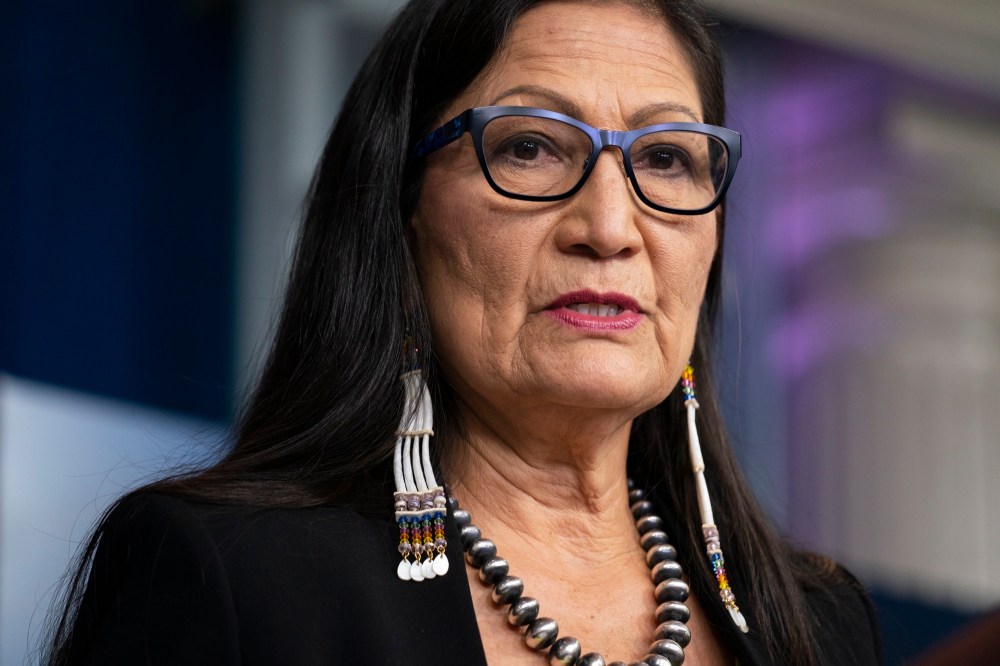
Her comments are a breakthrough in U.S. politics, where Indigenous issues and concerns are rarely addressed by government, and as CP reported, rarely front-page news.
Earlier this month, Haaland penned a column for the Washington Post that opened with the news coming out of Canada regarding the Kamloops discovery, and her comments about the U.S.’s own system of residential schools formed an eerie historical echo of what took place north of the border.
“My great-grandfather was taken to Carlisle Indian School in Pennsylvania,” she wrote. “Its founder coined the phrase, ‘Kill the Indian, and save the man,’ which genuinely reflects the influences that framed these policies at the time.”
That phrase sounds astonishingly similar to that of Sir John A. Macdonald, Canada’s first prime minister, who defended Canada’s residential school system as a way to “take the Indian out of the child.”
The article notes that when the U.S. Bureau of Indian Affairs had taken over Indigenous schooling from the Christian missionaries who initiated them, the department was operating 147 day schools and 81 boarding schools on U.S. reservations, with another 25 boarding schools off reserve. This is comparable to Canada’s own list of 150 residential schools that started operating from the 1880s, including several here in Manitoba, such as those in Brandon, Birtle and Elkhorn.
Media in the United States and around the world have taken an interest in news reports of unidentified graves at several cemeteries and residential schools in Canada. In fact, these ongoing revelations, like the most recent discovery of 751 graves of school children in southeast Saskatchewan, prompted Haaland to create the Indian Boarding School Initiative, a program that will attempt to identify all of the schools that were part of the U.S. program, with an emphasis on finding “any records relating to cemeteries or potential burial sites,” that could be later used to help locate and identify human remains.
Over the last several weeks, the Sun has taken calls and comments from individuals who have tried to downplay the suffering of Indigenous peoples under the residential school system — that they at least “got an education out of it” — or instead argued that other peoples have had similar treatment under Canadian laws and are not getting special treatment as a result.
Still others have expressed annoyance with the Sun for providing extra coverage of this issue and other Indigenous stories over the last few weeks, particularly on National Indigenous Peoples Day.
Yet it is imperative that non-Indigenous Canadians have a clear understanding of this country’s history and of the causes of pain and suffering felt by our Indigenous communities, so we can prevent similar occurrences from taking place in the future to any other people.
This is not an easy reckoning for the majority of Canadians who have taken pride in their country and the many blessings and accomplishments of which it boasts on the international stage. But it is a necessary one.
It’s at times like these we recall that the histories of Canada and the United States have long been intertwined, and often mirror each other. Canada is not alone in its treatment of its Indigenous population, though it can be argued that U.S. laws have given stronger recognition of political autonomy and self-determination for its Indigenous tribes — far stronger than those found in Canada.
As author Selena Zhao reported in the Harvard Political Review last January, the U.S. government passed the Indian Self-Determination and Education Assistance Act in 1975, which recognized U.S. Native American tribes’ “right to self-determination, or sovereignty within their boundaries …” and to “self-govern without the interference of federal agents from the Bureau of Indian Affairs.”
Canada’s First Nations are still governed by the racist and antiquated Indian Act — a situation that also needs to be addressed by our political classes moving forward.
No doubt, Americans will have similar difficulties as Canadians in facing the truth about their own residential school policies. But our neighbours to the south are already further ahead in addressing many issues that still plague our own Indigenous peoples.
If we are not very careful about our next steps forward — if we continue down the road of offering a progressive facade of apologies without meaningful action to back them up — we run a real risk of falling further behind our U.S. allies.
And our reputation in the world will suffer even further harm as a result.