Editorials

A lethal situation that demands a response

4 minute read Thursday, Apr. 16, 2026

According to Health Canada data, opioid-related deaths across the country fell by a startling 26 per cent during the 12-month period ending in September 2025. That followed a 17 per cent drop from 2023 to 2024. The general trend in Canada mirrors what has happened in the United States, where overdose fatalities fell by approximately 17 per cent nationally between 2023 to 2024.

The steep decline in overdose deaths is good news, but scientists and policy-makers in both nations are struggling to identify the precise reasons why it is happening. For example, why did fewer deaths occur in some jurisdictions, but not others? Why were deaths down in the western half of Canada in 2024, yet higher in the eastern half?

Some experts suggest the overall decline is due to the greater availability of naloxone medication in many provinces, along with the increased presence of addiction and harm reduction services. Others speculate that users may be becoming more educated and careful in their usage of the drugs, reducing their risk of death. It is also possible that law enforcement’s stepped-up war on fentanyl has caused shortages of that drug, resulting in it being mixed with other less-lethal drugs, thus resulting in fewer deaths.

Each of those factors may have contributed to the overall drop in overdose-related deaths, but some experts also suggest that fatalities are down because many of the opioid drug users who were at the greatest risk of dying from overdoses have already died.

Advertisement

Advertise With Us

Weather

Apr. 19, 12 AM: -3°c Cloudy with wind Apr. 19, 6 AM: -5°c Clear

Brandon MB

0°C, Cloudy with wind

Full Forecast

Manitobans deserve some answers on nurse practitioners

4 minute read Preview

Manitobans deserve some answers on nurse practitioners

4 minute read Wednesday, Apr. 15, 2026

With every region of Canada suffering from a doctor shortage, nurse practitioners are viewed by many as part of the solution to the problem. They are a category of nurses who have additional education and nursing experience, which enables them to autonomously diagnose and treat illnesses, order and interpret tests, prescribe medications and perform certain medical procedures.

They can play an important role in ensuring patients don’t fall through the gaps, and that is why the federal government directed in January of last year that Canada’s provincial and territorial health plans start covering the services of NPs, pharmacists and midwives who provide primary care to patients. Mark Holland, who was the federal health minister at the time, explained that he was “deeply concerned” about patients being charged for public health care, adding “That certainly isn’t in the spirit of the Canada Health Act, and this interpretation letter shuts that down.”

He set an April 1, 2026 deadline for the direction to be implemented and warned the provinces and territories that it would be enforced via deductions from federal health transfer payments if patients continued to be charged for medically necessary care. That deadline has now passed, however, and the CBC reported on Tuesday that Manitoba’s nurse practitioners are still not being paid via the province’s health plan.

The report quotes Ashley Carruthers, CEO of the Nurse Practitioner Association of Manitoba, who says “It is unfortunate that the government does not value nurse practitioners to see or know that they have that ability to know where those gaps are and the services that they can provide for their patients.”

Read
Wednesday, Apr. 15, 2026

Uzoma Asagwara

Health Minister Uzoma Asagwara says the province realizes that hiring more nurses “has to be our top priority.” (Mikaela MacKenzie/Winnipeg Free Press files)

Liberals must deliver on great expectations

4 minute read Preview

Liberals must deliver on great expectations

4 minute read Tuesday, Apr. 14, 2026

“This is a time to come together so we can build a Canada strong for all. That is how we will continue to govern. We will work with all parties and solicit all perspectives in Parliament … We will build a Canada that is not just strong, but good; not just prosperous, but fair; not just for some, most of the time, but for all, all of the time.”

— Prime Minister Mark Carney

With wins in all three byelections on Monday, Prime Minister Mark Carney’s Liberals now hold 174 of the 343 seats in the House of Commons. That gives them a razor-thin majority, but it dramatically changes both the political dynamics on Parliament Hill and the political reality across Canada.

For starters, as long as the Liberals continue to hold that majority (no deaths, departures or defections), Carney and his team have until October 2029 to implement their agenda before the next general election must be held. That gives them time for their key priorities to bear fruit — for example, new international trade deals, the Major Projects Office and the Defence Industrial Strategy.

Read
Tuesday, Apr. 14, 2026

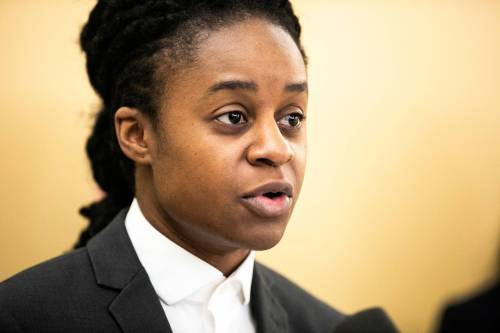
Liberal candidate Tatiana Auguste arrives after her win at her party's federal byelection night gathering in Terrebonne, Que., on Monday. After sweeping three byelections that evening, pushing the party to majority government status, it's time for the Liberals to deliver on expectations. (The Canadian Press)

Liberal candidate Tatiana Auguste arrives after her win at her party's federal byelection night gathering in Terrebonne, Que., on Monday. After sweeping three byelections that evening, pushing the party to majority government status, it's time for the Liberals to deliver on expectations. (The Canadian Press)

National problem requires a comprehensive solution

4 minute read Preview

National problem requires a comprehensive solution

4 minute read Monday, Apr. 13, 2026

The Brandon Chamber of Commerce is sounding the alarm over rising levels of retail theft in the city. As detailed in yesterday’s Sun, Brandon Police Service data reveal that shoplifting incidents in the city have risen by approximately 40 per cent. Chamber president Jennifer Ludwig says the issue has been building for some time and that many chamber members are struggling with the financial and operational strain.

“It’s another thing that business owners are having to deal with,” she says. “How do they manage security costs? How do they manage product walking out the door? How do we prevent it and work with the police so they can track what’s going on?”

Business owners and business organizations across the country are asking those same questions, with two reports released in the past month by national business organizations detailing the depth and severity of the problem.

Last week, the Canadian Federation of Independent Business released a report that reveals crime and disorder have become an everyday problem in Canada’s retail industry. In a survey of business owners conducted last fall, 50 per cent of respondents said crime had increased in their community over the previous 12 months, while just two per cent said it had declined. Despite the growing problem, the report noted that almost one-third of small business owners said they do not report crimes because they believe it’s a time-consuming process that won’t make a difference. That, the CFIB says, suggests current crime statistics may understate the true level of retail crime that is occurring.

Read
Monday, Apr. 13, 2026

The province introduced "controlled" entrances at liquor marts as a way to deal with shoplifting and the violence that can sometimes result. (File)

Controlled entrances at Liquor Marts, such as those found in Winnipeg, are coming to Brandon soon. (Submitted)

A horror movie starring your money

4 minute read Monday, Apr. 13, 2026

Many of the best horror movies depend on the fear of the unknown.

That strange shape, moving quickly through the trees outside the house. You catch a glimpse, but can’t quite…

Or the subtle changes that the main character finds when they get home — things that aren’t where they put them down. That they know have been moved — drawers left slightly ajar, curtains open when they left them closed, a hatchet that they use for making kindling mysteriously gone from the splitting block…

All of it, building a sense of foreboding.

An opportunity to rectify a mistake

4 minute read Preview

An opportunity to rectify a mistake

4 minute read Saturday, Apr. 11, 2026

Bobbi Taillefer, Manitoba’s commissioner of teacher professional conduct, has abruptly departed from that position after Manitoba media revealed on Thursday that she has been working remotely from Florida without the provincial government’s knowledge. Her departure is welcome news to those who have questioned whether she was ever the right fit for such an important role.

In her capacity as the head of Manitoba’s teacher misconduct registry, Taillefer was responsible for reviewing complaints about teacher misconduct and unprofessionalism and using her discretion to decide whether to investigate or dismiss complaints. Following her appointment in the fall of 2024, however, she had been dogged by allegations of a pro-teacher bias that some stakeholders argued would prevent her from discharging her duties in an objective and effective manner.

They pointed out that the former teacher and elementary school principal moved into union operations early in her career and subsequently served as the general secretary of the Manitoba Teachers Society, the highest non-political role in the teachers’ union. She had also held high-profile roles with the Elementary Teachers’ Federation of Ontario and Saskatchewan Teachers’ Federation.

Concerns over her potential conflict of interest were amplified in early 2025, months after her appointment as commissioner of teacher professional conduct here in Manitoba, when media reports revealed that she was still working as the executive director of the Saskatchewan Teachers’ Federation — a fact the Manitoba government was apparently unaware of until contacted by a reporter covering the story.

Read
Saturday, Apr. 11, 2026

Bobbi Taillefer's resignation from being Manitoba's commissioner of teacher professional conduct is a chance to put someone more suitable in the position.(Ruth Bonneville/Winnipeg Free Press files)

Manitoba’s independent education commissioner, Bobbi Taillefer, will have new powers to field and probe complaints about teacher performance in time for back-to-school season. (Ruth Bonneville/Winnipeg Free Press)

A better approach than gas-tax cuts

4 minute read Preview

A better approach than gas-tax cuts

4 minute read Thursday, Apr. 9, 2026

Less than two years after his year-long gas-tax holiday cost his government $340 million in lost revenues, 16 months after permanently lowering the rate for that tax, and just days after he characterized the 2024 gas-tax holiday as the most important decision ever made by a Manitoba government, Premier Wab Kinew is at it again.

During question period on Monday, as the premier was responding to the opposition’s questions regarding newly elected federal NDP Leader Avi Lewis, Kinew raised the idea of yet another fuel-tax cut. “All the member opposite can talk about is Avi Lewis,” he said, “but here in Manitoba, we’re focused on you. We cut the gas tax once. Maybe we’ll do it again.”

Neither the premier nor other representatives of his government have confirmed that another gas-tax cut is on the horizon, but he is not alone in floating the idea as a response to rapidly rising fuel costs. Last week, Conservative Party of Canada Leader Pierre Poilievre demanded that the federal Liberal government immediately suspend the fuel excise tax, clean fuel standard and GST surcharges from gas and diesel for the rest of the year. He estimates that doing so would save Canadian motorists approximately 25 cents per litre, while costing the federal government $5.25 billion in revenue.

Similarly, Alberta NDP Leader Naheed Nenshi is demanding that Danielle Smith’s United Conservative government suspend that province’s gas tax and, as Poilievre has requested, that the federal government also suspend its fuel taxes. He complains that “Albertans are facing a cost-of-living crisis and the Alberta and federal governments are not helping.”

Read
Thursday, Apr. 9, 2026

There are better ways to provide financial relief to Canadians during this cost-of-living crisis than simply slashing the gas tax. (The Canadian Press files)

A person fills up their car at a gas station in Montreal on Thursday, March 5, 2026. THE CANADIAN PRESS/Christopher Katsarov

Kids must be protected from online dangers

4 minute read Preview

Kids must be protected from online dangers

4 minute read Yesterday at 10:35 PM CDT

After delegates to last weekend’s Liberal Party national convention passed a resolution calling on the federal government to ban social media use for children under the age of 16, it was reported earlier this week that the government is very seriously considering the implementation of such a ban.

Federal Culture Minister Marc Miller told reporters on Wednesday that the federal government plans to introduce an online harms bill and is consulting with an expert advisory group on what specific measures should be included in the legislation. He emphasized that a ban could be an important tool, but that it would only be part of the solution to the problem.

“I do think it could be an important layer,” he said, “but it has to be seen as that and not as the answer to everything. Online harms don’t end as soon as you turn 15, or 16 or 17.”

Justice Minister Sean Fraser echoed Miller’s words, saying that a ban is one of several options the government is considering, “but we want to make sure that we have the full benefit of the deep policy advice from people whose full-time job it is to understand the consequences.”

Read
Yesterday at 10:35 PM CDT

Federal Culture Minister Marc Miller has said the Liberal government is seriously considering an age restriction on social media access. (File)

Federal Culture Minister Marc Miller has said the Liberal government is seriously considering an age restriction on social media access. (File)

Liberals on the threshold of a majority government

4 minute read Preview

Liberals on the threshold of a majority government

4 minute read Wednesday, Apr. 8, 2026

Longtime Conservative Party MP Marilyn Gladu announced yesterday morning that she is crossing the floor to become a member of the Liberal Party caucus. Her defection gives the Liberals 171 seats in the House of Commons, just one seat short of a majority.

The Liberals are expected to cross that threshold on Monday, when byelections will be held in three ridings. The contest in the Quebec riding of Terrebonne is expected to be very close between the Liberal and Bloc Québécois candidates, but the Liberals are widely expected to win in the Ontario ridings of Scarborough Southwest and University-Rosedale. Wins in the latter two ridings would give the Liberals a majority — enabling the government to enact its agenda over the next three years without needing the support of other parties — while a sweep of all three would give them additional breathing room.

Gladu is the fifth opposition MP to cross to the Liberals since October of last year. Matt Jeneroux, Chris d’Entremont and Michael Ma previously left the Conservative caucus, while Lori Idlout switched from the NDP. Of the five, however, Gladu stands out. She was candidate for the Conservative Party leadership in 2020 and was widely perceived as a staunch, true-blue Conservative. The fact that she believes she can fit within the more centrist Liberal caucus is remarkable, and may signal to other Tory caucus members that they too could be comfortable as part of Mark Carney’s Liberal government.

In fact, Ottawa media is awash with rumours and speculation that as many as 10 additional Conservative MPs are also considering switching to the Liberals sometime soon. If that is even partially true — if even only a few more Tory MPs bolt for the Liberals — it will deal a serious blow to Pierre Poilievre’s ability to remain as Conservative leader. It will also lend additional weight to questions that many Canadians are already asking.

Read
Wednesday, Apr. 8, 2026

Conservative Leader Pierre Poilievre leaves the stage after speaking at the Economic Club of Canada in Toronto in February. Poilievre has publicly expressed his displeasure with recent defections by his conservative MPs to the Liberals, but there's no law nor rule against them.

Conservative Leader Pierre Poilievre leaves the stage after speaking at the Economic Club of Canada in Toronto on Thursday February 26, 2026.THE CANADIAN PRESS/Chris Young

Bond-rating agencies send ominous signal

4 minute read Preview

Bond-rating agencies send ominous signal

4 minute read Tuesday, Apr. 7, 2026

In a post-provincial budget opinion piece published two weeks ago (“Finding the facts on Budget 2026,” March 26), Sun columnist Deveryn Ross questioned the plausibility of the Kinew government’s plan to slash the deficit via a combination of much higher tax revenues and Manitoba Hydro’s return to profitability.

He challenged the budget’s assumption that Hydro will earn $140 million this year, given the reality that the utility has recently incurred large losses due to lower-than-normal water levels in the lakes and waterways that supply the water that powers Hydro’s electricity-generating turbines. He argued that the government is “recklessly relying on the weather” to protect the province from another larger-than-projected deficit.

Ross also noted that Budget 2026 anticipates that the government’s tax revenues will be almost $300 million higher than last year. He pointed out, however, that the assumption appears to ignore the economic turmoil unfolding in Canada, the U.S. and around the world, along with the fact the province fell $161 million short of last year’s tax revenue projection.

Those concerns were validated last Thursday, when the Moody’s bond-rating rating agency issued a report that also questions the province’s plan to slash the deficit this year and balance the budget next year. The agency said the province’s deficit-reduction plan is inconsistent with the government’s own economic growth projections, and specifically noted that the “rapid pace of projected fiscal improvement” set out in Budget 2026 is contradicted by the fact that the document estimates economic growth of less than two per cent for each of the next two years.

Read
Tuesday, Apr. 7, 2026

Bond-rating agencies have express skepticism over Manitoba's Budget 2026, which includes an optimistic prediction for Manitoba Hydro, even though recent dry years have dampened its performance. (File)

Bond-rating agencies have express skepticism over Manitoba's Budget 2026, which includes an optimistic prediction for Manitoba Hydro, even though recent dry years have dampened its performance. (File)

A decision that crosses the line between church, state

4 minute read Preview

A decision that crosses the line between church, state

4 minute read Monday, Apr. 6, 2026

Manitoba’s NDP government is contributing $325,000 in taxpayer money toward the Brandon Islamic Centre’s proposed new worship building. The funding will reportedly go toward the cost of constructing a larger facility that will accommodate the centre’s growing congregation. The building, which will apparently be located just outside of the city, is expected to cost approximately $3 million.

The announcement of provincial support for the project comes after years of rejection at the local government level. In the summer of 2018, BIC representatives appeared before Brandon City Council to request the city’s assistance in finding a suitably sized piece of land for them to build a new facility on. They also discussed the idea of city council asking developers to allocate land for places of worship in future developments.

In response to those requests, this newspaper’s editors wrote (“Council must be careful how, where it spends money,” July 18, 2018) that Brandon is a better community for having the Islamic centre here, but governments at all level must be careful not to show favouritism when it comes to funding faith-based groups. They emphasized that if one religious organization receives financial help from the city, all religious organizations must be treated the same.

Former Sun columnist Kerry Auriat echoed those concerns, writing days later that “It is not the role of our city council to find low-cost property options for religious organizations, regardless of how important faith is in many of our lives. Showing preference for any religious organization is an absolute non-starter and should be rejected forthwith.”

Read
Monday, Apr. 6, 2026

Manitoba Premier Wab Kinew, Deputy Premier Uzoma Asagwara and over 400 people across the city gather Monday evening at the Healthy Living Centre at Brandon University for a community iftar hosted by the Brandon Islamic Centre. (Photos by Abiola Odutola/The Brandon Sun)

Manitoba Premier Wab Kinew, Deputy Premier Uzoma Asagwara and over 400 people across the city gather Monday evening at the Healthy Living Centre at Brandon University for a community iftar hosted by the Brandon Islamic Centre. (Photos by Abiola Odutola/The Brandon Sun)

Empty beds due to staffing shortage

4 minute read Preview

Empty beds due to staffing shortage

4 minute read Friday, Apr. 3, 2026

After almost four years of construction activity, the new critical care facility at the Brandon Regional Health Centre is expected to begin receiving patients next month. The number of beds in the new Intensive Care Unit will increase from 10 to 12, and eventually grow to 16 beds depending on the number of nurses interested in working in the unit. The 30-bed Internal Medicine Unit will open with 15 beds, with the remaining 15 beds being added as more staff are hired for the unit.

There is no timeline for the when the 15-bed Internal Medicine Unit will open. Similarly, the fourth level of the facility is a “shell space” for a planned neonatal intensive care unit which, once open, would enable the delivery of specialized neonatal services.

Health Minister Uzoma Asagwara says the hospital expansion will allow more Westman residents to receive life-saving care closer to home and will reduce the number of patient transfers to other hospitals. That’s a glossy spin of the situation, however. Just two more beds are being added in the ICU at the moment, while only one-half of the originally planned 30 beds will be available in the Internal Medicine Unit. The 15-bed Internal Medicine Unit will sit empty and unused for the time being, while the promised neonatal unit is likely years away under even the most optimistic scenario.

That amounts to just 17 new beds being available in May for a cost to taxpayers of $120 million — more than $7 million per bed — and that is almost entirely due to the staffing shortages at the Brandon hospital and in Prairie Mountain Regional Health Authority facilities throughout Westman.

Read
Friday, Apr. 3, 2026

Visitors to the Brandon Regional Health Centre pass by the under-construction critical care building in December 2025. The facility is expected to receive its first patients next month. (Tim Smith/The Brandon Sun files)

Visitors to the Brandon Regional Health Centre pass by the under-construction critical care building on Monday. The facility is scheduled to open early in the new year. (Tim Smith/The Brandon Sun)

Find fairer approach for byelection costs

4 minute read Preview

Find fairer approach for byelection costs

4 minute read Thursday, Apr. 2, 2026

The final numbers are in, and they aren’t pretty. According to a CTV News report, Canada’s chief electoral officer has revealed that last August’s byelection in the Battle River-Crowfoot riding cost Canadian taxpayers a staggering $2.342 million — more than half a million dollars higher than the average cost of federal byelections in Canada.

For those unfamiliar with the circumstances surrounding last summer’s byelection, it goes back to the federal general election one year ago, in which Conservative Party Leader Pierre Poilievre was defeated in his Carleton riding by Liberal Bruce Fanjoy by more than 4,500 votes. Mere weeks after the election, Conservative MP Damien Kurek announced that he intended to resign his Battle River-Crowfoot seat shortly after being sworn in. Poilievre then announced he would be running for the Tories in the byelection for that seat.

The contest was held on Aug. 18, and Poilievre won with more than 80 per cent of votes cast. That was hardly a surprise, given Battle River-Crowfoot’s reputation as one of the safest Conservative seats in the nation. The byelection was complicated by the fact, however, that more than 200 candidates were listed on the ballot. That was due in large part to efforts by the “Longest Ballot Committee,” which encourages multiple candidates to seek election in ridings as part of its push for electoral reform.

Was it reasonable for Kurek to resign his seat so soon after being elected, in order to bail his leader out of an embarrassing predicament? Was it reasonable for taxpayers to be forced to incur such a large expense solely because Poilievre wanted a second chance at being elected?

Read
Thursday, Apr. 2, 2026

Anaida Poilievre (from left), Conservative Party Leader Pierre Poilievre, Damien Kurek and Danielle Kurek celebrate Pierre Poilievre’s win during the Battle River-Crowfoot byelection in Camrose, Alta. in August. The byelection cost Canadian taxpayers $2.342 million. (The Canadian Press files)

Anaida Poilievre (from left), Conservative Party Leader Pierre Poilievre, Damien Kurek and Danielle Kurek celebrate Pierre Poilievre’s win during the Battle River-Crowfoot byelection in Camrose, Alta., on Monday. Poilievre passed the first challenge to his leadership following his election loss; the next will be his party leadership review in January. (The Canadian Press)

Kinew gets his history wrong

4 minute read Preview

Kinew gets his history wrong

4 minute read Tuesday, Mar. 31, 2026

Manitoba Premier Wab Kinew would be wise to familiarize himself with the history of the province he leads. According to a CBC report, the premier was asked last weekend to identify “the most important thing a Manitoba government has ever done.” His response was a surprise, to say the least.

The report quotes him as saying that his government’s decision to suspend the 14 cents per litre gasoline tax for all of 2024 was “the most important thing that a provincial government ever did in the history of Manitoba because it gave power back to the middle class and to the low-income folks.”

Really? That was the most important accomplishment by a Manitoba government in our province’s history?

The premier is wrong. The gas tax holiday, as it was often characterized, was the target of criticism as a misguided, costly stunt that deprived provincial coffers of almost $350 million in revenue at a time when the province was facing a much larger than expected deficit of more than $1 billion.

Read
Tuesday, Mar. 31, 2026

Manitoba Premier Wab Kinew speaks with reporters before the First Ministers Meeting in Ottawa on Jan. 29. If the premier believes populist measures like tax cuts should be lauded, he would have to admit that his temporary gas tax holiday was less significant in both impact and duration than the Pallister government’s decision to permanently cut the retail sales tax rate. (The Canadian Press files)

Manitoba Premier Wab Kinew speaks with reporters before the First Ministers Meeting in Ottawa, Thursday, Jan. 29, 2026.  THE CANADIAN PRESS/Adrian Wyld

Lewis and NDP at a crossroads

4 minute read Preview

Lewis and NDP at a crossroads

4 minute read Monday, Mar. 30, 2026

Avi Lewis has his work cut out for him. The newly elected leader of the federal New Democratic Party achieved a first-ballot victory this past weekend, receiving nearly 40,000 of almost 70,000 votes cast by party members in the ranked-ballot leadership contest. That’s an impressive accomplishment, but the task before him as leader is even more formidable.

His party is coming off of one of its worst results in a federal election in decades, in which then-party leader Jagmeet Singh was defeated and just seven NDP candidates were elected to the House of Commons. One of those MPs, Lori Idlout, recently crossed the floor to the governing Liberals while another, Alexandre Boulerice, is rumoured to be considering resigning as an MP in order to shift to Quebec provincial politics.

With such a small caucus, the NDP no longer has official party status, doesn’t have the higher budget that comes with that status, and is reportedly millions of dollars in debt.

To make matters worse, polls indicate that a large percentage of Canadians are happy with the performance of Prime Minister Mark Carney, and appear to believe the Liberals are better equipped than the NDP to respond to the heavy-handed actions of the Trump administration.

Read
Monday, Mar. 30, 2026

Avi Lewis, who was proclaimed as the new leader of the NDP, celebrates at the party convention in Winnipeg on Sunday, March 29, 2026. THE CANADIAN PRESS/John Woods

Avi Lewis, who was proclaimed as the new leader of the NDP, celebrates at the party convention in Winnipeg Sunday, March 29, 2026.   THE CANADIAN PRESS/John Woods

Overcrowding of jails has no simple fix

4 minute read Preview

Overcrowding of jails has no simple fix

4 minute read Sunday, Mar. 29, 2026

Rarely, if ever, does government respond so quickly to a demand for more money.

On March 20, the Manitoba Government and General Employees’ Union said that overcrowding in provincial jails was causing mayhem and putting their members at risk. “When you put more people in and have less programming, less opportunities for recreation … the temperature rises within the facility,” union president Kyle Ross said.

It didn’t take long for government to respond.

On the same day, Justice Minister Matt Wiebe gladly confirmed the NDP government was going to increase the budget for corrections by $14 million.

Read
Sunday, Mar. 29, 2026

The Brandon Correctional Centre on Veterans Way. There's no point in throwing money at hiring more guards unless something is done to adress the underlying reasons for crowding. (Tim Smith/The Brandon Sun files)

The Brandon Correctional Centre on Veterans Way. There's no point in throwing money at hiring more guards unless something is done to adress the underlying reasons for crowding. (Tim Smith/The Brandon Sun files)

LOAD MORE