
Manitobans could use gas tax relief
Advertisement
Read this article for free:
or
Already have an account? Log in here »
We need your support!
Local journalism needs your support!
As we navigate through unprecedented times, our journalists are working harder than ever to bring you the latest local updates to keep you safe and informed.
Now, more than ever, we need your support.
Starting at $15.99 plus taxes every four weeks you can access your Brandon Sun online and full access to all content as it appears on our website.
Subscribe Nowor call circulation directly at (204) 727-0527.
Your pledge helps to ensure we provide the news that matters most to your community!
To continue reading, please subscribe:
Add Brandon Sun access to your Free Press subscription for only an additional
$1 for the first 4 weeks*
*Your next subscription payment will increase by $1.00 and you will be charged $20.00 plus GST for four weeks. After four weeks, your payment will increase to $24.00 plus GST every four weeks.
Read unlimited articles for free today:
or
Already have an account? Log in here »
Hey there, time traveller!
This article was published 10/03/2022 (1466 days ago), so information in it may no longer be current.
Spiking gas prices across the country are spurring both anxiety and anger among motorists, general consumers and the business community as Canadians watch their buying power dwindle, their budgets shrink and their business inputs rise.
The cost of a barrel of oil has been rising on the back of high demand and a shortage of supply — a situation that has been further exacerbated by Russia’s invasion of Ukraine, and the resulting economic sanctions imposed upon Russia by much of the Western world.
This sudden rise in gas prices the past two weeks — the average cost of a litre of regular fuel in Brandon stood at $1.73 on Thursday – has prompted calls for both federal and provincial governments to find ways to ease the pressure at the pumps.
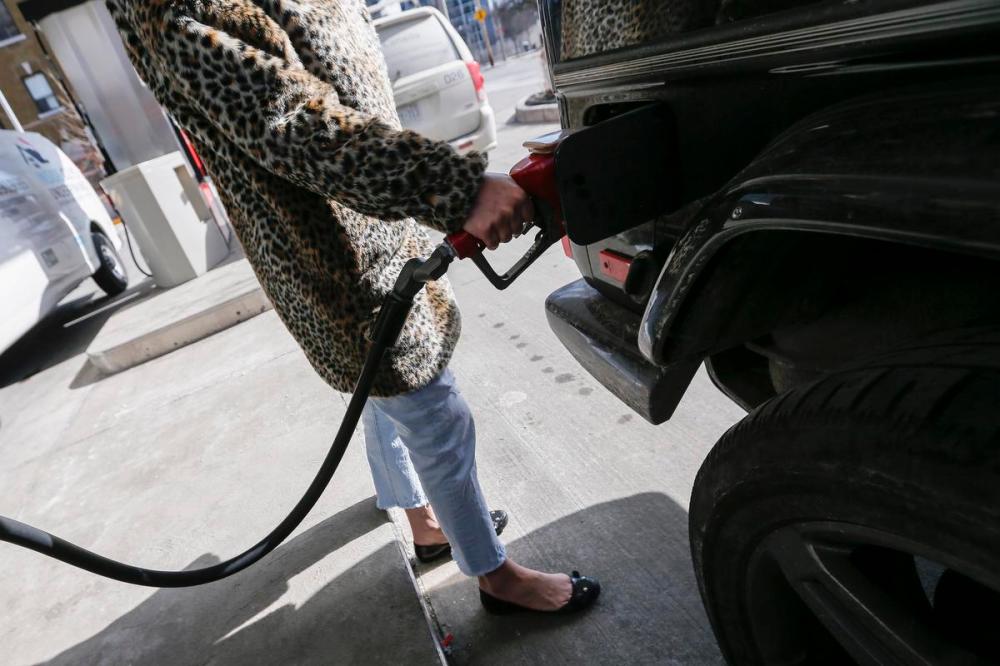
Earlier this week, New Brunswick Premier Blaine Higgs called upon the federal government to defer the carbon tax in that province by three months as a means to bring down the cost of fuel. His plea was echoed by Ontario Energy Minister Todd Smith on Tuesday, who urged the Trudeau government to further reconsider a planned increase in the federal carbon tax of 2.2 cents per litre across the country to a total of 11 cents planned for April 1.
“We encourage the federal government to reduce or at least pause their increase in the carbon tax on April 1,” Smith said Tuesday.
But that deferral is unlikely to come. As the CBC reported yesterday, federal Intergovernmental Affairs Minister Dominic LeBlanc said the Trudeau government’s carbon pricing standard will stay the same and increase as scheduled at the end of this month.
“The New Brunswick government has a whole series of tools on its own to decide it it wants to do something about the price at the pump,” LeBlanc told the CBC, “but the federal carbon price increase will go ahead as planned.”
The increasing pain at the pumps comes in the midst of today’s two-year anniversary of the ongoing COVID-19 pandemic in Canada, and the financial and social turmoil that has affected every part of our day-to-day lives. Business owners who have already felt the economic blow of a pandemic are now being hit with growing inflation in both Canada and the United States.
Meanwhile, ordinary consumers are forced to watch as everything from food prices to home renovation materials — items shipped by truck — rise. Yet any increase they may see on their paycheques will fail to meet the rate of inflation. It’s a one-two punch that will no doubt further constrain the recovery of our already impacted economy.
As a result, at least one province has decided to cut its own gas tax on April 1 as a means to blunt the impact on motorists and businesses. Alberta Premier Jason Kenney said Monday that his government would pause the collection of its 13 cent per litre provincial fuel tax, and would only resume the collection of the tax when the West Texas Intermediate price of a barrel of crude oil falls below US$80 US. The WTI closed at US$119 per barrel on Monday, and had risen to US$127 on Tuesday, according to reports.
While oil-rich Alberta may have the ability to enact such a temporary tax cut, not all provinces are as secure. Higgs told CBC that he’d like to do something to ease prices at the pumps, but that provinces like Alberta stand to benefit from the rising cost of oil to offset the tax cut.
“They are making this up many times over on the increased price of crude oil and their ability to get revenues there,” Higgs said.
At least one University of Calgary economist, Trevor Tombe, suggests provinces like New Brunswick should simply send people cheques instead of demanding a gas tax deferral, an option he says would allow the province to target those who need the most help if it chose to.
Further, The Monitor — a bimonthly current affairs magazine published by the left-leaning Canadian Centre for Policy Alternatives — argues in a recent article that the whole point of the carbon tax “is to encourage people to use fewer fossil fuels to help slow climate change while giving them time to adapt.” The solution, says author Randy Robinson, is not to cut taxes that are already being rebated back to consumers or helping to pay for roads, but rather to “reduce our reliance on fossil fuels altogether.”
Perhaps the best option lies somewhere in the middle. No government should stand by and watch its citizens suffer financial pain when they have the power to at least lessen the impact in the short term. It’s not good economic policy, and quite simply it’s not good politics. A long-term strategy to reduce carbon emissions and gradually wean ourselves off of fossil fuels does have merit, even if the federal Conservatives argue otherwise. And there is a need to continue down the road we are now following — the health and viability of our environment depends upon it.
But the recent rise in fuel prices goes well beyond those parameters, and thanks to the situation in Ukraine and the need for swift international co-operation and action, this most recent spurt in fuel prices is an unhelpful burden upon our economy that has given no one time to adjust. No doubt, a deferral of the federal gas tax for a few months to let Canadians catch their breath, or perhaps a decision by the Manitoba government to take a page from Alberta’s book and cut some or all of its 14 cents per litre gas tax would offer some relief to Manitoba’s economy.
In the short term, that too is a defensible position.
» Matt Goerzen, editor