
Lessons from overpriced chicken breasts
Advertisement
Read this article for free:
or
Already have an account? Log in here »
We need your support!
Local journalism needs your support!
As we navigate through unprecedented times, our journalists are working harder than ever to bring you the latest local updates to keep you safe and informed.
Now, more than ever, we need your support.
Starting at $15.99 plus taxes every four weeks you can access your Brandon Sun online and full access to all content as it appears on our website.
Subscribe Nowor call circulation directly at (204) 727-0527.
Your pledge helps to ensure we provide the news that matters most to your community!
To continue reading, please subscribe:
Add Brandon Sun access to your Free Press subscription for only an additional
$1 for the first 4 weeks*
- Enjoy unlimited reading on brandonsun.com
- Read the Brandon Sun E-Edition, our digital replica newspaper
*Your next Free Press subscription payment will increase by $1.00 and you will be charged $20.95 plus GST for four weeks. After four weeks, your payment will increase to $24.95 plus GST every four weeks.
Read unlimited articles for free today:
or
Already have an account? Log in here »
Hey there, time traveller!
This article was published 14/01/2023 (1208 days ago), so information in it may no longer be current.
It all started with one reporter taking a simple, trivial picture of an overpriced pack of five boneless, skinless chicken breasts. The cost was $26.87 a kilo, a world-class sticker shocker, at least double what one would expect to pay for chicken breasts.
Within hours, the picture became the lightning rod for frustrated consumers on social media. Loblaw and Galen Weston — the company’s chairman, president, and well-known public persona of the company’s brand — became public enemy No. 1. Attacks were instant, and mostly vicious.
On the surface, the collective uproar against Loblaw lacked any rational thinking. The chicken breasts in the picture were skinless, boneless, and free from hormones and antibiotics, which would make them premium products. The untrained eye may not have been able to see the “PC FF” on the label, which meant “Free From,” but it was there.
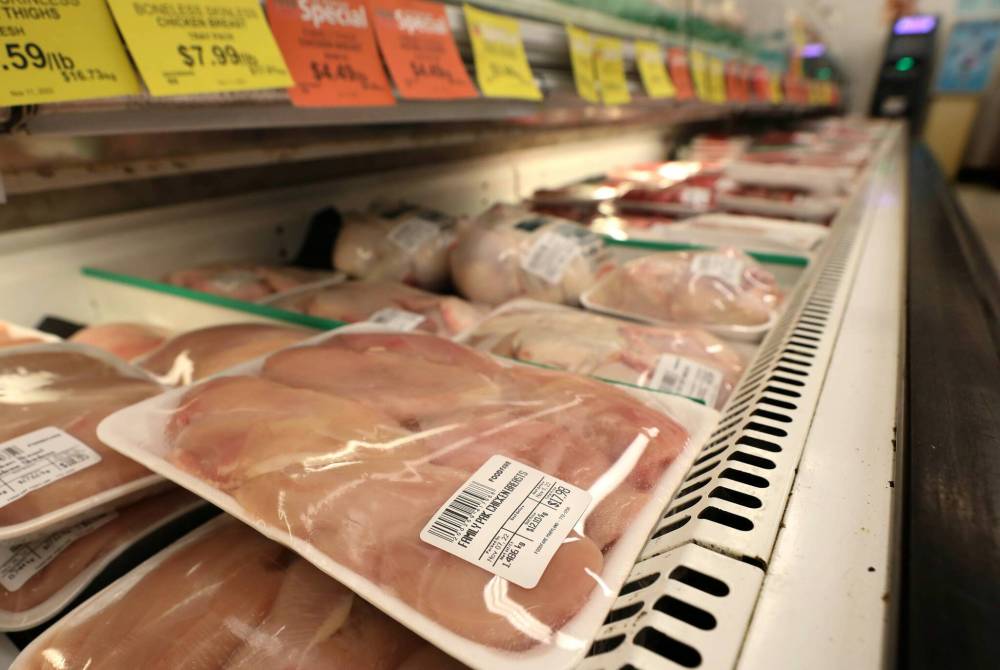
Canadians consumers have been up in arms over the high cost of meat, especially chicken. However, Canada has one of the lowest food inflation rates in the Western world, according to Sylvain Charlebois. (File)
Other retailers in the Greater Toronto Area were even selling similar products at similar price points.
Furthermore, for months now the poultry industry, including egg producers, has been challenged by an avian flu outbreak, affecting almost 300 farms across the country. Many of them are in Ontario. Almost five million birds were culled in the last year, preventing millions in inventory from reaching the market. Supply-side pressures have been significant for a while. As such, prices for chicken, turkey, and eggs have all been impacted by the outbreak.
What also needs to be underscored is that chicken production is supply-managed in Canada. With our quota system, we essentially produce what we need and consume very little imported poultry products. According to Statistics Canada, the average net worth of a poultry and egg farmer in Canada is well over $6 million. Farmgate prices are set by boards which, in turn, are heavily influenced by production costs. In most years, farm prices will go up and the rest of the supply chain will cope with supply chain economics.
That’s how supply management works. Poultry and egg prices have historically been higher in Canada than elsewhere in the Western world. Nonetheless, supply management has offered Canadians stable prices. In fact, chicken has been the more stable component of the meat trifecta, which also includes pork and beef. But since early 2020, the meat counter has increasingly become expensive, no matter what protein you are after. Many of these factors are far beyond Loblaw’s control.
Still, call it “chickengate” if you will, but instant public outcries like the one we witnessed with the picture of overpriced chicken breasts do happen for a reason. The last time Canada’s food inflation rate was below our nation’s general inflation rate was in October 2021. While everything in our lives got more expensive, it got significantly worse at the grocery store.
Consumers are actively looking for a scapegoat, one they can relate to. Most consumers barely appreciate how farming, logistics, or even food processing works, but most of us have been to a grocery store. It’s a familiar environment for most of us. Grocery stores are portals to a very complex food system we can barely see and understand, so promptly blaming grocers for overpriced products is instinctive.
Like in many Western countries, the politicization of higher food prices has led to a parliamentary investigation and broad-based inflationary support payments in provinces like Quebec and Prince Edward Island. These payments will likely make things worse, but it doesn’t matter.
Canada has one of the lowest food inflation rates in the Western world. Among G7 countries, only Japan has a lower food inflation rate right now. Higher food prices are a global phenomenon, full stop. Even if it makes little sense to blame one grocer, or even one man for our ills at the grocery store, Canadians have every right to be upset. Context is everything, and consumers are on edge and will second-guess anything and everything and have every reason to do so.
The bread price-fixing scandal, which lasted 14 years, the hero-pay debacle during the pandemic, almost forcing consumers to use self-checkout counters, all add up to many Canadians feeling incredibly vulnerable and unprotected.
In December, our parliamentary standing committee in agriculture and agri-food called top grocers to testify in Ottawa as part of an investigation of food inflation. None of the CEOs showed up, including Galen Weston himself. All of them opted to send their CFOs instead. They should have had the decency to show up and oblige our House of Commons, which represents the Canadian people.
The chicken breast incident points to how incredibly delicate things are right now. The food industry, and particularly grocers, are facing a crisis of confidence, no less. Consumers have become hyper-sensitive to any potential evidence suggesting abuse of market power, and grocers will need to navigate the coming months with extreme caution. Showing more public empathy would be a good start.
In the meantime, consumers should know their prices even before they show up at the grocery store, stay calm, and read labels. If a price is beyond what was expected, just walk away. A more affordable substitute in the same store is likely within reach. Consumers have more power than they believe.
» Sylvain Charlebois is senior director of the agri-food analytics lab and a professor in food distribution and policy at Dalhousie University.