
Soil conservation, irrigation have untapped potential amid droughts
Advertisement
Read this article for free:
or
Already have an account? Log in here »
We need your support!
Local journalism needs your support!
As we navigate through unprecedented times, our journalists are working harder than ever to bring you the latest local updates to keep you safe and informed.
Now, more than ever, we need your support.
Starting at $15.99 plus taxes every four weeks you can access your Brandon Sun online and full access to all content as it appears on our website.
Subscribe Nowor call circulation directly at (204) 727-0527.
Your pledge helps to ensure we provide the news that matters most to your community!
To continue reading, please subscribe:
Add Brandon Sun access to your Free Press subscription for only an additional
$1 for the first 4 weeks*
- Enjoy unlimited reading on brandonsun.com
- Read the Brandon Sun E-Edition, our digital replica newspaper
*Your next Free Press subscription payment will increase by $1.00 and you will be charged $20.95 plus GST for four weeks. After four weeks, your payment will increase to $24.95 plus GST every four weeks.
Read unlimited articles for free today:
or
Already have an account? Log in here »
Hey there, time traveller!
This article was published 16/10/2023 (973 days ago), so information in it may no longer be current.
World Food Day Oct. 16 is all about water, or rather, the impact of looming global shortages if we don’t do a better job of managing it.
It’s not something we’re accustomed to worrying about here in Manitoba, purportedly the land of 100,000 lakes where approximately 16 per cent of our surface area is under water.
Or in Canada, for that matter, which is home to 20 per cent of the world’s total freshwater resources.
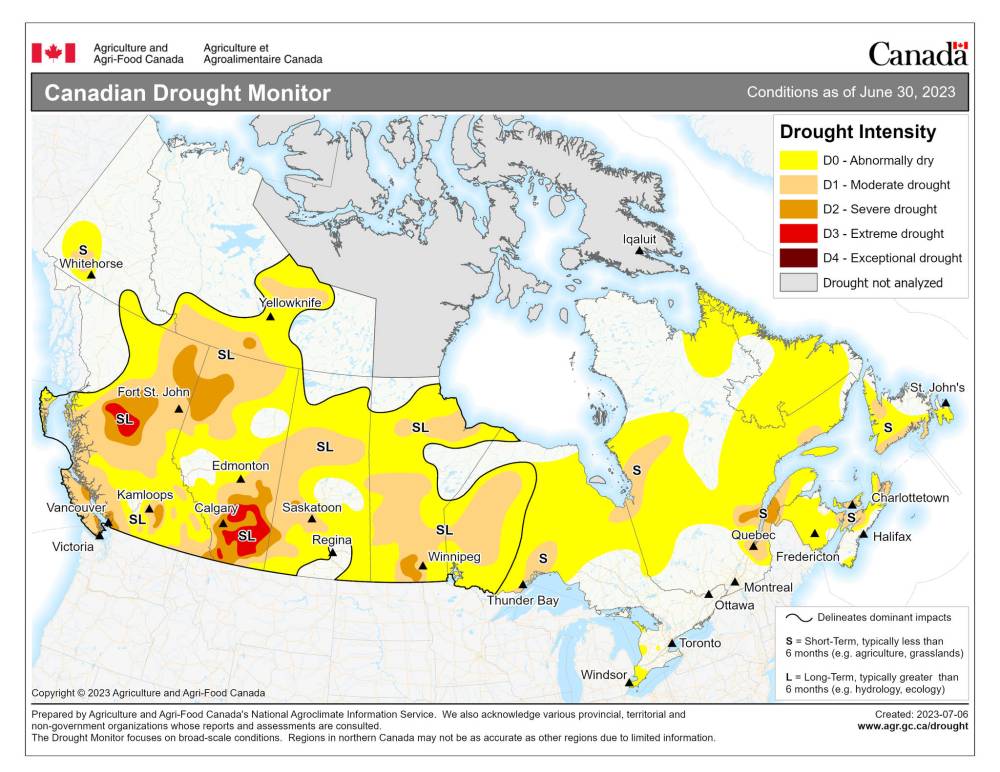
This map from July, found on Agriculture and Agri-Food Canada’s website, shows nearly all of Manitoba under abnormally dry, moderate drought or severe drought conditions. Laura Rance writes that irrigation and soil conservation may help alleviate the effects of drought on farming. (Agriculture & Agri-Food Canada)
But the United Nations Food and Agriculture Organization’s messaging around this critical resource hits close to home as we wrap up another growing season where yields across the West were compromised by moisture deficits.
The latest Farm Credit Canada outlook says production for the major field crops has fallen a range of eight to 13 per cent below the five-year-average. Compared to the 2022 crop, production across the West is off by 17 per cent.
That’s not nearly as severe as the losses incurred after the 2021 drought. However, the effects on producers’ incomes might be greater. Crop prices have also fallen, yet costs of production remain elevated.
More importantly, much of the region remains in a state of moderate to exceptional drought as we head into an El Nino winter, which tends to be warmer and drier.
If you want an even more compelling visual, you need only look at the photos of the Old Man River and reservoir in Southern Alberta, which has slowed to a trickle and currently contains less than 30 per cent of its usual capacity. Water levels in other reservoirs across the region have dropped to single digits relative to their capacity.
The United Nations Food and Agriculture Organization (FAO) says global freshwater reserves are declining due to population growth, industrialization, urbanization and climate change. It also says we will need more water in the future, not less.
Currently, 70 per cent of the world’s freshwater use is by agriculture. “Changing the ways we produce our food, fibre, and other agricultural products is the most crucial task. It is also where failure to act will have the gravest consequences,” director general QU Dongyu says in an opinion piece circulated for World Food Day.
One of the water management strategies the FAO is zeroing in on is irrigation. It says irrigated land produces 40 per cent of the world’s food on 20 per cent of arable land, and it remains an untapped potential.
Southern Alberta is home to about two-thirds of the irrigated farmland on the Prairies. Saskatchewan, with only four per cent, is seen as the next big frontier. A new report released by the Canadian Agricultural Policy Institute (CAPI) points to the Saskatchewan government’s efforts of late to promote more irrigation using the Lake Diefenbaker reservoir built in the 1960s.
Manitoba never moved on a 1980s report that promoted damming the Assiniboine River between Glenboro and Treherne to support municipal water systems, irrigation and recreation.
Of course, increasing our food supply’s reliance on irrigation is predicated on the water being there in the first place. The scientists studying climate change aren’t so sure due to the cascading impacts of global warning.
Many of Alberta’s irrigation districts shut their taps off early this year as low spring run-off from the mountain glaciers and snow melt combined with virtually no rain. Irrigation district representatives told the Western Producer that the consequences of another dry winter will be dire and far-reaching.
Water flows east across the Prairies. Interprovincial agreements signed a half a century ago require Alberta to send 50 per cent of its river water to Saskatchewan, which shares 50 per cent of its river flows with Manitoba, the CAPI report says.
“So far, good relations have prevailed among provinces, but the severity of the predicted droughts could risk souring relations,” the report says.
Irrigation may be part of the solution, but most Prairie farmers will have to continue coping with moisture deficits using soil conservation practices such as zero tillage and crop residues that trap more snow cover. At least that’s something they can control.
» Laura Rance is vice-president of content for Glacier FarmMedia. She can be reached at lrance@farmmedia.com. This column previously appeared in the Winnipeg Free Press.