
Canada’s economic backbone facing another crisis
Advertisement
Read this article for free:
or
Already have an account? Log in here »
We need your support!
Local journalism needs your support!
As we navigate through unprecedented times, our journalists are working harder than ever to bring you the latest local updates to keep you safe and informed.
Now, more than ever, we need your support.
Starting at $15.99 plus taxes every four weeks you can access your Brandon Sun online and full access to all content as it appears on our website.
Subscribe Nowor call circulation directly at (204) 727-0527.
Your pledge helps to ensure we provide the news that matters most to your community!
To continue reading, please subscribe:
Add Brandon Sun access to your Free Press subscription for only an additional
$1 for the first 4 weeks*
*Your next subscription payment will increase by $1.00 and you will be charged $20.00 plus GST for four weeks. After four weeks, your payment will increase to $24.00 plus GST every four weeks.
Read unlimited articles for free today:
or
Already have an account? Log in here »
Hey there, time traveller!
This article was published 18/05/2024 (659 days ago), so information in it may no longer be current.
In a country as vast and resource-rich as Canada, one would expect logistics — a critical backbone of our economy — to be a priority. Yet, it remains one of the most underappreciated aspects of our economic infrastructure.
Canadians, largely oblivious to the intricacies of supply chains, are accustomed to the seamless appearance of goods on store shelves. This perception belies a stark reality: Canada has one of the poorest reputations worldwide for logistical efficiency, and we are teetering on the brink of yet another disruptive labour dispute.
The looming strike involving Canadian National (CN) and Canadian Pacific Kansas City (CPKC) threatens to cripple the nation’s largest railway network. CN, spanning 20,000 miles and transporting 300 million tons of cargo annually, is vital for connecting Eastern and Western Canada with the southern U.S.
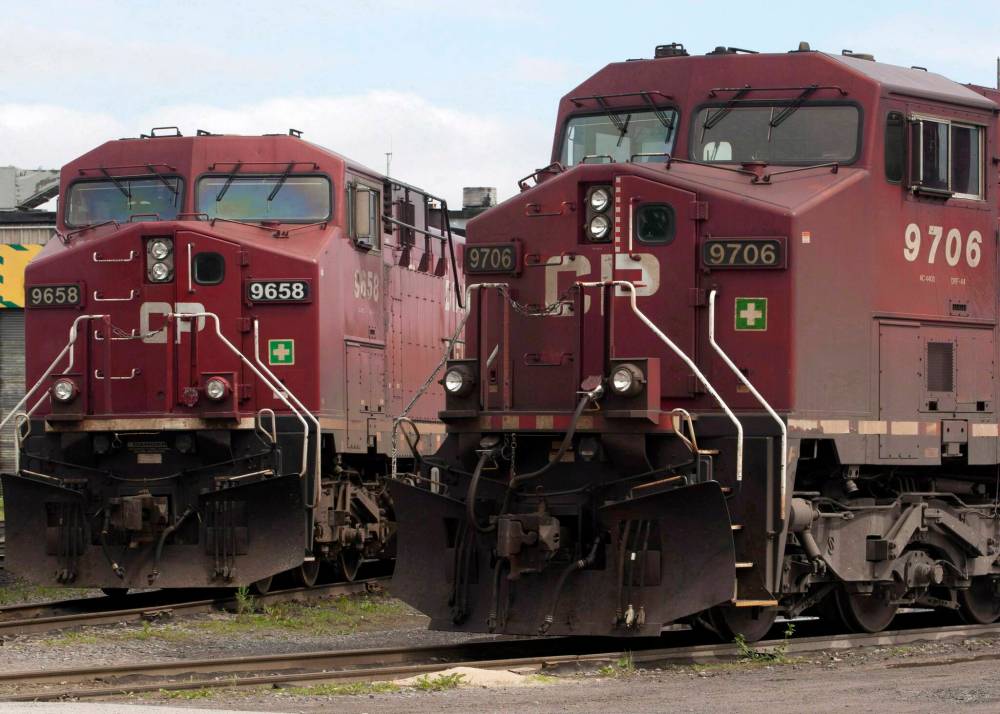
This potential strike, the third rail conflict in five years and the fifth including port disputes in Montreal and Vancouver, highlights a chronic vulnerability in our national logistics system.
Unfortunately, the timing coincides with peak export periods. For instance, Canada exported more than 2.6 million metric tonnes of grain last June. A strike during this period could inflict economic losses exceeding $35 million daily, not to mention the cascading effects on global supply chains.
The frequency of these disruptions tarnishes Canada’s reputation for reliable transportation and procurement, particularly impacting the food and beverage sector. This sector depends crucially on both the steady supply of manufacturing inputs and the distribution of finished products across the country. Repeated labour disputes and logistical bottlenecks have become annual threats to the economic stability of our agri-food industries.
The pandemic starkly tested our already fragile infrastructure, with blockades and additional strikes exacerbating the situation. Disruptions often compromise the cold chain, leading to decreased quality and safety of food products — overripe produce and prematurely spoiled dairy products became familiar sights during supply irregularities.
Our logistical framework, encompassing roads, bridges, railways and ports, is notably underfunded. According to rankings by the World Bank and S&P Global Market Intelligence, the Port of Vancouver is the second-worst globally based on efficiency. All major Canadian ports rank low internationally, and our airports do little better.
In response, the Trudeau government’s recent budget proposes a paltry sum of less than $5 billion for strategic infrastructure to support exports — a mere drop in the bucket given the scale of needed improvements. This underinvestment signifies a grave underestimation of logistics’ critical role in our national economy.
To safeguard the sustainability and competitiveness of Canada’s food economy, it is imperative to recognize food supply chains as an essential service nationwide. This recognition would help stabilize expectations and planning for agri-food companies, from farmers to retailers.
Furthermore, logistical operations should be elevated to a national priority, reflecting the sector’s strategic importance to our economic sovereignty. The federal government must take the lead in reminding us of logistics’ pivotal role rather than relying on the public to recognize this need.
The challenges posed by climate change and the vast Canadian landscape demand a deliberate and strategic approach to logistics. While the East has benefited from the St. Lawrence Seaway, deliberate efforts to stay competitive must be made in the rest of the country.
It is becoming clear that addressing ongoing logistical challenges is not just a matter of economic policy but of national importance. It is time for Ottawa to step up and champion a robust national logistics strategy, ensuring that the veins and arteries that keep our country’s economic heart beating are healthy and resilient.
» Sylvain Charlebois is senior director of the agri-food analytics lab and a professor in food distribution and policy at Dalhousie University.