
Why we should care about this week’s European Parliament elections
Advertisement
Read this article for free:
or
Already have an account? Log in here »
We need your support!
Local journalism needs your support!
As we navigate through unprecedented times, our journalists are working harder than ever to bring you the latest local updates to keep you safe and informed.
Now, more than ever, we need your support.
Starting at $15.99 plus taxes every four weeks you can access your Brandon Sun online and full access to all content as it appears on our website.
Subscribe Nowor call circulation directly at (204) 727-0527.
Your pledge helps to ensure we provide the news that matters most to your community!
To continue reading, please subscribe:
Add Brandon Sun access to your Free Press subscription for only an additional
$1 for the first 4 weeks*
*Your next subscription payment will increase by $1.00 and you will be charged $20.00 plus GST for four weeks. After four weeks, your payment will increase to $24.00 plus GST every four weeks.
Read unlimited articles for free today:
or
Already have an account? Log in here »
Hey there, time traveller!
This article was published 03/06/2024 (668 days ago), so information in it may no longer be current.
The European Parliament (EP) elections being held this week will likely alter the political orientation of the European Union’s main legislative and budgetary authority, the only directly elected EU body.
Parties that are skeptical about European integration, along with populist right-wing politicians, are expected to gain ground, while centre-left and Green parties are poised to lose votes and seats.
The outcome will have a big impact on EU policy on the environment and climate change, the Russian invasion of Ukraine, migration, trade agreements — including one with Canada — and other policy areas.
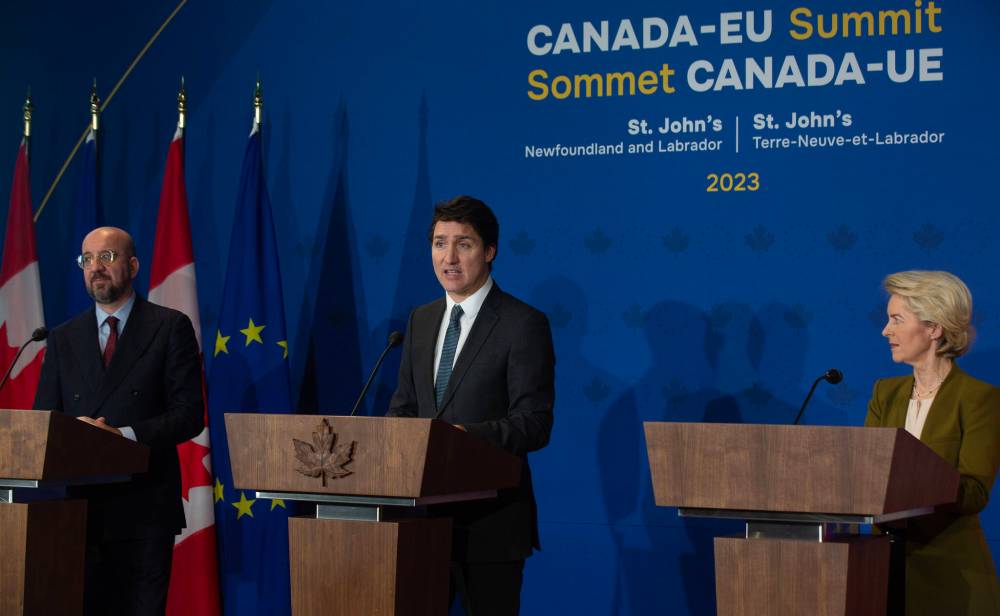
European Council President Charles Michel, Prime Minister Justin Trudeau and European Commission President Ursula von der Leyen (left to right) hold a news conference in St. John’s on Nov.24, 2023 on the second day of the Canada-EU Summit. (The Canadian Press)
Since the first direct elections in 1979 — before that, Members of the European Parliament (known as MEPs) were also MPs in their own national parliaments — EP elections have been held every five years and are often volatile.
In the 2019 EP election in the United Kingdom, the Liberal Democrats jumped to 16 seats from only one previously (coming second after the Brexit party’s 24 seats), Labour dropped to 10 from 20 and the governing Conservatives were left with only four seats of their previous 19.
Such volatility reflects the fact voters often use EP elections to punish or reward national parties, and that turnout tends to be lower than in national elections. With lower numbers of people voting, a slight swing in terms of which party gets votes can mean a big swing in EP seats.
When the UK subsequently left the EU in January 2020, some of its EP seats were redistributed to remaining EU member states and the loss of British members resulted in new coalitions in all policy areas.
TURNOUT CHALLENGES
In 2019, overall turnout for the EP elections was under 51 per cent, still an improvement on the turnout of only around 43 per cent in both the 2014 and 2009 elections.
Under the 1992 Maastricht Treaty, all citizens of EU member states have the right to vote and to be elected in both EP and local elections in their states of residence.
Over the years, these political rights have grown in importance as more Europeans make use of them, though participation rates for EU citizens living outside their state of citizenship remain relatively low.
The elections are taking place in different countries on different dates, from June 6 to June 9. They’re likely to continue the trend of the traditional centre-right and centre-left groups losing ground. Forming a recognized parliamentary group requires at least 23 MEPs from at least seven countries, and various national parties often switch groups or become unaffiliated.
The far-right Identity and Democracy group — in which the French Rassemblement National party led by Marine Le Pen plays a leading role — recently expelled the Alternative for Germany delegation after its leader said members of the Nazi SS were “not all criminals.”
Some far-right parties are also accused of ties to China and Russia. Belgian and French police recently searched EP offices on suspicion that MEPs were approached and offered money to promote Russian propaganda. The scandal, nicknamed “Russiagate,” has added to concerns about the lack of transparency into how parties raise money and resulted in an investigation revealing that a quarter of private funding goes to extremist and populist parties.
WHAT DOES EUROPEAN PARLIAMENT DO?
The EP is often considered weaker than the European Council, which represents the member states, or the European Commission, which forms the EU’s executive branch together with the Council.
The EP approves or rejects the nominees for commission president and each of the 26 other members of the commission — one from each EU member state, nominated by each government. In this way, the commission is comparable to a government cabinet, with each commissioner responsible for a policy area.
The EP also approves the EU budget that devotes funds to cohesion measures among the member states, agriculture, the environment and other priorities.
For Canadians, the biggest impacts of the EP elections may not be obvious at first.
Canada’s formal relationship is the oldest the EU has with any industrialized country, dating back to 1959 when the EU was known as the European Economic Community.
Canada and the EU have signed a Strategic Partnership Agreement that includes regular summits between Canada’s prime minister and the presidents of the European Council and European Commission.
The most recent was held in November 2023 in St. John’s, NL.
HOW THE ELECTIONS COULD IMPACT CANADA
The EP president doesn’t participate in the Canada-EU summits. That’s despite the fact the EU is Canada’s second-largest trading partner, and the EP plays a major role in evaluating all EU trade and investment agreements and approving them before they can take effect.
The EP’s Delegation for relations with Canada is described by the head of the entity as “one of the oldest in the European Parliament, reflecting the importance of the partnership and close co-operation between the EU and Canada.”
The elections may dramatically change the delegation’s composition, with repercussions for Canadian trade deals. More broadly, the elections will help determine the EU’s priorities on the environment and climate, agriculture, defence, migration, justice, technology and many other policy areas that are important to Canada.
» Willem Maas Jean Monnet is chair and professor of political science, socio-legal studies, and public and international affairs, York University. This column was originally published at The Conversation Canada: theconversation. com/ca.