
Is the media reporting news — or creating it?
Advertisement
Read this article for free:
or
Already have an account? Log in here »
We need your support!
Local journalism needs your support!
As we navigate through unprecedented times, our journalists are working harder than ever to bring you the latest local updates to keep you safe and informed.
Now, more than ever, we need your support.
Starting at $15.99 plus taxes every four weeks you can access your Brandon Sun online and full access to all content as it appears on our website.
Subscribe Nowor call circulation directly at (204) 727-0527.
Your pledge helps to ensure we provide the news that matters most to your community!
To continue reading, please subscribe:
Add Brandon Sun access to your Free Press subscription for only an additional
$1 for the first 4 weeks*
- Enjoy unlimited reading on brandonsun.com
- Read the Brandon Sun E-Edition, our digital replica newspaper
*Your next Free Press subscription payment will increase by $1.00 and you will be charged $20.95 plus GST for four weeks. After four weeks, your payment will increase to $24.95 plus GST every four weeks.
Read unlimited articles for free today:
or
Already have an account? Log in here »
Hey there, time traveller!
This article was published 08/07/2024 (678 days ago), so information in it may no longer be current.
When I was teaching some university courses that covered global issues and world politics, I would always start by asking students where they got their news. Of course, there were some that — even though they were taking a course like mine — didn’t really follow the news at all, but most said that X or Twitter was their main news source. Sounds scary!
While social media outlets do carry some news, they are really set up to encourage communication — or argument or debate — around a range of opinions. There really isn’t much hard news in social media. In fact, some might argue that you will find more misinformation or disinformation than real information.
I was speaking with a high school student the other day who passionately told me that our prime minister is a sinister dictator. I was impressed that this young person was keenly engaged in our country’s politics, but wondered where she got such a strong (and in my estimation, incorrect) idea. She told me that she follows numerous on-line “news” sites that tell her the “truth” about Canada’s problems. I asked her if she followed mainstream news media and if she’d read any current books on Canadian politics, as opposed to quick, opinion-laden video clips. I think that I lost her at that moment.
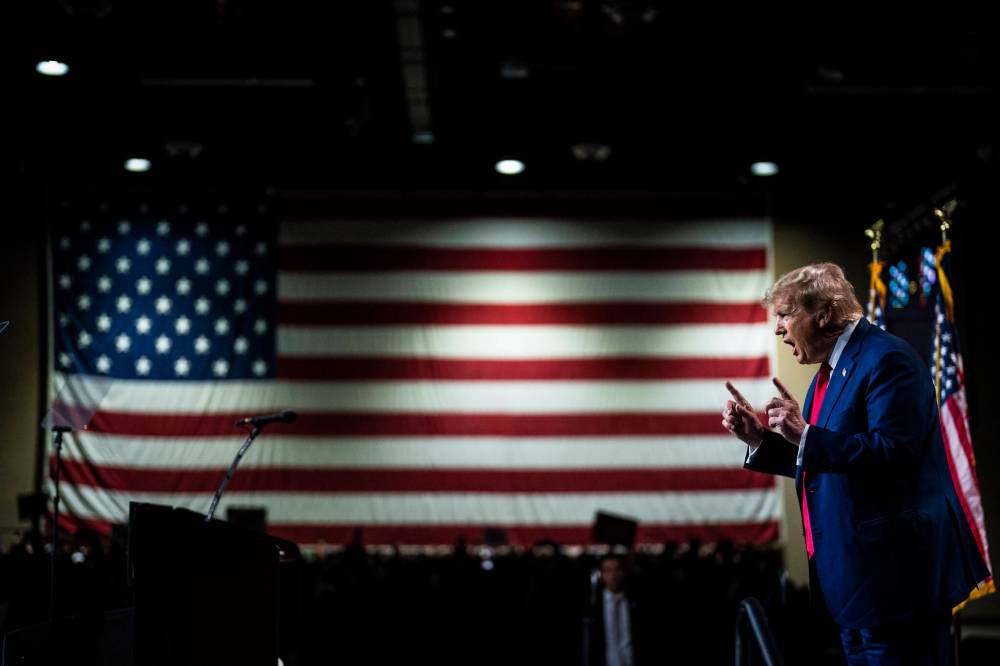
Former president Donald Trump speaks at a “Commit to Caucus” event on Dec. 17 in Reno, Nev. The media’s tendency to simply repeat everything Trump, or others, say is just one of the shortfalls of news coverage these days, Zack Gross writes. (File)
But, it seems that even the mainstream media has become much more sensationalist and opinion-laden in recent times, possibly seeking ways to keep people following them instead of switching to social media.
Back when I was a student, the leading American broadcast networks competed with one another for audience percentages in watching their news programs. The American Broadcasting Corporation (ABC) broke the mold and captured the highest ratings by appointing their head of sports coverage to head of news. He brought a less “dignified, traditional” style of news reading — news coverage on steroids, you might say. Since then, networks have also realized that (or decided that) viewers are mostly interested in crime and the weather, so these have become a big part of reporting.
In his first book of a two-volume political autobiography, “A Promised Land”, Barack Obama writes that the American news media industry has done its population a disservice by covering everything that Donald Trump does and says. Given, he says, that much of it is nasty and false, why do they flock to every event and availability he participates in? It’s sensational but its not news, and it’s not going to contribute to rational policy debate.
In today’s news cycle, stories that promote Justin Trudeau and Joe Biden stepping down are dominant. There is very little coverage of policy but rather a gossipy, personal attack-based array of stories that would have been featured in the tabloids in the past, but now are seen as mainstream. A news story that raises questions about this recently aired on CBC’s The National, focusing on how a Russian team is creating and injecting these kinds of stories into US media in order to swing the election in Trump’s favour. Previously, this group worked at creating false stories about the invasion by Russia of the Ukraine in order to turn public opinion against U.S. aid to the embattled country.
Stories about the current conflict in the Middle East also raise questions of credibility. Both sides are active in swinging the news in their favour and reporters cover stories without always fact checking. When coverage turns out to be the product of misinformation, it is too late to correct what’s been said. While a story might make the front page or the first item one day, the retraction for it might be on page 16 in small type the next.
There has been a recent effort by news media to get the “ordinary person” or “man on the street’s” opinion injected into the news. The Friends of the CBC website featured a discussion recently initiated by someone who thought that “expert” panels on radio and TV should be replaced by ordinary folks sharing their thoughts and opinions. While this might sound good, it likely would mean less hard information and less opinion backed up by experience and research — more heat than light, as they say. No question, today’s world is dominated by heat and desperately needs some light!
So, beware of where you get your news and opinion. You may be fooled by a Russian or Chinese initiative or by a person who has an axe to grind, a strong and irrational political philosophy, someone who is well-meaning but just hasn’t done their homework or an agency that rates their ratings as more important than their dedication to the truth.
» Zack Gross is Board Chair of the Marquis Project, a Brandon-Westman based international development organization.