
What’s ahead for geopolitics in 2025
Advertisement
Read this article for free:
or
Already have an account? Log in here »
We need your support!
Local journalism needs your support!
As we navigate through unprecedented times, our journalists are working harder than ever to bring you the latest local updates to keep you safe and informed.
Now, more than ever, we need your support.
Starting at $15.99 plus taxes every four weeks you can access your Brandon Sun online and full access to all content as it appears on our website.
Subscribe Nowor call circulation directly at (204) 727-0527.
Your pledge helps to ensure we provide the news that matters most to your community!
To continue reading, please subscribe:
Add Brandon Sun access to your Free Press subscription for only an additional
$1 for the first 4 weeks*
*Your next subscription payment will increase by $1.00 and you will be charged $20.00 plus GST for four weeks. After four weeks, your payment will increase to $24.00 plus GST every four weeks.
Read unlimited articles for free today:
or
Already have an account? Log in here »
Hey there, time traveller!
This article was published 30/12/2024 (460 days ago), so information in it may no longer be current.
Nothing will shape next year more than the shockwaves soon to emanate from Washington.
Political decisions, business strategies and livelihoods everywhere are bound to be affected — directly or indirectly — by Donald Trump’s looming revenge tour.
China is already preparing for a Trump-induced trade war. Its government this month announced a ban on exports to America of certain refined minerals used in high-tech goods. The same is true for commercial drone supplies — of which China controls 80 per cent of the market.
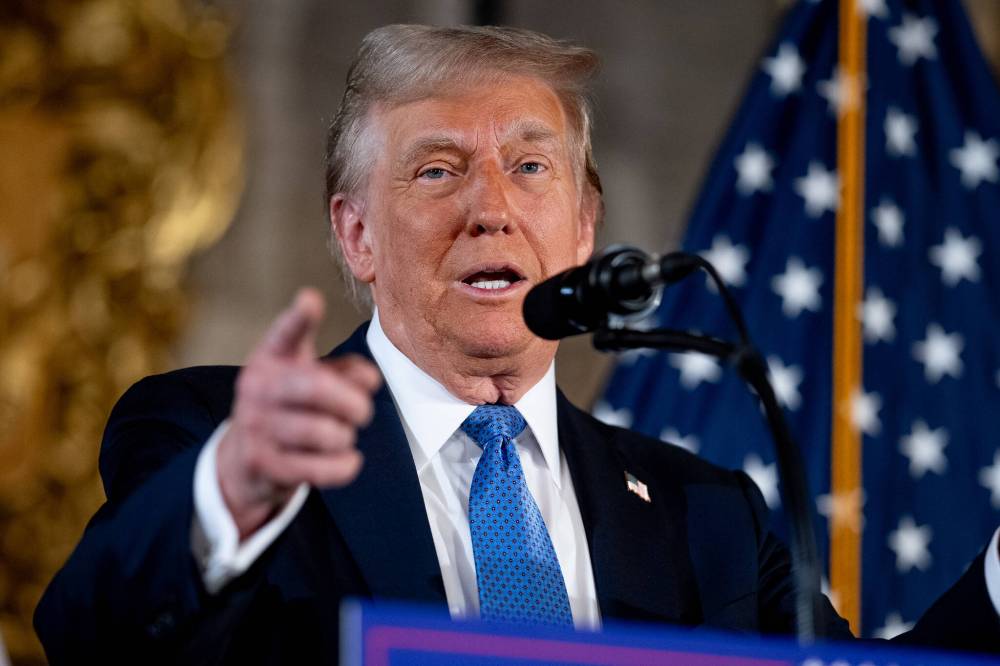
President-elect Donald Trump speaks during a news conference at his Mar-a-Lago resort on Dec. 16 in Palm Beach, Florida. Columnist Kyle Hiebert writes there will be plenty to read about on the world stage in 2025, one of the main sources of noteworthy international events being Donald Trump’s return to the White House. (Tribune News Service)
Beijing may also artificially devalue China’s currency to dampen any tariffs.
These just are the opening salvos in a fight that will have global ripple effects.
In Canada, economist Trevor Tombe calculates the blanket penalties on Canadian exports threatened by Trump would shrink the economy by two to three per cent. Some 2.4 million jobs could be impacted.
Trump also intends to immediately push for a ceasefire in Ukraine. How he might achieve this remains unclear. Trump could appease Moscow by pressuring Kyiv to concede some of its territory, while also vetoing Ukraine’s bid to join NATO.
But Trump also covets the status of dealmaker. He may thus radically escalate military aid to Ukraine if Vladimir Putin prevents this by refusing to come to the table.
Meanwhile, the conflict will reach a frenetic pace as both Russia and Ukraine try to gain leverage ahead of talks unfolding.
Ukraine is already hitting targets deep within Russia using long-range drones and Western-supplied rockets. Russia has fired an experimental ballistic missiles and making steady battlefield gains along the frontlines in Ukraine. Putin hasn’t flinched over his forces suffering around 1,500 casualties daily.
The Kremlin’s revised nuclear doctrine now allows for a tactical nuclear strike in response to any serious conventional weapons attack.
In the Middle East, Israeli military operations in Lebanon have shattered Hezbollah, killing thousands of civilians in the process. A tenuous ceasefire there seems to be holding. Yet despite Hamas also being a spent force, similar respite isn’t likely on the horizon for Gaza. And Trump isn’t about to rein in Israel either.
“A ceasefire in Lebanon is not necessarily a precursor to one in Gaza,” warns the BBC’s international editor. The war there is “also about revenge, about Benjamin Netanyahu’s political survival, and his government’s absolute rejection of Palestinian aspirations for independence.”
Next door, the Assad dictatorship’s collapse in Syria is undeniably good for the country’s people. It’s also created a massive power vacuum involving a kaleidoscope of actors. Syrians will attempt to construct a new government over the coming months.
The likes of Russia, Israel, Iran, Turkey, the Gulf states, Western countries, U.S.-backed Kurdish militias, Iraqi paramilitary groups and domestic rebel factions will all inject themselves into the process — via diplomacy or force. Local remnants of the Islamic State are also reanimating.
If outside actors paralyze Syria’s rehabilitation, the outcome will be a familiar one: a newly liberated nation devolving into anarchy, criminality and warlordism. Libya, Somalia and Yemen offer cautionary tales.
Iran is vulnerable too. Its strategy of insulating itself from foreign threats by arming a halo of terrorist proxies is in shambles. Its 85-year-old supreme leader, Ayatollah Ali Khamenei, is ailing and there is no succession plan. If Donald Trump renews his maximum pressure campaign against Tehran — or Israel chooses to press its military advantage — don’t be surprised if Iran jump-starts a nuclear weapons program.
Elsewhere, Sudan’s horrific civil war will remain neglected and unresolved. Myanmar’s repressive junta regime may be toppled by pro-democracy rebels. Houthi militants in Yemen will maintain their violent stranglehold over shipping through the Red Sea. Western governments may re-engage the Taliban to halt Afghanistan’s humanitarian free fall. State sponsored hacker groups will continue to push the boundaries of cyberattacks and digital espionage.
Plus, after two years of being hosted in petro-states, the UN’s annual climate summit shifts to Brazil. The planet is ablaze, yet governments’ focus on climate action has fallen off in recent years. Environmentalists now fear Trump’s re-emergence in the White House means the U.S. will again abandon the Paris Climate accords.
But a massive green energy transition is still underway, thanks to market forces. South Africa has vowed to place climate issues — and debt relief for developing nations — atop the global agenda as it assumes the rotating presidency of the G20.
And then there’s the possibility of a black swan event happening: a wildcard scenario that triggers devastating consequences, like a military accident around Taiwan or even a new pandemic.
All told, when it comes to geopolitics in 2025, expect the unexpected.
» Kyle Hiebert is Winnipeg-based political risk analyst and former deputy editor of the Africa Conflict Monitor