
Moving from throne speech to results
Advertisement
Read this article for free:
or
Already have an account? Log in here »
We need your support!
Local journalism needs your support!
As we navigate through unprecedented times, our journalists are working harder than ever to bring you the latest local updates to keep you safe and informed.
Now, more than ever, we need your support.
Starting at $15.99 plus taxes every four weeks you can access your Brandon Sun online and full access to all content as it appears on our website.
Subscribe Nowor call circulation directly at (204) 727-0527.
Your pledge helps to ensure we provide the news that matters most to your community!
To continue reading, please subscribe:
Add Brandon Sun access to your Free Press subscription for only an additional
$1 for the first 4 weeks*
*Your next subscription payment will increase by $1.00 and you will be charged $20.00 plus GST for four weeks. After four weeks, your payment will increase to $24.00 plus GST every four weeks.
Read unlimited articles for free today:
or
Already have an account? Log in here »
Hey there, time traveller!
This article was published 02/06/2025 (297 days ago), so information in it may no longer be current.
The usual “speech from the drone” became a true speech from the throne this past week.
Gone were the long, lofty flights of rhetoric and open-ended ambition that peppered Liberal throne speeches of the past.
This one, like its progenitor, Prime Minister Mark Carney, was more sober and serious, with a speech shorn of the ornamental ellipses favoured by his predecessor, Justin Trudeau. It was delivered as well from a real Canadian throne, made from Canadian black walnut and donated English walnut from a forest behind Windsor Castle. And it was read by King Charles, the only person in the Senate chamber that day who can honestly lay claim to the phrase, “to the throne, born.”
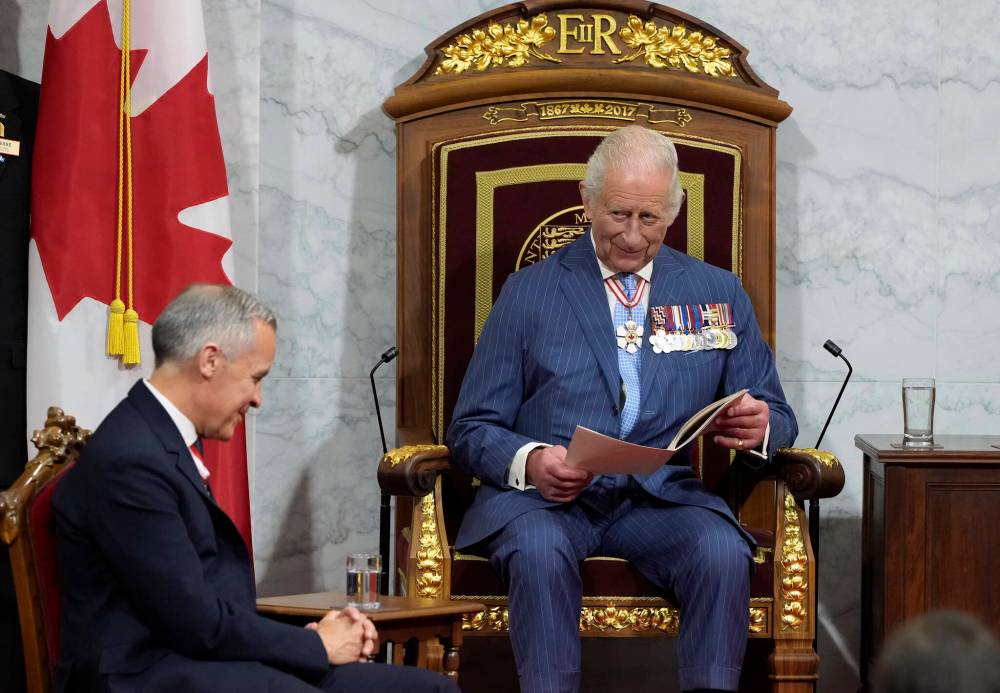
King Charles delivers the speech from the throne in the Senate in Ottawa on May 27. (The Canadian Press)
Pageantry aside, there was little new in the actual speech that had not been telegraphed by Carney in the days following his election. That’s no bad thing.
In fact, it was all contained in the single two-page mandate letter (shorter than this column!) he wrote to his cabinet colleagues the week before. It contained seven priorities that the whole government would focus on, beginning with “establishing a new economic and security relationship with the United States,” “building one Canadian economy,” and “bringing down costs for Canadians” leading the list. These became the first three sections of the throne speech. For now, the new prime minister is sticking to the electoral winning knitting from the campaign that won his party an unprecedented fourth term.
Ambition was not absent, though, in the throne speech. But it was the ambition of fortitude and resilience in the face of external economic threats that Carney put before Canadians, not the ambition of hope and dreams propagated by his predecessor. “We must be clear-eyed,” the King intoned on the prime minister’s behalf, “the world is a more dangerous and uncertain place than at any point since the Second World War.”
The new prime minister is engaged in a radical act of political revisionism. The very next day in the House of Commons, he labelled his team as “Canada’s new government,” a phrase not actively heard in Ottawa since Stephen Harper branded itself as such in 2006.
No one should be surprised. That is simply the latest apotheosis of a branded makeover of the Liberal government he has embarked upon. The symbolism of the King coming to Canada to read the throne speech, its stylistic shift in tone and tenor, and a tight, focused agenda as its content, all reinforce the impression and momentum of what are deliberate “points of departure.”
To chart a new course, to set a new agenda, or strike in a new direction, all requires a starting point. A point of departure, you might say. Carney’s magic so far is to ignore what came before and concentrate attention on what’s to come. Shakespeare wrote “what’s past is prologue” in The Tempest. For Carney, it isn’t even past. It’s as if it never was.
This is a political juggling feat of no mean skill. Our new prime minister defied political gravity and political convention by showing he is a politician of better-than-average skills. So, it might just work.
What Carney has most going for him is that the country wants it to work. Fatigued from past Liberal virtue signalling, wary of Donald Trump’s America, and more than a little attracted to the Conservative policy offerings of the campaign, the prime minister has real running room to set his new points of departure.
Setting and achieving are two very different things. Ten years of overpromising and under-delivering by Justin Trudeau makes for a skeptical electorate. Still, they suspended enough of that skepticism to give him a chance. Carney’s real challenge isn’t what he’s saying or how he’s saying it. It is whether the federal government as an institution can be corralled and focused to do his bidding.
A public story making the rounds in Ottawa is that the new prime minister sent a deputy minister packing from an inadequate briefing session, telling him to return when he knew his file. Truth be told, our federal bureaucracy is not fit for Carney’s purpose. He wants to move fast to get things done. Save for the once-in-a-lifetime pandemic experience, this is not standard operating procedure for official Ottawa. It needs to be more nimble, more horizontal in thinking and acting across government, less consumed by process, and relentless in focusing on delivery and results.
Canada’s operating environment outside Ottawa hasn’t changed. The same political barriers to action remain, from premiers to Indigenous leaders and communities, to advocacy groups, to industry, to … the list goes on. Mr. Carney does not control that. What he does control is the operating environment inside Ottawa. Changing Ottawa from the inside out will be seen as the single most important reason for whether throne speech poetry gets translated into governing prose. Now that would be a true point of departure.
» David McLaughlin is a former clerk of the executive council and cabinet secretary in the Manitoba government. This column previously ran in the Winnipeg Free Press.