
Dr. Schipper’s philosophy of education
NEELIN VIEWS
Advertisement
Read this article for free:
or
Already have an account? Log in here »
We need your support!
Local journalism needs your support!
As we navigate through unprecedented times, our journalists are working harder than ever to bring you the latest local updates to keep you safe and informed.
Now, more than ever, we need your support.
Starting at $15.99 plus taxes every four weeks you can access your Brandon Sun online and full access to all content as it appears on our website.
Subscribe Nowor call circulation directly at (204) 727-0527.
Your pledge helps to ensure we provide the news that matters most to your community!
To continue reading, please subscribe:
Add Brandon Sun access to your Free Press subscription for only an additional
$1 for the first 4 weeks*
*Your next subscription payment will increase by $1.00 and you will be charged $20.00 plus GST for four weeks. After four weeks, your payment will increase to $24.00 plus GST every four weeks.
Read unlimited articles for free today:
or
Already have an account? Log in here »
Choosing a career is an inevitable part of growing up. When preparing for either post-secondary education or getting into the job market, this big step in life will bring more responsibility, require courage and build new skills. For some, this choice can be exciting and simple, while for others this could be the most difficult decision of their lives. There are thousands of professions that many people don’t even know about, and thousands of other professions that most people don’t care to explore more deeply. Academia is often one of those occupations that aren’t as commonly discussed. The Neelin Journalism Team had the chance to speak with 2007 Neelin graduate Adam Schipper, who is currently a part-time professor at Brandon University.
Q: Can you introduce yourself and your research?
A: My name is Adam Schipper, or Doctor Adam Schipper. I’m still getting used to that. I have a PhD in Philosophy. I teach Philosophy and English Literature at Brandon University online from Montreal, and my research is in the philosophy and politics of housework and domestic labour.
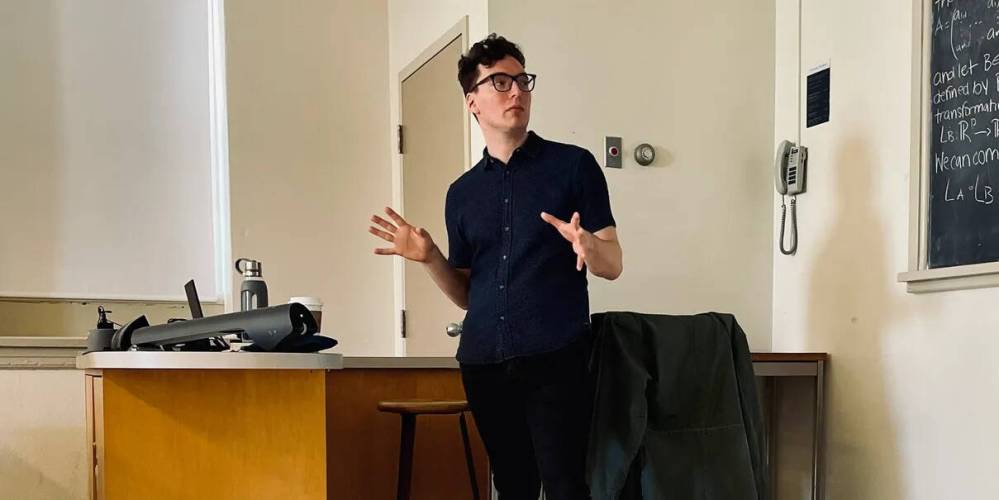
École secondaire Neelin High School graduate Adam Schipper shares what a life in academia is like as a Brandon University philosophy professor. (Submitted)
Q: Can you describe a typical day in your life?
A: I get up and have breakfast. Then, I sit down (and go) onto Teams. I teach my classes, then I prep between classes for the following day. I answer student emails and try to get my own work done in the afternoon, sort of picking away at journal articles and things to submit to journals. But it’s quite the balance I have to strike, and there’s a lot of self-discipline involved. I really have to be my own boss in a sense of (being) my own motivator.
Q: Are your research projects collaborative or are they more individual?
A: So, in philosophy, sometimes it’s collaborative, especially if it’s more interdisciplinary work. I got invited to collaborate with a hospice nurse who’s working on a paper on clinical nursing with some theory and philosophy. So, she emailed me and asked me if I’d like to work on the theory parts of it. But for the most part, it is solo work. It’s quite a solitary profession, in humanities, at least.
Q: What was your PhD experience like?
A: You know, it was great. I started my PhD at Queens University in Kingston in 2018 and that was after a couple years away from academia, when I worked many odd jobs. I worked in a restaurant, I worked in a couple offices. I did side gigs here and there, but it really didn’t click for me until I started the journey back into academia, and it’s one of those things where everything kind of aligned for me. And I loved my times at Queens, so I got really lucky in that my cohort, the people in my year, we clicked very well, we bonded very well. Two years into my PhD program, the pandemic happened. The lockdowns happened, and I don’t think I need to talk about how disruptive that was, of course, but it really was. But it was lovely to stay connected with the people in my year and to stay connected with my supervisor, who is very supportive and very helpful. She really became a mentor for me. I ended up moving away from Kingston that same year, in 2020, here to Montreal permanently, and I found myself. I was in school, but I was also supposed to be a professional. So, I was trying to find the balance between those two things and that’s when I learned, for instance, that doing a PhD and writing a thesis is not a sprint, it’s a marathon. So, I learned to pace myself in terms of doing research, but also in terms of writing. I ended up working for maybe an hour or two a day on my thesis for about three to four years, and one day it was finished and then I defended it and slept for a couple months. But overall, it was a very positive journey for me. It was very valuable. I really grew and changed as a person, too, and I learned to tap into things that I didn’t know, skills and reserves of energy that I didn’t know I had.
Q: Did you always know that you kind of wanted to go into this field?
A: I think so. My parents are university professors. My dad just retired, but my mom still teaches at Brandon University. And so, I kind of grew up around universities. You know, sometimes I was juggled between my parents’ classes when I was really young and playing computer games on their office computers. But also, there were always lots of books around me, books with very mysterious titles that really interested me. So, I guess I was kind of born into it, like it’s in my DNA, and it was never really a question for me that I would go to university and go on to grad school, for instance. But you know, once I got to my masters in 2012, I really had to ask myself, “(Am) I doing this for me?” (and) not just because it’s the thing I was supposed to do. There was kind of a moment where I had to step away from all that for a few years and all that did was really reinforce that this is what I’m supposed to do … I tried doing many other things and the only thing that really clicked for me was academia. (Because of that) I came back.
Q: Do you have any advice for people who are interested in doing a PhD or being in academia?
A: … The real advice that I wish I had learned earlier that I couldn’t really figure out until halfway through my PhD is, don’t compare yourself to other people in academia. It’s an industry that’s built around comparing yourself to others, but it’s a very, very, very easy and simple way to get in your own way. You might think, “Why didn’t I get that grant? Why didn’t I get that award? Why didn’t I get published in that journal, etcetera, etcetera?” But no one can do your academic journey for you. Only you can.
Q: This is a little bit of a deeper question, but what is it like to do what you do right now facing the funding cuts that the universities are going through?
A: It’s tough. I’m fortunate that I have a little more teaching experience than other people who were just recently out of their PhDs, because they don’t teach you how to teach in a PhD program. It’s not like getting an education degree. I got kind of lucky with that. Of course it’s also kind of a snowball effect. Because I have teaching experience, I’m able to find teaching experience easily. But every year there are fewer jobs and more and more applicants, and so as the demand grows, the supply shrinks. With that, there are more and more people leaving academia. People who have been trained as academics are going into nonacademic fields. I think that’s a very wise thing (for them) and it’s something that’s still on the table for me. I mean I’m still in the process of finding full-time teaching work because right now it’s part-time. In the middle of every semester, I’m doing job applications. I’m fortunate that I live in Montreal. It’s a city that has five to six research universities that are in the area, or at least travelable. I’m an over-educated anglophone fighting with other over-educated anglophones for these jobs. We fall in love with the city and then we don’t want to leave. I do my best not to see my peers as competitors, even through funding cuts and the administrative bloat in universities, but especially in humanities, it’s rougher and rougher out there.
Q: Have there been any big changes in the past couple of years in the work environment because of the political climate?
A: The political climate, yes. I would add also the technological changes. Things like AI in classrooms or not even in classrooms. But students using ChatGPT to write essays, there is a political element to that. I think it kind of stems from universities being run more and more like businesses. They need to make a profit every year, and this causes subtle changes. We need to think about what the purpose of universities is, and what kind of attitudes we have towards what an education is. Ideally, we go to university to pursue education for its own sake, to become well-rounded human beings. But now, it feels like you go to university to get a piece of paper that will give you a high-paying job. And for instance, it’s nothing against my computer science students, I love them. They’re great. But if you’re a compsci student and you’re taking a philosophy course to get your humanities credit, and you’re really busy with everything else you’re trying to get, then you’re just like, “Oh geeze, I’ve got to do this humanities credit. Well, I can just boot up ChatGPT and get it to write my philosophy paper for me.” With that, you kind of sell yourself short with challenging yourself to grow. You take away this unique opportunity to grow as a human being and as a person. And on the other hand, you’re sort of wasting your tuition. You know, this is an opportunity you’re letting go away. But I understand the motivation to do that. So, I can’t really blame students for it either.
Q: What are the challenges of AI, particularly when you’re teaching remotely?
A: With teaching in person, you can give in-person assignments. You can’t use AI to do handwritten assignments, yet. I can have a class where they do it like a midterm, and they have to write it by hand, and they get really grumpy about that. But it’s the only surefire way I can make sure 100 per cent of them aren’t using ChatGPT. When I’m teaching online, I’m removed from the students, and I try to take the personable approach. I try to win them over and hope that they like me enough so that they’ll think, “Oh, I’ll disappoint Adam if I use ChatGPT to write this assignment, you know he’s really excited about this material. Maybe there’s something in here that is worth exploring, that’s worth trying to be excited about, too.” And it works for the most part. I don’t know if it’s sustainable on my end, but you know, (it’s) trying to appeal to their humanity instead of appealing to the machine.
Q: What are some of the challenges of teaching remotely versus in person?
A: The first is trying to establish that connection with the classroom. Especially in philosophy, we’re reading Aristotle for class this week and it’s a big book. It’s really dense. It was written 2,300 years ago. It’s not necessarily something that people will grab off the shelves and read independently. You have to learn how to read philosophy. It’s a skill that you have to build. It’s something that takes a lot of time and effort. It’s my job as an educator to try and capture the essence of the argument in the text and then directly engage them with it. I help summarize, then ask them several questions about it, and I will stare at my camera and smile until they start answering me. I tell them that I am a master of staring contests with students. And this is in person and online. I really don’t mind sitting here and sipping my coffee for five to 10 minutes, waiting for someone to answer. With online, I can make it as accessible as possible. I record all my classes and post them. I have students with jobs and children, and who, you know, have a life outside of academia. I wonder what that’s like. So online teaching is a way to universalize it a little bit more. Less gatekeeping when it comes to who can attend university, practically speaking, and who can get something. I really take advantage of these technical means of doing, so rather than seeing it as a hindrance.
Q: Philosophy is often asked to justify itself as a pursuit. What is it good for? Why take philosophy?
A: Because we are rational animals, and because I truly believe that everyone on this planet and everyone who has ever lived has had very difficult questions that have no easy answers, and perhaps never will have an answer. Philosophy is a rigorous pursuit of this kind of truth. I realized by the end of my undergraduate degree in philosophy that I wasn’t going to get any answers. I just got a lot better at asking questions. But I found philosophy for me was a way of understanding the world, not on my own terms but meeting the world in the middle. I learned to build this kind of lens on reality that made a lot more sense to me than the answers that I was given. And then, when I look back before I ever started studying philosophy at university, I realize how fundamentally I’ve changed as a person. You really grow as a human being when you work to test your conceptual limits and your rational limits. I would love for philosophy to be something taught at high school for instance, because having a more rational society would go a long way for how people treat each other, how people treat themselves, how people treat the world and the environment.
Q: Lastly, what’s the most valuable lesson you’ve learned throughout your academic career?
A: This is really basic and very cheesy, but we have to take care of each other. We live in a very cruel and uncaring world that I think is built and organized to perpetuate itself, and I think the only way to transform that world is to transform the way we relate to each other. I think a basis of care and concern and mutual understanding where we meet people’s needs, and we ask people what they’re able to do, is the only way forward.
» Georgia Feng is a Grade 12 student at École secondaire Neelin High School.