
Derzhavnost and ‘respect’
Advertisement
Read this article for free:
or
Already have an account? Log in here »
We need your support!
Local journalism needs your support!
As we navigate through unprecedented times, our journalists are working harder than ever to bring you the latest local updates to keep you safe and informed.
Now, more than ever, we need your support.
Starting at $15.99 plus taxes every four weeks you can access your Brandon Sun online and full access to all content as it appears on our website.
Subscribe Nowor call circulation directly at (204) 727-0527.
Your pledge helps to ensure we provide the news that matters most to your community!
To continue reading, please subscribe:
Add Brandon Sun access to your Free Press subscription for only an additional
$1 for the first 4 weeks*
*Your next subscription payment will increase by $1.00 and you will be charged $20.00 plus GST for four weeks. After four weeks, your payment will increase to $24.00 plus GST every four weeks.
Read unlimited articles for free today:
or
Already have an account? Log in here »
The Russian word “derzhavnost” is usually translated as “great power status,” but the real meaning is closer to the gangland concept of “respect.” The word was beyond the reach of my feeble Russian vocabulary until I heard it about 20 times in 20 minutes while interviewing an ultranationalist ideologue called Aleksandr Dugin about 20 years ago.
He was then popularly known as “Putin’s brain,” although his role was always to provide philosophical justifications for what the Russian dictator wanted to do anyway, not to give him policy guidance. Vladimir Putin already had the attitudes of somebody who grew up poor and short on the mean streets of Leningrad, where “respect” meant everything.
Dugin is still around, although he is probably no longer in close touch with Putin. But he’s still in play, and in a CNN interview last March, he claimed that Trump’s America has a lot more in common with Putin’s Russia than most people think: “The followers of Trump will understand much better what Russia is, who Putin is and the motivations of our politics.”
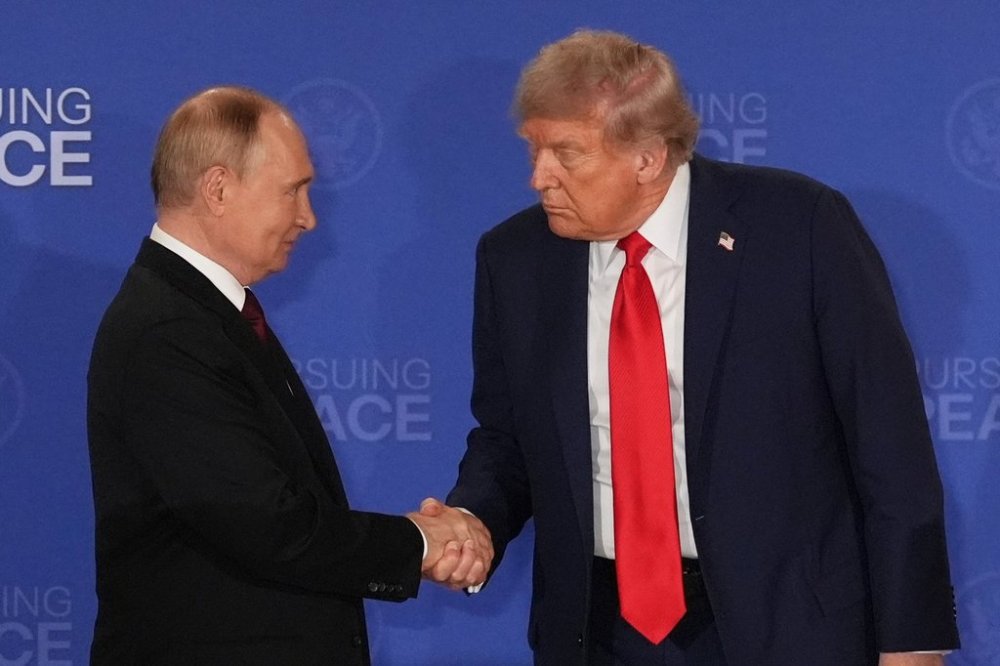
Well, yes, of course. As the Kremlin spokesman said of Trump’s new National Security Strategy, published two weeks ago, “The adjustments that we see correspond in many ways to our vision.” That vision is a deeply traditional version of nationalism which includes the conviction that the great powers have the right to command all the others.
Trump’s new national security doctrine states that the United States aims to “restore American pre-eminence in the Western Hemisphere,” and it has not a word of criticism about Russia’s wars in Europe — from Georgia in 2008, down to the full-scale invasion of Ukraine in 2022.
Perhaps the answer is simply that the two men have identical 19th-century views about how the world should work, at a time when almost everybody else sees it differently.
In this vision, the world is to be divided up between the spheres of influence of the great powers: Russia, America and China, maybe with a share for India too if it can get rich enough fast enough. It’s as arbitrary and non-negotiable as the partition of Africa between the European great powers in the 1880s, only this time on a global scale.
Maybe all of this time we have been looking in the wrong place for an answer to the question: why does Donald Trump always yield to Vladimir Putin? Maybe Putin has no incriminating information about Trump’s sexual or financial peccadillos, no kompromat of any sort.
Perhaps the answer is that the two men have identical 19th-century views about how the world should work, at a time when almost everybody else sees it differently.
The belief that all the states that belong to the United Nations are sovereign and inviolable has reigned (with only minor interruptions) since 1945. It has led to a stabilization of borders and an absence of global wars for a full eight decades. But it has always required the great powers to refrain from using all their power, lest the world wars return.
Neither Putin nor Trump accept that rule. Putin has already violated it by invading countries around its borders that used to be part of the Russian empire, and regularly threatens nuclear war even in the service of quite petty objectives. Trump is newer to this game, but has already attacked Middle Eastern targets and may be working up to a full-scale attack on Venezuela.
Most countries still cling to the old rules (also known as “the international rule of law”) because that is their main protection against violation by one or more of the great powers. And crucially, the two other major concentrations of wealth and military power in the world, the European Union and China, still support the law — at least in principle.
The fate of the Long Peace will be decided by the choices of these two centres. Europe knows that it should defend international law, but it is as divided internally as the Holy Roman Empire (27 sovereign states). China has mostly observed the rules in the past, but now has an alliance with Russia and a president-for-life whose choices are imponderable.
We are where we are, and it’s not a good place to be. However, the numbers are definitely on the side of those who do not want to return to the lawless past, and both Trump and Putin are mortal men. It will take several years yet to learn the outcome.
» Gwynne Dyer’s new book is “Intervention Earth: Life-Saving Ideas from the World’s Climate Engineers.” This column previously appeared in the Winnipeg Free Press.